The story in 5 beats
- Candles in Worf's quarters
Worf misses his shift. Riker finds him in a trance among candles and incense, trying to summon a vision of Kahless.
- Boreth
Picard grants him leave to visit the monastery on Boreth. Ten days pass with nothing. Then Kahless walks in, solid and alive.
- Gowron's test
Gowron calls him a fraud. A DNA test against an ancient blood-stained dagger comes back a perfect match.
The duelSpoiler · tap to reveal
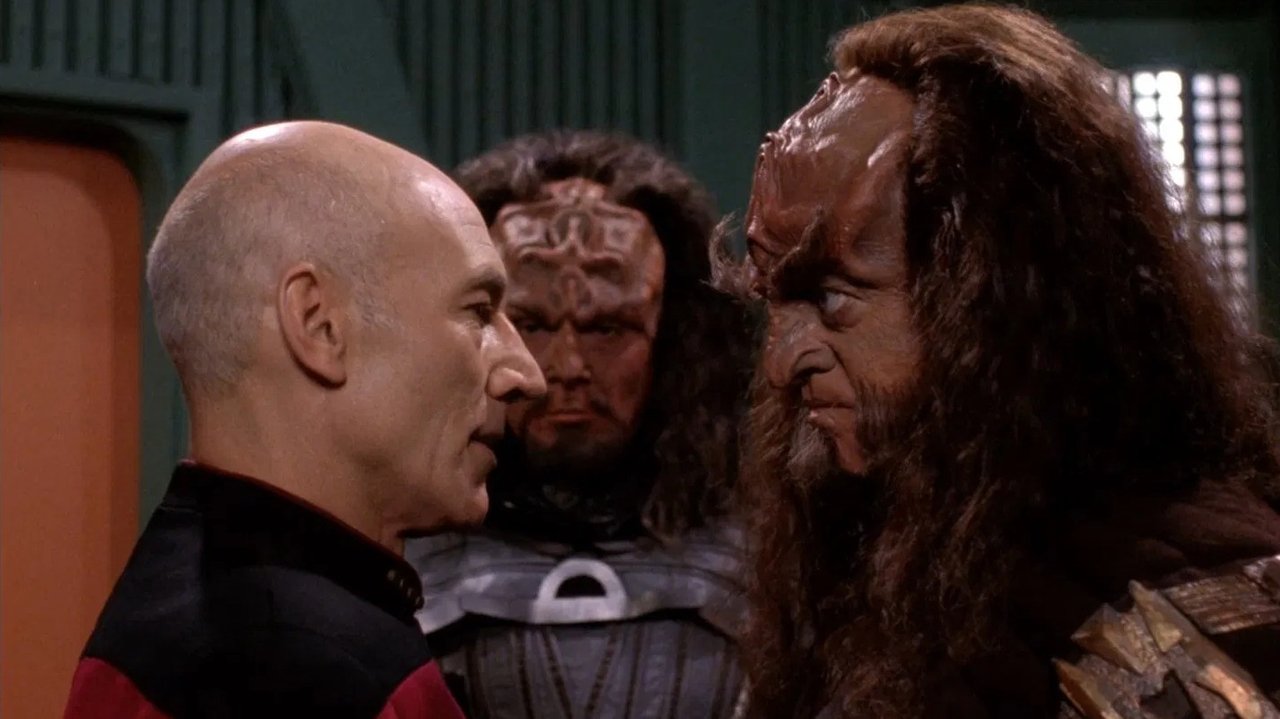
Gowron beats Kahless in a fight, and the high cleric Koroth admits what the returned emperor really is.
An emperorSpoiler · tap to reveal
Worf proposes a way to keep the Empire from splitting, with Kahless on a throne and the High Council in charge.
Why it still matters
Under Gene Roddenberry, Star Trek steered clear of religion, especially for its regulars. StarTrek.com's retrospective argues that once he was gone, the Klingons were the natural way in, and this is the episode that took it. It takes Worf's faith seriously and asks what a believer does when the thing he prayed for actually shows up.
Kevin Conway plays Kahless as a man who fills a room: the founder of the Klingon Empire, returned as promised, laughing in the middle of a fight and rallying the monks with a speech. Keith R.A. DeCandido's Reactor rewatch called him "convincingly messianic," and gave the episode a perfect 10. Michael Dorn is just as good as a man who badly wants to believe and can't stop checking.
It also ties off the Klingon political story that ran through TNG from "Sins of the Father", with Robert O'Reilly's Gowron sneering at the whole business from the start.
A clone with a script
Kahless is a clone, grown by the clerics of Boreth from the blood on the dagger, with memories imprinted from the sacred texts. That's why the DNA matched, and why he doesn't remember the taste of warnog or what the afterlife of Sto-Vo-Kor is like. When Gowron quizzes him on the story of the man from Quin'lat, he can't answer; Gowron beats him in a fight, and Koroth confesses.
Worf is furious at the deception. Then Data, of all people, talks to him about his own leap of faith: believing he could become more than a machine. Worf's answer is a compromise. The clone becomes emperor, a moral and ceremonial figurehead, while the High Council keeps real power, and Gowron and Koroth agree and kneel. Before Kahless leaves for the homeworld, he tells Worf that what matters is that Klingons keep following his teachings, whoever is speaking them.
Behind the scenes
- Ronald D. Moore wrote the teleplay from a story by James E. Brooks. Winrich Kolbe directed, and later directed the series finale, "All Good Things...".
- Kahless had been seen once before, in the original series' "The Savage Curtain", played by Robert Herron.
- It was Robert O'Reilly's last TNG appearance as Gowron. He and the character moved to Deep Space Nine, starting with "The House of Quark" in 1994.
- Alan Oppenheimer, who plays Koroth, is a third cousin of J. Robert Oppenheimer.
- LeVar Burton and Marina Sirtis don't appear, though StarTrek.com notes that production call sheets show Sirtis shot a scene.
- Its first airing drew a 10.6 rating, third in its timeslot.
The thread
A founder returns, and the faithful have to decide whether that's good news.
Came before
Shares DNA with
Left its mark on
DNA strand
Is Any of This Real?
Every test the crew runs says Kahless is who he claims to be, and Worf still can't settle the matter. The episode moves from "is he real?" to "does it matter?", and lets a believer, a politician and an android each answer it differently.
Every great sci-fi story is built from a handful of strands like this one. Each strand page explains how it works and traces it across shows, books and films.
If this one stayed with you
Where to go next, and why.
Read · Novel
The Brothers Karamazov by Fyodor Dostoevsky
Go straight to the Grand Inquisitor chapter. If Koroth and Gowron arguing over what to do with a returned founder was your favorite part, this is the heavyweight version of that argument.
Read · Short story
The Man Who Would Be King by Rudyard Kipling
Two adventurers find a people ready to believe in a god-king. It makes a good companion to Worf's question of what a legend is worth once you know how it's made.
Watch · Star Trek S3
"The Savage Curtain" (1969)
Kahless's first outing, from the original series. Fun to see how differently the legend looked before TNG built a religion around him.
Watch · Deep Space Nine
"The Way of the Warrior" (1995)
If you want more of Gowron and Worf after this, the Klingon story carries on here, on a different show.