The story in 5 beats
- A distress call
The Enterprise traces a signal to the Jenolen, a transport missing for 75 years, crashed on the outer shell of a Dyson sphere.
- Held in the buffer
Geordi finds the transporter rigged to hold two patterns in its buffer. One is lost. The other is Captain Montgomery Scott, retired, who did the rigging himself.
- Out of date
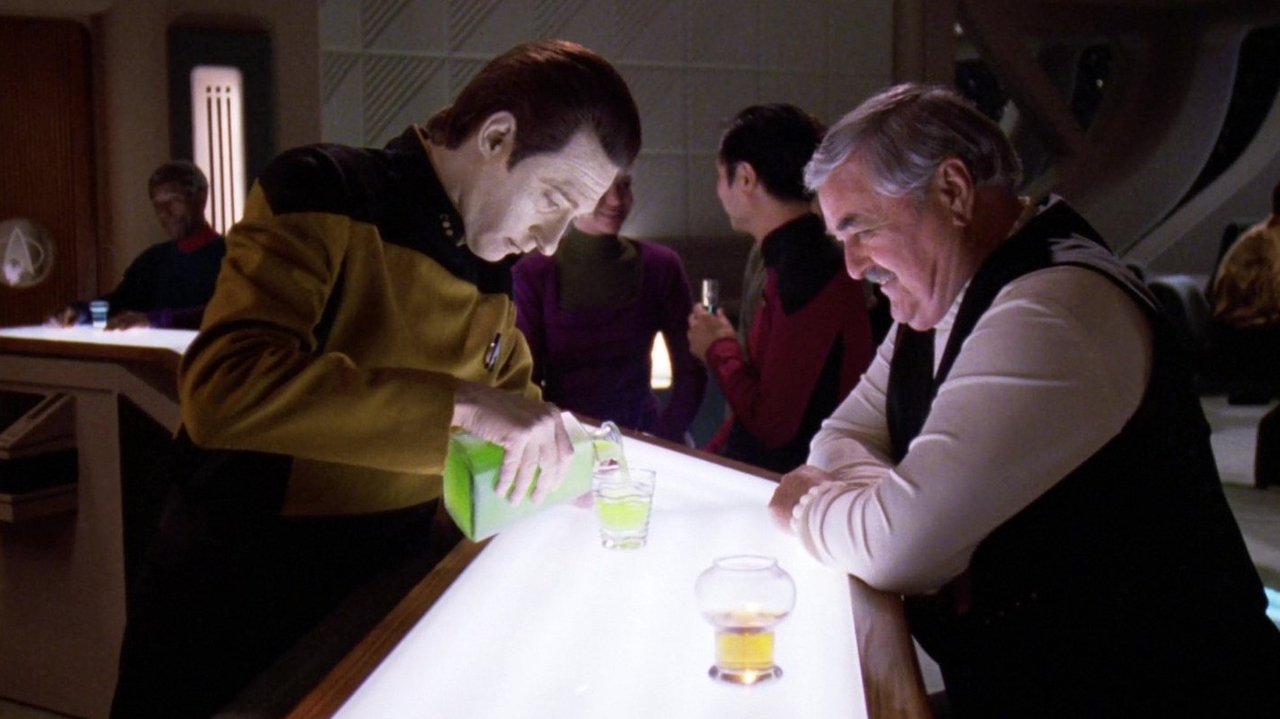
Scotty gets in the way in Engineering and Geordi throws him out. In Ten Forward there's only synthehol, until Data finds him something green.
- The old bridge
On the holodeck, Scotty recreates his Enterprise's bridge. Picard joins him, and the two old captains trade stories over Aldebaran whisky.
Two engineersSpoiler · tap to reveal
With the Enterprise trapped inside the sphere, Scotty and Geordi get the Jenolen flying and wedge it in the sphere's door.
Why it still matters
James Doohan's Scotty steps out of a transporter buffer into the 24th century and finds everything he knew out of date. It could have been a nostalgia parade. Ronald D. Moore, an avowed original-series fan, wrote something gentler and sadder: an old engineer who isn't sure he's still useful, and a young one who doesn't have time for him.
The best scene is on the holodeck, where Scotty calls up the bridge of his old Enterprise and Picard joins him for a drink. Radio Times ranked it the 18th greatest scene in Star Trek. Scotty and Geordi start off badly and end up crawling around a dead ship together, which gives LeVar Burton some of his best material too.
There's also a Dyson sphere, the giant shell around a star that the physicist Freeman Dyson proposed in 1959. The A.V. Club noted that we never learn who built it or why, though for most viewers the hour belongs to Scotty anyway.
Still useful
Picard sends Scotty and Geordi to the Jenolen to recover its logs, mostly to give Scotty something to do. While they're away, the Enterprise hails the sphere and gets pulled through a hatch into the interior, where the star is unstable and the radiation lethal. Its systems fail, and it can't open the hatch from inside.
Scotty and Geordi bring the old transport back to life, open the hatch from outside and jam the Jenolen into it, its shields holding the doors apart. The Enterprise flies out, beams the two engineers aboard and destroys the Jenolen behind it. Picard gives Scotty a shuttlecraft "on extended loan" to explore or retire as he likes, and before he goes Scotty tells Geordi to make the most of being chief engineer while he can.
Behind the scenes
- The script originally had a holographic original bridge crew, young again, but that was cut as too expensive to film.
- The holodeck bridge was put together with bluescreen and a shot from "This Side of Paradise." The captain's chair and helm console were rented from fan builder Steve Horch, and the part of the bridge where Scotty and Picard talk was built new.
- The Jenolen is a modified model of the shuttle Industrial Light & Magic built for Star Trek VI: The Undiscovered Country, which also became the basis for the Runabout on Deep Space Nine.
- The green Aldebaran whisky was Hi-C Ecto Cooler, a drink made to promote The Real Ghostbusters. Whoopi Goldberg was supposed to play the "It's green" scene as Guinan, but her schedule didn't allow it, so the lines went to Brent Spiner's Data.
- The original series' producer Robert Justman visited the set during filming.
- In a 2003 interview, Freeman Dyson called the episode's science "nonsense," though he enjoyed it as a viewer.
- Scotty's line about Kirk himself coming to rescue him doesn't fit Star Trek Generations, made two years later. Moore, who wrote both, has said they could hardly leave Scotty out of the film.
The thread
The novel that gave Dyson his sphere, the original-series memories Scotty brings with him, and the film he walked into next.
Came before
Shares DNA with
Picked up later
DNA strand
Time Loops & Timelines
Scotty doesn't travel in time so much as get left behind by it. Seventy-five years in a transporter buffer make him a man from the past stuck in the present, and the episode's feeling comes from how kindly, and how bluntly, the future treats him.
Every great sci-fi story is built from a handful of strands like this one. Each strand page explains how it works and traces it across shows, books and films.
If this one stayed with you
Where to go next, and why.
Watch · Star Trek
"The Naked Time" (1966)
Scotty brings it up in Engineering, and it's a good look at the younger engineer he used to be.
Read · Novel
Ringworld by Larry Niven
If the Dyson sphere left you wanting a proper look around, Niven's ring around a star is the full expedition.
Watch · Film
Star Trek VI: The Undiscovered Country (1991)
The original crew's last voyage together, about old soldiers facing a world that's moving on. Scotty's farewell here plays like a postscript to it.
Watch · TNG S1
"Encounter at Farpoint" (1987)
The first time the show let an original-series veteran pass the torch, in a brief scene with an old Dr. McCoy.
Sources
- “Relics (Star Trek: The Next Generation),” Wikipedia
- “Star Trek: The Next Generation season 6,” Wikipedia
- Keith R.A. DeCandido, “Star Trek: The Next Generation Rewatch: "Relics",” Reactor (Tor.com), 2012
- “TNG's "Relics" Debuted 23 Years Ago Today, Laddie,” StarTrek.com, 2015
- Zack Handlen, “Star Trek: The Next Generation: "Man Of The People"/"Relics",” The A.V. Club, 2011