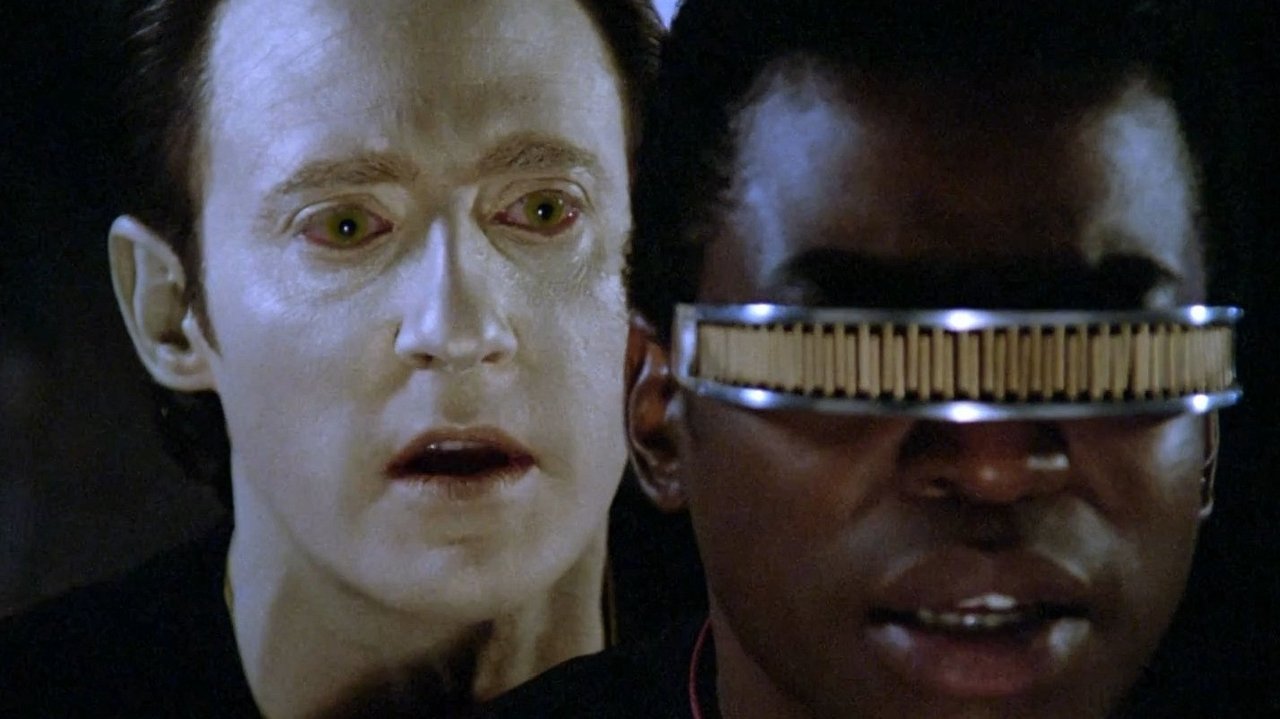
The story in 5 beats
- Behind schedule
The Enterprise is diverted to Velara III. Mandl says the terraforming is on time. Troi senses otherwise.
- The drill
An engineer is killed by a laser drill. When Data inspects it, it fires at him too.
- The crystal
Near the drill site they find a crystal giving off pulses of light. Crusher and Data begin to think it's alive.
Ugly bagsSpoiler · tap to reveal
On the ship, the crystal grows, taps the translator and tells the crew what it thinks of them.
Lights outSpoiler · tap to reveal
It starts taking over the computers. Data and La Forge think of something very simple to try.
Why it still matters
The Enterprise is sent to check on a terraforming project that's behind schedule. Its director, Kurt Mandl, insists everything is fine, and Troi can tell he's hiding something. Before long an engineer is dead, killed by a laser drill that someone reprogrammed to fire on people. The murder mystery turns into a first-contact story, and the suspect turns out to be the planet's only native life.
It's one of the early episodes where TNG reaches for harder science fiction, and it gave fans a line they still quote. The life form's opinion of humanity, "ugly bags of mostly water," is pretty much the definition of seeing yourself through alien eyes.
Why it attacked
Mandl's team had met the crystals before and suspected they were alive, but kept terraforming anyway. Their drilling was draining a layer of salt water just under the surface, and that water was what connected the separate crystals into one mind. When the drilling began, the crystals fought back by reprogramming the drill. One crystal alone isn't intelligent, Data explains; linked together, they're formidable.
On the Enterprise, the crystal blocks every attempt to beam it away. Data and La Forge find cadmium in it and guess that it runs on light. They switch off the lab lights, and it immediately begs for its life. Picard negotiates, the crystal goes home, and Starfleet puts Velara III under quarantine so it can be left in peace. The humans were the invaders all along.
The Question Underneath
How do you know when to stop a project you believe in?
The terraformers don't fail to notice the crystals. They notice and keep going, because the project matters more to them. The episode's sharpest idea is that the alien's insult, calling humans ugly bags of mostly water, is fair. It sees us as we see it: as something in the way. Life here doesn't look like life, which is exactly why it's easy to ignore.
Challenge the DNA
Were the terraformers villains or just people who didn't want to know?
Or skip ahead to our reading
Somewhere in between, which is the point. Suspecting and carrying on anyway is how a lot of real damage gets done.
Behind the scenes
- The script was still being rewritten during shooting. Director Corey Allen got pages the day before filming and called it a struggle.
- Writer-producer Maurice Hurley's verdict: "An interesting idea, but the execution fell apart."
- The terraforming director is Walter Gotell, best known as General Gogol in the James Bond films.
- Andrew Probert painted a matte of the terraforming station's exterior, but it never made it into the episode.
- About 9 million people watched, the second-lowest audience of the first season.
- Reviewers noticed the crew acting as if silicon life were new. Keith R.A. DeCandido at Tor.com said the episode had "amnesia regarding the Horta."
- The story resembles the Space: 1999 episode "All That Glisters," which also has intelligent rocks that drink water.
The thread
Life that doesn't look like life, and the people who almost miss it.
Came before
Shares DNA with
Left its mark on
DNA strand
First Contact & Invaders
Plenty of first-contact stories end with us meeting them. This one ends with us realising we're the ones who barged in. The terraformers aren't villains; they just didn't want to know what they were standing on.
Every great sci-fi story is built from a handful of strands like this one. Each strand page explains how it works and traces it across shows, books and films.
If this one stayed with you
Where to go next, and why.
Watch · Star Trek
"The Devil in the Dark"
The episode this one forgets: miners, a monster, and the moment Spock understands what it's protecting.
Watch · Twilight Zone
"The Invaders"
A first-contact story told almost without words, by one great actress.
Read · Novel
Solaris — Stanisław Lem
A whole planet that might be one mind, and scientists who can't make sense of it.
Your next episode
Three directions to go from here, all on Sci-Fi DNA.
More of this feeling
The Devil in the Dark
Star Trek
The original Trek monster-that-isn't, and still the best.
Same question, different answer
The Invaders
The Twilight Zone
First contact from the ground up, told almost without a word.
Something completely different
The Big Goodbye
Star Trek: The Next Generation
From hard sci-fi to fedoras: Picard plays detective.