The story in 5 beats
- The missing ship
The Enterprise goes looking for the medical ship Fleming in the Hekaras Corridor. Data, meanwhile, is losing a battle of wills with Spot.
- A Ferengi complaint
A crippled Ferengi ship blames a Federation weapon for its damage. Then the Enterprise is knocked dead in space by a pulse from what looks like a navigation buoy.
- The scientists
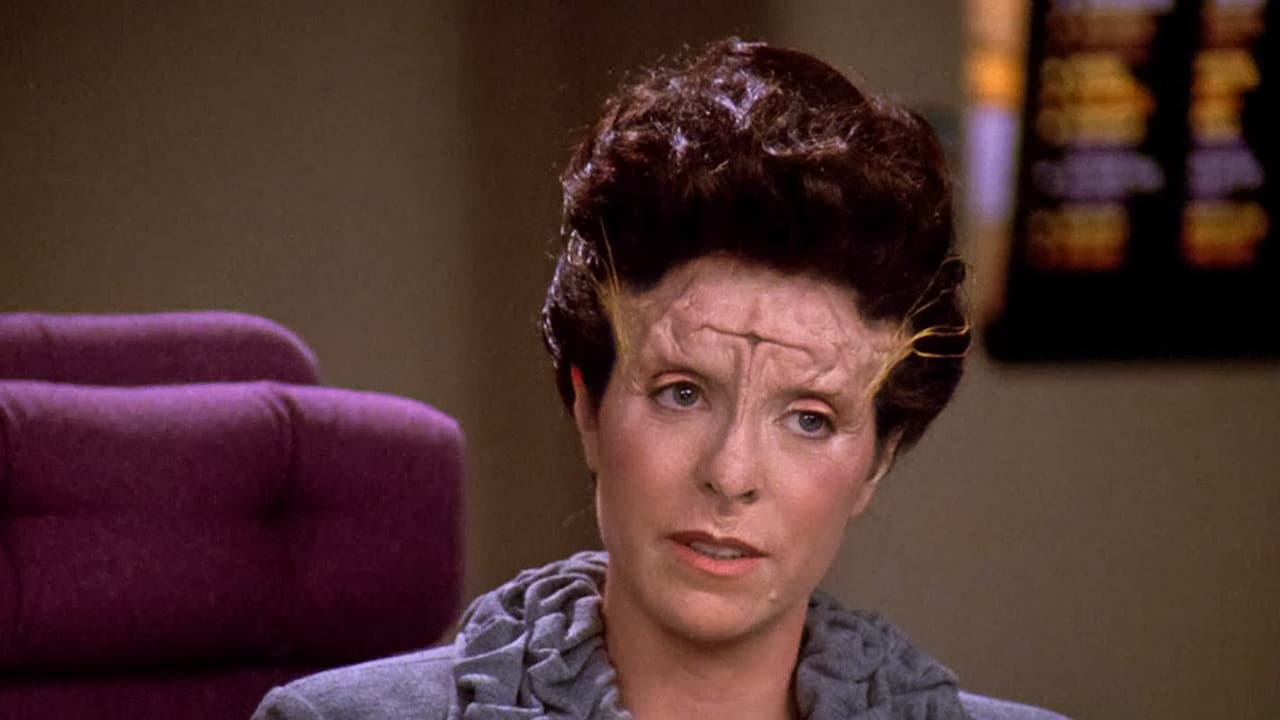
Hekaran siblings Rabal and Serova admit they planted the buoys. Their research says warp travel is damaging space near their homeworld.
Proof the hard waySpoiler · tap to reveal
Serova won't wait for a study. She breaches her own warp core, dies, and opens a rift that traps the Fleming.
Warp fiveSpoiler · tap to reveal
The Enterprise coasts in without warp to rescue the Fleming, then the Federation sets a speed limit of warp five except in emergencies.
Why it still matters
This is the episode where Star Trek asked whether the thing that makes Star Trek possible might be bad for the galaxy. The Enterprise is looking for a missing medical ship in the Hekaras Corridor, the only safe route through a stretch of hostile space, and runs into a pair of local scientists who have evidence that warp drive is slowly tearing the fabric of space near their home.
The idea grew out of early-1990s worries such as the thinning ozone layer, and the result is a parable about exhaust fumes with starships in it. It's an odd fit for a show about the joys of exploring, and that tension is the most interesting thing about it.
For lighter relief there's Data trying, and failing, to train his cat Spot, and Geordi in a running competition with an engineer on another ship over whose engines are more efficient.
The galaxy gets a speed limit
Data reviews the Hekarans' research and finds it has merit but needs more work, so Picard asks the Federation Science Council for a proper study. Serova decides a study will take too long. She breaches her ship's warp core, killing herself, and the explosion tears open the rift she had predicted. The Fleming is caught inside. The Enterprise makes a short burst at maximum speed so it can coast through the rift without using warp drive in it, beams up the Fleming's crew and rides the rift's disruption waves out.
The Federation Council then limits its ships to warp five except in extreme emergencies and warns every warp-capable species. Worf says the Klingons will go along; nobody knows whether the Romulans, Ferengi or Cardassians will. The limit is mentioned again in "The Pegasus" and then dropped, which Keith R.A. DeCandido pointed to as one of the episode's problems.
Behind the scenes
- The core idea came from former staff writer Joe Menosky. Co-executive producer Jeri Taylor sent Naren Shankar and Brannon Braga to meet an environmental watchdog group, and Shankar developed the pitch from there.
- Earlier drafts gave Geordi's sister a part. All that survived is a reference to her cat-training methods.
- Spot is called female here for the first time, with no explanation, and it sticks.
- Science advisor André Bormanis coined "bio-mimetic gel" for this episode. It turns up again in Deep Space Nine's "In the Pale Moonlight" and in Voyager.
- Lee Arenberg, who plays the Ferengi DaiMon Prak, played several more Ferengi across the franchise, including DaiMon Bok in "Bloodlines."
- Reviews split. The A.V. Club gave it a B; Tor.com's rewatch gave it 2 out of 10 and called it "a mess with no emotional core."
The thread
Real-world environmental worry, given a warp core.
Came before
Shares DNA with
Left its mark on
DNA strand
Technology Outpaces Ethics
Usually on Star Trek the dangerous technology belongs to somebody else. Here it's the warp drive itself, the engine of every adventure, and the question is whether the Federation will slow down once it knows the cost.
Every great sci-fi story is built from a handful of strands like this one. Each strand page explains how it works and traces it across shows, books and films.
If this one stayed with you
Where to go next, and why.
Read · Novel
The Ministry for the Future by Kim Stanley Robinson
If you wanted the episode to spend more time on how anyone actually gets a civilisation to change its habits, Robinson spends a whole novel on exactly that.
Watch · TNG S4
"Data's Day" (1991)
More Data at home with Spot, and the best look at how he spends his time off duty.
Watch · TNG S7
"The Pegasus" (1994)
A few weeks later Riker's past catches up with him, and the speed limit gets a nod. Go in knowing as little as you can.
Sources
- “Force of Nature (Star Trek: The Next Generation),” Wikipedia
- “Star Trek: The Next Generation season 7,” Wikipedia
- Keith R.A. DeCandido, “Star Trek: The Next Generation Rewatch: "Force of Nature",” Reactor (Tor.com), 2013
- Zack Handlen, “Star Trek: The Next Generation: "Force Of Nature"/"Inheritance",” The A.V. Club, 2011
- “Montreal Protocol,” Wikipedia
- “The Ministry for the Future,” Wikipedia