The story in 5 beats
- The standoff
Residents hold hostages in the processing center. Sisko works to keep everyone alive as demands go to the governor: airtime, the districts closed, real work for the people inside.
- Dax goes in
Dax watches the news from Brynner's office, then slips into the district through a sewer line to find Sisko and Bashir. They tell her they can't leave yet.
- Searching the centuries
Kira and O'Brien beam to one period after another looking for their crewmates, and at last reach the right year and contact Dax.
The Guard goes inSpoiler · tap to reveal
The governor sends the National Guard. Many rioters are killed, and Sisko is shot shielding a hostage. Bashir finds the wound isn't fatal.
A different photographSpoiler · tap to reveal
Back on the Defiant the timeline is restored, except that the history files' picture of Gabriel Bell is now Sisko's face.
Why it still matters
Part One built the sanctuary district. Part Two locks the door and makes you sit through the standoff. Sisko spends the hour pushing for airtime and for the residents' right to say what was done to them, while knowing roughly how the week ends. It plays as a hostage drama with a time-travel catch: Sisko can't simply do whatever seems best for the people in the room.
This is the half where the episode states its argument. The Atlantic, revisiting it in 2017, called "Past Tense" the most political episode in Star Trek and read it as a story about America's racism, violence and "apathy toward human suffering." Ars Technica held it up in 2016 as an example of DS9's "dogged Utopianism," praising how its characters try to help the poor.
In 2021 Robert Hewitt Wolfe told Vox that they had never been trying to be predictive; they were writing about what they saw in the 1990s. In January 2024 the BBC ran a piece on the episode's resemblance to the real thing, in which Stephen Pimpare said it shows people preferring to "hide the problem, rather than addressing its causes."
History gets its hero
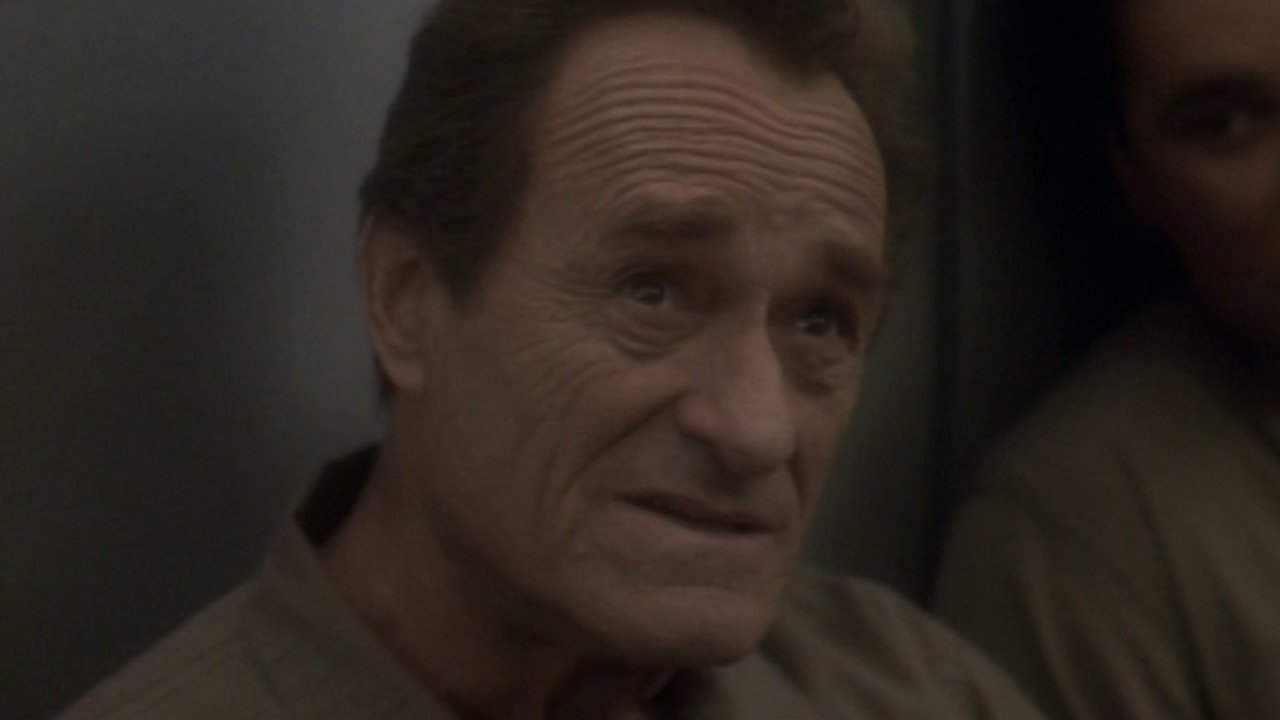
Sisko has been Gabriel Bell since the hostages were taken, and he plays the part to the end. The governor refuses the demands and sends in the National Guard. The first unit storms the processing center and kills many of the residents, and Sisko takes a bullet protecting a hostage. Meanwhile Dax slips back out to get Brynner to have a terminal switched on at the center, so the residents' stories go out to the world. In Sisko's history books, that broadcast is what turned the public against the sanctuary districts and led to their end.
Bashir finds the wound survivable, and the two walk out past bodies in the streets. The police officers who first sent them into the district agree to plant their identity cards on two of the dead and to tell the truth about what happened. Back in the 24th century, everything is where it should be. The only change is in the records: the hero of the Bell Riots now has Benjamin Sisko's face.
Challenge the DNA
Was Sisko right to become Gabriel Bell?
Or skip ahead to our reading
He had no choice, and he plays the part to the end. The episode makes the riots matter. Bell's story becomes his.
Behind the scenes
- Ira Steven Behr and René Echevarria wrote Part Two's teleplay from the story Behr developed with Robert Hewitt Wolfe. Wolfe had written Part One's teleplay on his own.
- Jonathan Frakes, TNG's Commander Riker, directed Part Two. Reza Badiyi had directed Part One.
- Talking to Vox in 2021, Wolfe said the one 2020s prediction they felt they got wrong was the computer technology, and that they hadn't set out to predict anything.
- Part Two drew a Nielsen rating of 8.0 in its first run, up from Part One's 7.4.
The thread
The first half, the Star Trek history stories it echoes, and other tales of a city that hides its poor.
Came before
Shares DNA with
DNA strand
The State Knows Best
The sanctuary districts exist because it is easier to wall a problem off than to fix it, and Part Two follows the people inside as they insist on being seen. The episode's answer to that kind of power is a camera and an open channel.
Every great sci-fi story is built from a handful of strands like this one. Each strand page explains how it works and traces it across shows, books and films.
If this one stayed with you
Where to go next, and why.
Watch · Film
Dog Day Afternoon (1975)
A hostage siege where the crowd outside and the TV cameras matter as much as the guns, and the people holding the hostages stay human throughout.
Watch · Star Trek S1
"The City on the Edge of Forever" (1967)
The best-known Star Trek trip to America's past, and the closest in spirit to this one: officers who have to let history run its course.
Read · Novel
Parable of the Sower by Octavia E. Butler
Published two years before this aired and set in a 2024 California just as divided. Read it for life in a walled neighborhood with the poverty pressing in from outside.
Your next episode
Three directions to go from here, all on Sci-Fi DNA.
More of this feeling
Past Tense: Part One
Star Trek: Deep Space Nine
The first half of the story.
Same question, different answer
The Cloud Minders
Star Trek
Who gets to live above, and who below?
Something completely different
Heart of Stone
Star Trek: Deep Space Nine
Odo and Kira trapped on a moon, and Nog's big request.
Sources
- “Past Tense (Star Trek: Deep Space Nine),” Wikipedia
- “List of Star Trek: Deep Space Nine episodes,” Wikipedia
- “Revisiting the Most Political 'Star Trek' Episode (Robert Greene, 2017),” The Atlantic
- “What Deep Space Nine does that no other Star Trek series can (Annalee Newitz, 2016),” Ars Technica
- “Star Trek: Deep Space Nine accidentally predicted the 2020s by writing about the 1990s (Emily VanDerWerff, 2021),” Vox
- “Star Trek: The Deep Space Nine episode that predicted a US crisis (Christian Kriticos, 2024),” BBC
- “Star Trek: Deep Space Nine: "Past Tense, Part I"/"Past Tense, Part II" (Zack Handlen, 2012),” The A.V. Club