The story in 5 beats
- An accident in transit
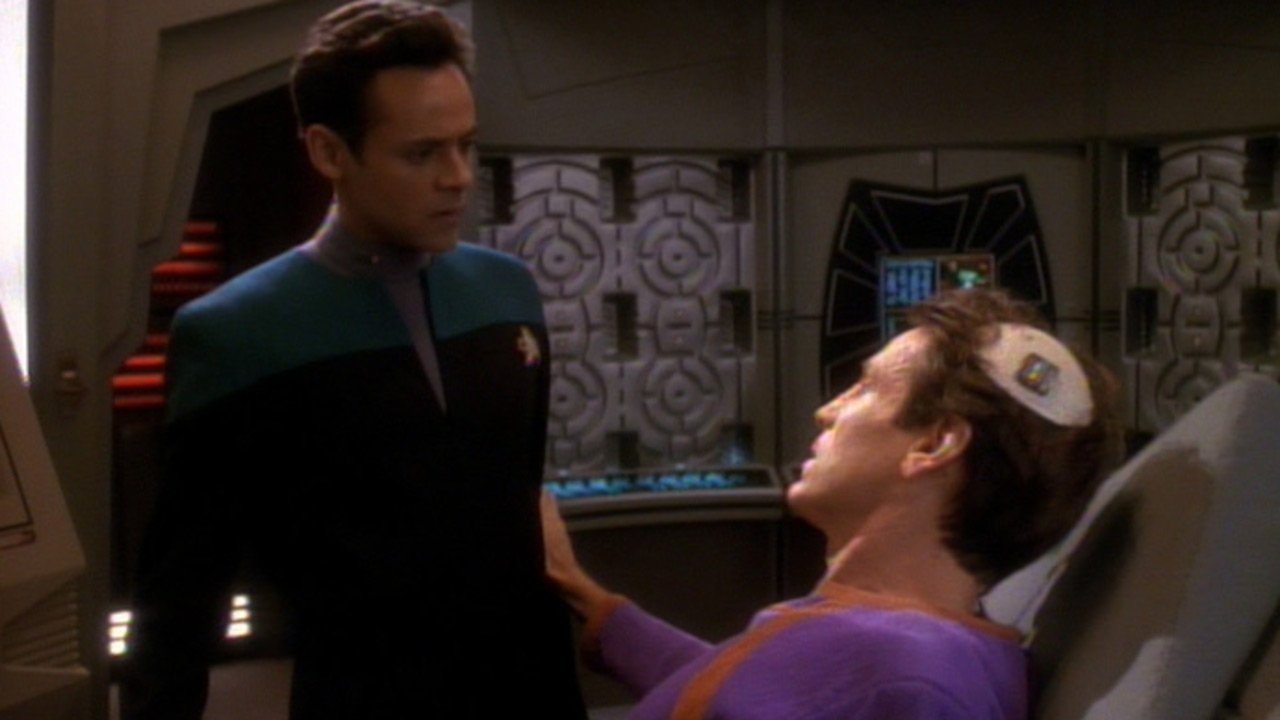
A ship carrying Kai Winn and Vedek Bareil to the station for talks with the Cardassians has a mishap. Bareil arrives gravely hurt, and Bashir finds him brain-dead.
- Signs of life
During the autopsy, Bashir notices Bareil's nervous system is still active, and revives him. Winn wants him back at the negotiating table.
- Vasokin
Bareil refuses stasis. To keep him working, Bashir weighs Vasokin, an experimental drug that boosts blood flow but will damage his organs further.
A positronic patchSpoiler · tap to reveal
The drug starts to damage Bareil's brain. Bashir replaces the damaged part with a positronic matrix, and Bareil barely recognizes Kira.
The treatySpoiler · tap to reveal
The treaty is signed. Bashir refuses to replace the rest of Bareil's brain, Winn agrees it's time to let him go, and Kira sits with him at the end.
Why it still matters
Ronald D. Moore's teleplay starts with a medical miracle and spends the rest of the hour asking what it costs. Bajor and Cardassia are close to a treaty, Kai Winn is leaning on Bareil's experience to get it, and an accident on the way to the station leaves him brain-dead. Bashir finds enough activity in his nervous system to bring him back. After that, Bashir's patient won't rest until the talks are done, the Kai needs him at the table, and each treatment that keeps him there does more harm.
Zack Handlen at The A.V. Club (2012) praised what it does for Winn and for Bashir, and Keith R.A. DeCandido at Tor.com (2013) singled out Alexander Siddig, Louise Fletcher and Nana Visitor, though he found Philip Anglim's Bareil "wooden" and scored it 5 out of 10. Both disliked the B-story, in which Jake has to face Nog's attitudes toward women and dating: DeCandido called it "out of place," and Handlen called the contrast "grating" and objected that the episode nudges Jake to go along with Nog's misogyny. It still made io9's 2020 list of DS9's must-watch episodes and SyFy Wire's 2018 guide to Kira.
Where Bashir stops
The Vasokin keeps Bareil at the table until it starts damaging his brain, and he slips back into unconsciousness. Winn insists he be kept alive at any cost, and Bashir accuses her of wanting him around only as a scapegoat if the talks fail. Bashir replaces the damaged part of his brain with a positronic matrix. It works, after a fashion: Bareil has a few months, enough to see the negotiations through, but he hardly knows Kira and isn't the man she fell in love with.
The treaty between Bajor and Cardassia is signed. When Bareil worsens, Kira asks Bashir to replace the rest of his brain too, and Bashir says no: it would take away whatever spark of life he has left. Winn agrees it's time to let him die, and the episode ends with Kira at his bedside, telling him how she first fell in love with him. Handlen credits the episode for taking Bareil's death seriously.
Challenge the DNA
Should Bashir have kept Bareil alive?
Or skip ahead to our reading
It's the hardest question in the episode. Bareil wanted to finish the talks. The cost is what's left of him.
Behind the scenes
- Ronald D. Moore wrote the teleplay from a story by Christian Ford and Roger Soffer. Reza Badiyi directed, with Jonathan West as director of photography.
- Bareil first appeared in season one's "In the Hands of the Prophets." Philip Anglim, who plays him, made his name on stage as John Merrick in The Elephant Man, winning an Obie Award when it opened off-Broadway in 1979.
- Louise Fletcher, who plays Kai Winn, is best known as Nurse Ratched in One Flew Over the Cuckoo's Nest (1975). She played Winn from 1993 to 1999.
- Lark Voorhies, who plays Leanne, was Lisa Turtle on Saved by the Bell. Aron Eisenberg plays Nog.
- It aired two weeks after Star Trek: Voyager's premiere, "Caretaker," which launched UPN on January 16, 1995.
- It was released on VHS and, on October 26, 1999, on US LaserDisc, both times paired with "Heart of Stone."
The thread
*Star Trek* had already asked how far a doctor should go for a patient who has his own ideas, and what a positronic brain makes of a person.
Came before
Shares DNA with
DNA strand
Technology Outpaces Ethics
Bashir can do things no doctor before him could, and the episode keeps asking whether he should. Each step is small and reasonable on its own: wake him up, give him something to keep going, patch what's failing. The question is who gets to say stop, when the patient, his Kai and the woman who loves him all want different things.
Every great sci-fi story is built from a handful of strands like this one. Each strand page explains how it works and traces it across shows, books and films.
If this one stayed with you
Where to go next, and why.
Watch · Star Trek: TNG S5
"Ethics" (1992)
The same argument from the other side of the sickbay. Here the patient wants to stop, and Dr. Crusher has to decide what an experimental treatment is worth.
Watch · Star Trek: DS9 S2
"The Collaborator" (1994)
Where the rivalry between Winn and Bareil comes to a head, with Kira caught between them. It makes their scenes here much richer.
Watch · Star Trek: TNG S2
"The Measure of a Man" (1989)
Bashir's fix is a positronic matrix, and Data's brain is positronic too. This is the episode where Starfleet argues over whether that makes Data a person or property.
Read · Novel
Frankenstein — Mary Shelley
The classic story of a scientist who can revive the dead and has to live with the result. Bashir faces a smaller, harder version: how far to go.
Your next episode
Three directions to go from here, all on Sci-Fi DNA.
More of this feeling
The Collaborator
Star Trek: Deep Space Nine
Bareil, Kai Winn and the price of leading Bajor.

Same question, different answer
The Measure of a Man
Star Trek: The Next Generation
How much of a person can be replaced before they're someone else?
Something completely different
Destiny
Star Trek: Deep Space Nine
A prophecy, a comet and a Cardassian science team.
Sources
- “Life Support (Star Trek: Deep Space Nine),” Wikipedia
- “List of Star Trek: Deep Space Nine episodes,” Wikipedia
- Zack Handlen, “Star Trek: Deep Space Nine: "Life Support"/"Heart Of Stone",” The A.V. Club, 2012
- Keith R.A. DeCandido, “Star Trek: Deep Space Nine Rewatch: "Life Support",” Tor.com, 2013
- “Caretaker (Star Trek: Voyager),” Wikipedia
- “List of Star Trek: Deep Space Nine characters,” Wikipedia
- “Philip Anglim,” Wikipedia
- “Louise Fletcher,” Wikipedia