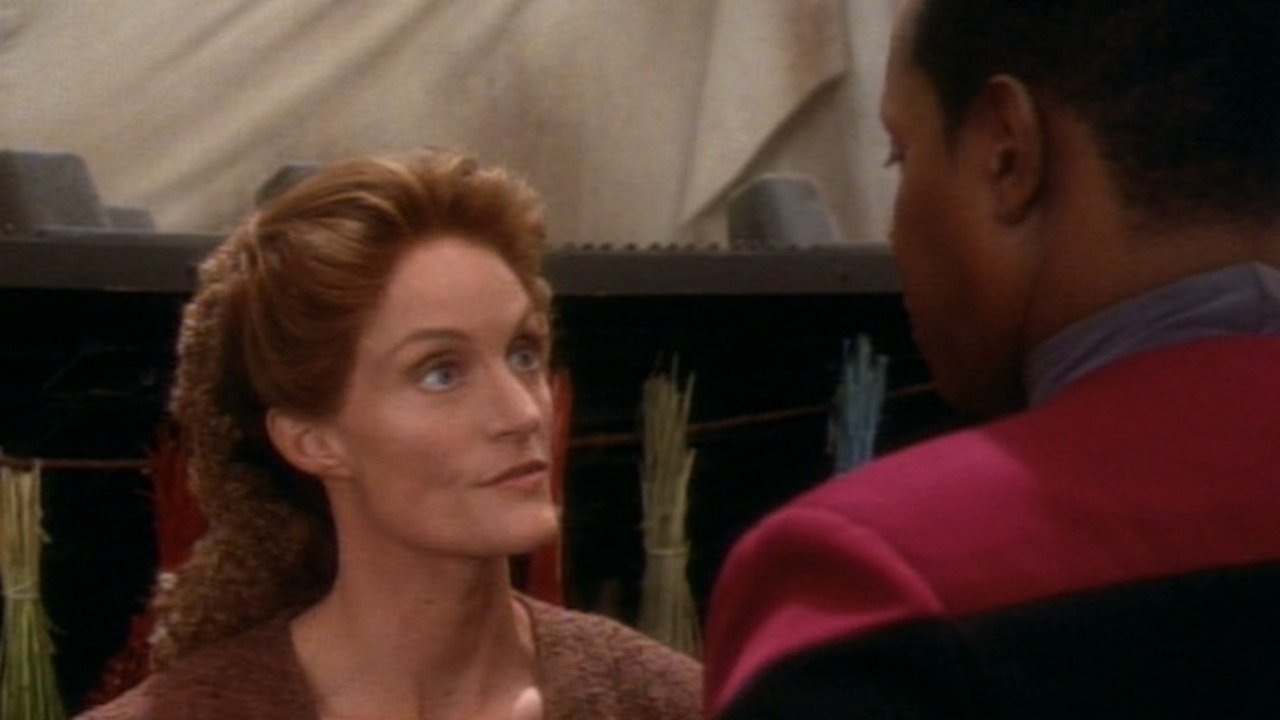
The story in 5 beats
- Life signs
On a survey run, Sisko and O'Brien find humans on an uncharted planet. They beam down, and an energy field kills every device they carry. There's no way back up.
- Alixus
The colonists have been stranded for ten years. Their leader is Alixus, a philosopher who used to warn that people depend too much on technology.
- The box
A young man is let out of a metal box, his punishment for stealing a candle. That night Alixus sends a colonist, Cassandra, to seduce Sisko.
- Back in the box
A sick colonist dies. O'Brien keeps trying his gadgets, so Sisko is boxed. Offered water to give up his uniform, he climbs back in.
BuriedSpoiler · tap to reveal
O'Brien tracks the field to a generator buried in the sand. Alixus built it. When rescue comes, the colonists are told they're staying.
Why it still matters
Star Trek has always been on the side of the machines. The replicator, the transporter and the computer that answers when you speak are the reason nobody in the Federation goes hungry. "Paradise" hands the microphone to someone who thinks all that has made people soft. Alixus, played by Gail Strickland, was a philosopher who wrote against humanity's dependence on technology before her ship was stranded on a planet where none of it works. Ten years on, she runs the colony, and she has an answer for everything, including the colonist who dies for want of the medicine sitting in Sisko's runabout.
The episode's best idea is that Sisko never argues with her on her terms. He just refuses. When Alixus offers him water after a stretch in the colony's metal punishment box, on the condition that he take off his Starfleet uniform, he says nothing and climbs back in. Avery Brooks plays the moment without a word. Io9 put the episode at 98 on its 2014 list of the 100 best Star Trek episodes, out of more than 700.
Who switched off the world
O'Brien rigs a compass, follows it to the source of the field and digs up a generator. Alixus's son Vinod tries to stop him with a bow and fails. With his phaser working again, O'Brien cuts Sisko out of the box and shows the colony that the field is artificial. Alixus admits she created it, and she defends it: cut off from their machines, she says, the survivors found out what they were capable of.
Kira and Dax arrive, and Sisko and O'Brien assume the colonists will want to leave. Instead Joseph announces that they've chosen to stay, though nobody has actually asked them. Alixus and Vinod go with Sisko. The last shot is two children staring at the spot where the four of them vanished, which leaves the question the episode never quite answers: was anyone on that planet free to choose?
Challenge the DNA
Did Alixus do any good for her colony?
Or skip ahead to our reading
She's half right, which is what makes her dangerous. The colonists did learn they could cope. That doesn't excuse taking away their choice.
Behind the scenes
- Five writers share the credit: a story by Jim Trombetta and James Crocker, a teleplay by Jeff King, Richard Manning and Hans Beimler. Beimler and Manning wrote together often on The Next Generation between 1988 and 1990.
- Director Corey Allen started as an actor. He played Buzz Gunderson, the gang leader who races James Dean's character toward a cliff in Rebel Without a Cause (1955), and won an Emmy in 1984 for directing an episode of Hill Street Blues.
- Cassandra is played by Julia Nickson, the female lead in Rambo: First Blood Part II (1985).
- Geek.com named it essential watching in its 2015 condensed guide to Deep Space Nine.
- It drew a Nielsen rating of 8.2.
The thread
Colonies cut off from the modern world, the leaders who make a virtue of it, and the punishment box.
Came before
Shares DNA with
DNA strand
The State Knows Best
Alixus is a one-woman state, and like most rulers in these stories she is sure she's doing it for everyone's good. What makes her worth watching is that her philosophy isn't stupid. The episode lets her make her case, then shows the dead woman, the box and the generator, and asks whether a good idea imposed by deception is still a good idea.
Every great sci-fi story is built from a handful of strands like this one. Each strand page explains how it works and traces it across shows, books and films.
If this one stayed with you
Where to go next, and why.
Watch · Star Trek: TNG S5
"The Masterpiece Society" (1992)
A colony sealed off by its founders' design, and a Starfleet crew whose arrival may wreck it. The same argument about isolation, with the sympathies flipped.
Watch · Film
The Bridge on the River Kwai (1957)
Alec Guinness's colonel is shut in a punishment box and won't bend on a point of principle. Sisko climbing back in is very much in his tradition.
Watch · Star Trek S1
"This Side of Paradise" (1967)
Another colony where people have stopped wanting anything more, and another officer the place almost keeps.
Read · Book
Walden — Henry David Thoreau (1854)
The gentle original of Alixus's argument: a man goes to the woods to live simply and see what he's made of. Nobody makes him stay.
Your next episode
Three directions to go from here, all on Sci-Fi DNA.
More of this feeling
The Apple
Star Trek
A paradise run on rules that someone else set.
Same question, different answer
The Return of the Archons
Star Trek
How much freedom would you trade for a quiet life?
Something completely different
Shadowplay
Star Trek: Deep Space Nine
A village where people keep disappearing, and Odo makes a friend.