The story in 5 beats
- The accident
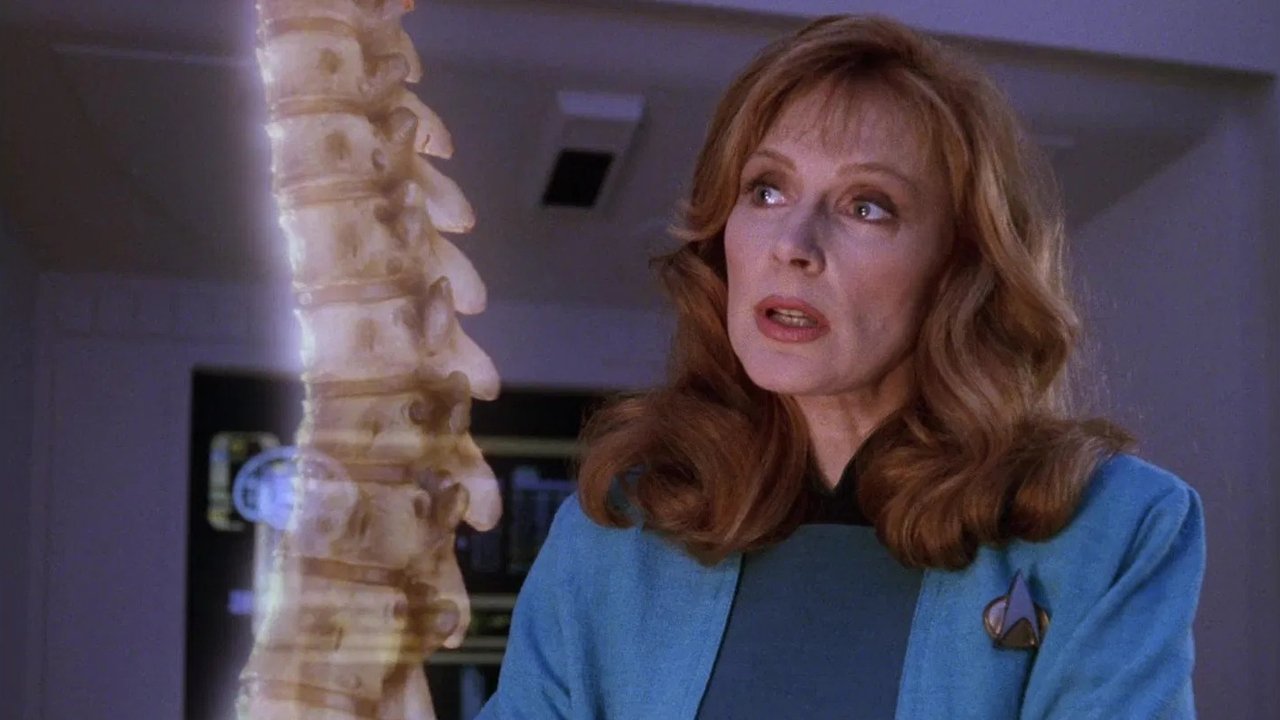
A barrel falls on Worf in a cargo bay and leaves him paralyzed, so Crusher calls in a neurologist, Dr. Toby Russell.
- Two treatments
Crusher offers implants that might give back about 60% of his movement. Russell proposes replicating a whole new spinal cord, an untested procedure.
- Worf's request
Worf asks Riker to help him die by Klingon ritual. Riker refuses, then points out that the ritual calls for Worf's son, Alexander.
Russell's gambleSpoiler · tap to reveal
Worf won't ask Alexander. He chooses Russell's surgery. It works, until his heart stops and Crusher pronounces him dead.
Backup systemsSpoiler · tap to reveal
Worf starts breathing again. Klingons have a backup for almost everything.
Why it still matters
Worf is hit by a falling barrel in a cargo bay and left paralyzed. Dr. Crusher can offer implants that might restore some of his movement. To a Klingon that isn't enough, and Worf asks Riker to help him end his life by Klingon ritual. StarTrek.com later called it one of the series' more controversial episodes.
There are two arguments running at once. One is Worf's right to choose death, which Riker refuses to help with and Picard asks him to weigh as Klingon custom. The other is about medicine: Dr. Toby Russell, a visiting neurologist, has an experimental procedure that could give Worf his whole spine back, and Crusher thinks it's far too risky to try on a patient. Screen Rant called it "a two-pronged social message."
Critics were mixed. Keith R.A. DeCandido at Tor.com thought the pieces didn't fit together, and that Russell is written too plainly as the villain, but he singled out Gates McFadden and called Riker's refusal maybe the best Riker scene in the show. The A.V. Club gave it a B-, saying "At least it had ambitions."
Built with spares
Worf can't bring himself to ask Alexander to help him die, so he takes the gamble instead and agrees to Russell's surgery against Crusher's advice. The new spine works. Then, as life support is withdrawn, his heart stops and his higher brain function goes. Crusher tries everything, and after five attempts with a corticostimulator she pronounces him dead.
While Alexander mourns, Worf starts breathing again. Klingon anatomy is full of redundancies, the brak'lul, and a backup part of his brain restarts his body. Crusher then turns on Russell, who also used an untested drug on a patient who died, and who put her research ahead of the people on the table. Russell leaves without a word. The episode ends with Worf in physical therapy, Alexander helping him walk.
Behind the scenes
- Ronald D. Moore, who wrote the teleplay, said in Star Trek: The Next Generation 365 that he hated working on it.
- StarTrek.com notes that it was the last episode shot in 1991.
- Al Foster, Michael Dorn's photo double, plays Worf for most of the surgery.
- Caroline Kava, who plays Dr. Russell, had played Thelma Beckett on Quantum Leap.
- This was director Chip Chalmers's fourth and final TNG episode. He had worked his way up from assistant director.
- The episode gave fans a list of Klingon anatomy: a backup synaptic system, two livers, 23 ribs, a double-lined neural pia mater and an eight-chambered heart.
The thread
A patient who wants to die, a doctor who wants a breakthrough, and the people stuck in between.
Came before
Shares DNA with
Where it led
DNA strand
Technology Outpaces Ethics
Russell's procedure might work, and that's the problem: she wants to find out on a patient. The episode sets that beside Worf's right to choose, and lets Crusher argue against both.
Every great sci-fi story is built from a handful of strands like this one. Each strand page explains how it works and traces it across shows, books and films.
If this one stayed with you
Where to go next, and why.
Watch · Film
Whose Life Is It Anyway? (1981)
If Worf's fight to choose for himself was the heart of it, this film puts the same fight in a hospital bed.
Read · Book
The Immortal Life of Henrietta Lacks by Rebecca Skloot
For the real-world version of Crusher's argument with Russell: who medical research is for, and who pays for it.
Watch · Star Trek: Voyager S5
"Nothing Human" (1998)
Another Trek doctor faces a cure with an ugly past and has to decide whether to use it.