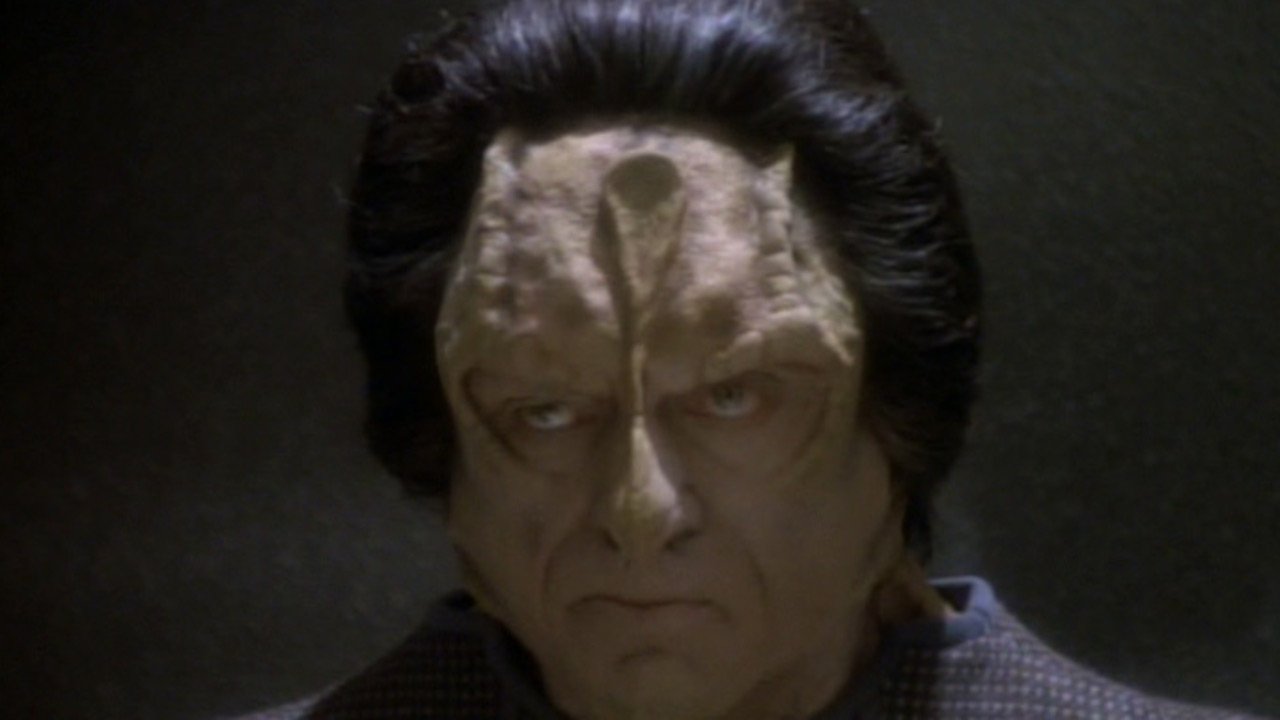
The story in 5 beats
- Kalla-Nohra
A freighter passenger needs treatment for Kalla-Nohra, a condition caused by a mining accident at Gallitep. The patient is Cardassian, and Kira has him arrested.
- No record
His name, Aamin Marritza, isn't on any list of war criminals. Sisko holds him anyway while they look further, and lets Kira stay on the case after she pleads.
- The file clerk
In the holding cell, Marritza insists he was only a clerk at Gallitep. Kira keeps coming back, and he starts asking her questions too.
The photographSpoiler · tap to reveal
An old picture from Gallitep says the prisoner is Gul Darhe'el, the camp commander, and he proudly agrees. Then the pieces stop fitting.
Reason enoughSpoiler · tap to reveal
Kira learns who he really is and lets him go. On the Promenade a Bajoran stabs him to death, saying that being Cardassian is reason enough.
Why it still matters
For a lot of viewers, this is where Deep Space Nine showed what it could be. Sandy Stone, an editor at StarTrek.com, called it the moment she "knew DS9 really had something going on." It was part of the Museum of Television and Radio's 1994 "Tribute to Excellence," and it keeps turning up on best-of lists: seventh among Deep Space Nine episodes for The Hollywood Reporter in 2016, 33rd of all Star Trek episodes for Empire the same year, and essential viewing in Wired's 2015 binge guide.
Most of it is two people in a room. Kira Nerys, who fought the Cardassian occupation of her planet, faces a Cardassian named Aamin Marritza, who was at Gallitep, a labor camp where Bajorans were worked and killed. He says he only kept the files. She thinks being there at all is enough. Nana Visitor and Harris Yulin play it as a long argument about guilt, and SyFy Wire later put it in its short watch guide for Kira, saying "the story sounds simple; the performance is anything but."
The story is credited to Lisa Rich and Jeanne Carrigan-Fauci, and it was originally called "The Higher Law." Peter Allan Fields wrote the teleplay, and he and Ira Steven Behr reshaped it with Robert Shaw's The Man in the Glass Booth, about a Jewish man accused of being a Nazi war criminal, in mind. Armin Shimerman later put its success down to "the writing and the directing and the acting all coalescing perfectly."
The clerk who wanted to be the butcher
The photograph seems to settle it: the man in the cell is Gul Darhe'el, the "Butcher of Gallitep," and he boasts about it. But Gul Dukat says Darhe'el is dead, with a well-attended funeral and a death certificate to prove it, and Darhe'el wasn't on Bajor when the Kalla-Nohra accident happened, so he couldn't have the disease. Bashir finds signs of cosmetic surgery. The prisoner really is Marritza, the file clerk, and he has made himself look like his old commander on purpose.
Kira confronts him, and Marritza breaks down. He calls himself a coward for doing nothing while the camp's atrocities went on, and begs her to try him as Darhe'el anyway, so that Cardassia has to admit what it did and Bajor gets its trial. Kira lets him go instead. As she walks him to his ship, a Bajoran stabs him, and when she asks why, he repeats what Kira said at the start: he's Cardassian, that's reason enough. Kira tells him it isn't. In 2016 Radio Times ranked Marritza's death the 26th greatest moment in all of Star Trek.
Challenge the DNA
Was Marritza right to pose as Darhe'el?
Or skip ahead to our reading
His plan was desperate, and it changes Kira. She lets go the man she wanted to see punished. Then the ending turns her own first words back on her.
Behind the scenes
- The working title was "The Higher Law," according to The Star Trek: Deep Space Nine Companion.
- Peter Allan Fields wrote the teleplay from a story by Lisa Rich and Jeanne Carrigan-Fauci. Fields and Ira Steven Behr reworked it with Robert Shaw's The Man in the Glass Booth as a reference. James L. Conway directed.
- In the Companion, Armin Shimerman said the episode works because of "the writing and the directing and the acting all coalescing perfectly," and Nana Visitor credited it with having "such important things to say."
- Behr listed it among his favorites, as did the Companion's co-author Terry J. Erdmann.
- Harris Yulin, who plays Marritza, played a lot of villains; his 2025 New York Times obituary was headlined "Harris Yulin, Actor Who Perpetually Played the Bad Guy, Dies at 87." The critic Jim Emerson once said Yulin "should be in every movie ever made."
The thread
War-crimes trials, hidden identities, and the question of what an ordinary functionary owes for a system's crimes.
Came before
Shares DNA with
DNA strand
Us vs. Them
Kira starts the episode believing a Cardassian's guilt comes with being Cardassian. The story makes her argue that position all the way through, against a prisoner who gives her every reason to hold on to it. Few us-versus-them stories let the hero's side hold the prejudice.
Every great sci-fi story is built from a handful of strands like this one. Each strand page explains how it works and traces it across shows, books and films.
If this one stayed with you
Where to go next, and why.
Watch · Star Trek: TNG S6
"Chain of Command: Part Two" (1992)
Another long duel in a cell between a Cardassian and a Federation officer, with Picard as the prisoner this time, two weeks before Deep Space Nine began.
Watch · The Twilight Zone S3
"Deaths-Head Revisited" (1961)
Rod Serling wrote it while Adolf Eichmann was on trial in Israel: a former SS captain comes back to Dachau and finds the dead waiting for him.
Watch · Star Trek S1
"The Conscience of the King" (1966)
The original series' version of a crew member who can't let go of a suspicion about a man's past, and what it costs.
Read · Nonfiction
Eichmann in Jerusalem by Hannah Arendt
Arendt's account of the real trial of a Nazi official who presented himself as a bureaucrat. It wrestles with the same question Kira keeps putting to Marritza: what does a man who handled the paperwork owe?
Your next episode
Three directions to go from here, all on Sci-Fi DNA.
More of this feeling
Past Prologue
Star Trek: Deep Space Nine
Kira and the Occupation's long shadow.
Same question, different answer
Deaths-Head Revisited
The Twilight Zone
What do we owe the victims of an atrocity?
Something completely different
The Homecoming
Star Trek: Deep Space Nine
A resistance hero, a labour camp and a rescue.