The story in 5 beats
- Back to the table
Jellico keeps up his hard line with Gul Lemec while the Cardassian fleet gathers near Minos Korva.
- Riker relieved
Riker pushes back once too often, and Jellico relieves him. Data becomes first officer.
Madred's roomSpoiler · tap to reveal
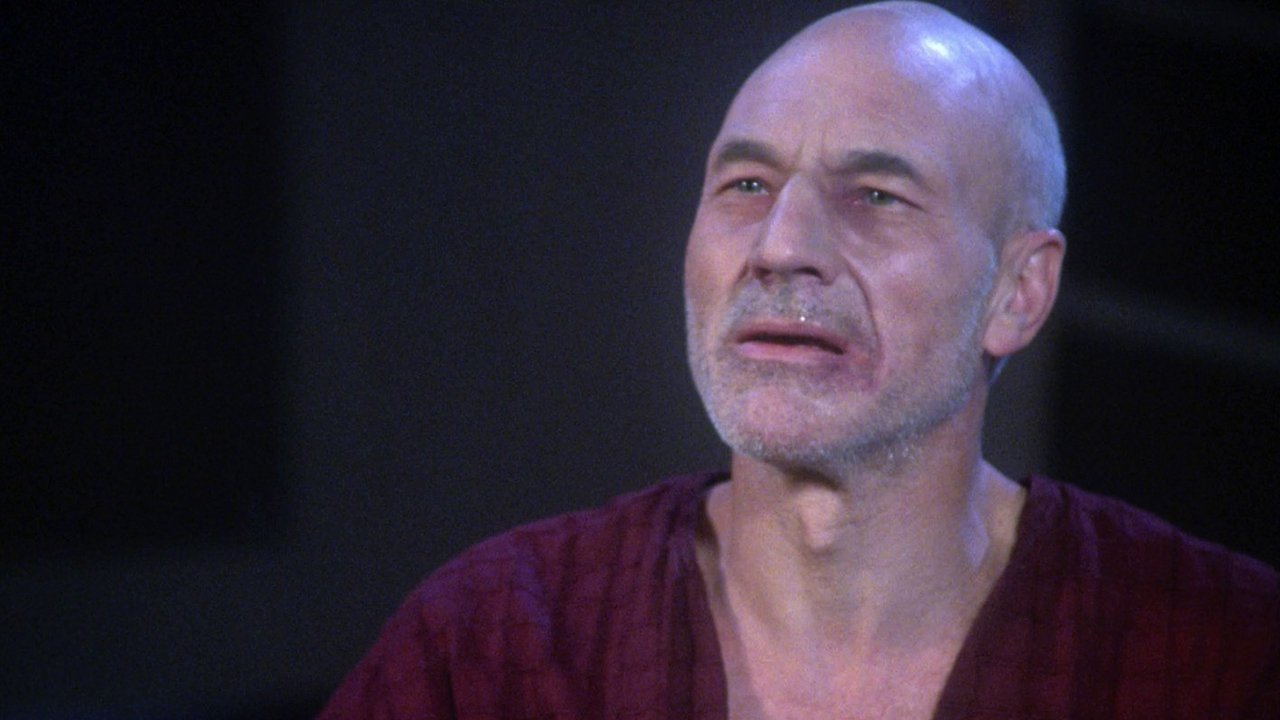
Picard, a prisoner, is stripped, hung up, starved and kept awake. Madred calls him only "human" and asks the same questions again and again.
The minefieldSpoiler · tap to reveal
Jellico asks Riker, rather than orders him, to fly a shuttle and lay mines in a nebula. Riker and Geordi do it, and the Cardassians have to back down.
Four lightsSpoiler · tap to reveal
Madred shows Picard four lights and demands that he say there are five. On the day he is set free, Picard shouts the truth.
Why it still matters
Much of it belongs to two actors: Patrick Stewart, and David Warner as the Cardassian Gul Madred. Michael Piller had pictured it as a two-person play, a chance to put Stewart "alone in a room with one other good actor and really letting him go." Jeri Taylor later called it probably Stewart's finest performance.
Warner took over the part on three days' notice, had no time to learn it, and read many of his lines off cue cards, which you'd never guess. He and Stewart had worked together decades earlier, on a 1965 Hamlet, and they play their scenes like two old colleagues doing something very uncomfortable.
The rest of the episode stays on the Enterprise, where Jellico's standoff with the Cardassians, and with Riker, comes to a head. It's the weaker half, though it moves, and it builds toward one of the most quoted lines in Star Trek, which lands best in context.
There are four lights
Picard spends the episode in Madred's hands. Madred uses a device implanted in his chest, sleep deprivation, hunger and humiliation, wanting information about the defenses at Minos Korva and, more than that, his submission. The test he keeps returning to is a row of four lights. Madred tells Picard there are five, and hurts him each time he says otherwise. At one point Madred's young daughter, Jil Orra, drops by, as if this were an ordinary workday.
Jellico's minefield wins the standoff, and Picard's release is part of the deal. Madred tries one last lie first: the Enterprise is destroyed, Minos Korva has fallen, and Picard can spend the rest of his life comfortably in Cardassian care if he will just say he sees five lights. He is about to answer when the Cardassian delegation arrives to say that a ship is waiting to take him back. As he is led out, Picard turns and shouts, "There are four lights!" Back aboard, he tells Troi what he didn't say to Madred: he would have said anything, and by the end he believed he could see five.
Behind the scenes
- Frank Abatemarco researched torture and its survivors in material compiled by Amnesty International. Patrick Stewart, a supporter of the organization, asked Amnesty for videos to help him understand what torture does to people.
- Stewart insisted that the scene in which Picard is stripped be filmed, and asked for a closed set.
- David Warner read his lines "over Patrick's shoulder" from cue cards. He said he preferred Madred to St. John Talbot and Chancellor Gorkon, his two earlier Star Trek film roles.
- Jeri Taylor did an uncredited rewrite of Abatemarco's script.
- Picard sings the French children's song "Sur le pont d'Avignon" during his ordeal.
- Michael Piller took out a full-page ad in Variety to push for an Emmy nomination for Stewart. He wasn't nominated.
The thread
A war of wills, with the novel and the film behind its best-known scene.
Came before
Shares DNA with
Left its mark on
DNA strand
The State Knows Best
The Cardassians want Starfleet to accept whatever they say is true, and the episode borrows its best-known scene from Orwell to show what that demand looks like up close, in one small room.
Every great sci-fi story is built from a handful of strands like this one. Each strand page explains how it works and traces it across shows, books and films.
If this one stayed with you
Where to go next, and why.
Read · Novel
Nineteen Eighty-Four by George Orwell
The episode's best-known scene is a tribute to a moment in this book, so it's the natural next read.
Watch · TNG S4
"The Drumhead" (1991)
Another TNG hour built on a long, hard conversation in a room, with Picard defending something he believes in against people who are sure they're right.
Read · Novel
Darkness at Noon by Arthur Koestler
Koestler's novel about what the state can make a person say, and why. It's heavier going than an hour of TNG and asks the same question.
Watch · Film
Closet Land (1991)
Tor.com's rewatch names this 1991 film as one of the episode's inspirations. If Stewart and Warner's scenes are what stayed with you, it's worth tracking down.
Sources
- “Chain of Command (Star Trek: The Next Generation),” Wikipedia
- “Star Trek: The Next Generation season 6,” Wikipedia
- Keith R.A. DeCandido, “Star Trek: The Next Generation Rewatch: "Chain of Command, Part II",” Reactor (Tor.com), 2012
- “Chain of Command, Part II: Episode Behind the Scenes,” TrekCore
- StarTrek.com Staff, “"Chain of Command, Part II" -- 24 Years Later,” StarTrek.com, 2016
- Sebastian De Toma, “The Four Lights,” StarTrek.com, 2021