
More from the episode
The story in 5 beats
- Io Polytechnic
Young Arnold Rimmer is the unwitting subject of a conformity test run by his father, a lecturer. When he goes along with the class's wrong answers, his father humiliates him.
- Hogey the Roguey
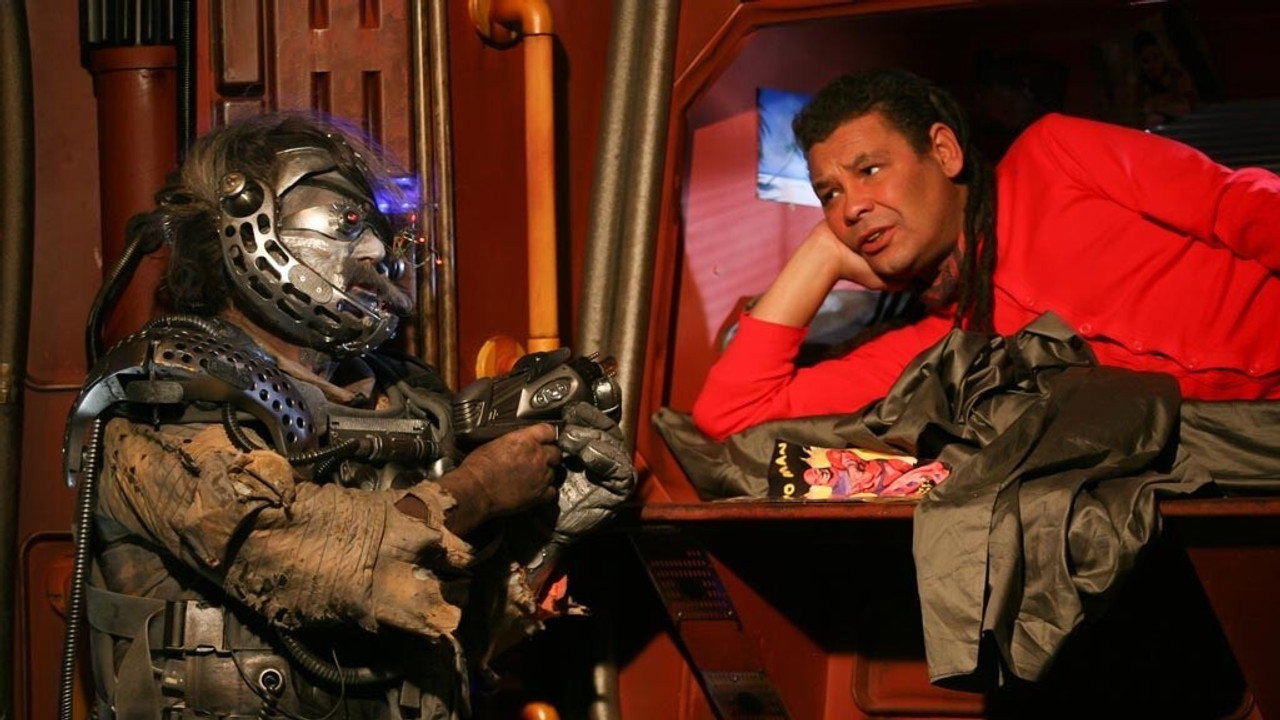
Three million years later, a dim rogue droid visits Red Dwarf to challenge the crew to duels. He has stolen a map from a Simulant Death Ship.
- Hiding in the rocks
The Simulants follow. The crew flee in Blue Midget and hide inside an asteroid, and Lister puts Rimmer in charge of the battle plan.
The messageSpoiler · tap to reveal
Rimmer plays a message from his father. His real father, it says, was the family gardener, Dungo, and Rimmer takes it as a release.
The slime's coming homeSpoiler · tap to reveal
The crew vote his plan down three to one. He holds his ground, and it works: the Simulants' missiles pass straight through Blue Midget.
Why it still matters
The Series X finale is Rimmer's episode. It opens with a flashback to his student days at Io Polytechnic, where his father, a lecturer, makes an example of him in front of the class, and it builds to a fight he has to plan himself. Den of Geek's Pete Dillon-Trenchard called the climax "a really satisfying punch-the-air moment" and the episode "a wholly fitting last hurrah."
It's bigger and more action-led than the rest of the series because much of it was adapted from the unused script for the unmade Red Dwarf film, including Hogey the Roguey, a duel-obsessed droid played by Richard O'Callaghan, who had read for the part years earlier in the film's pre-production.
The title is a deliberate nod to the very first episode, "The End," and so is the last line. The working title was "Death Day." It is dedicated to Peter Wragg, the BBC visual effects designer who built the original ship models, and Den of Geek ranked Bill Pearson's model work on the Simulant Death Ship and the asteroid belt among the show's best effects.
The son of the gardener
Hiding in the asteroid, Rimmer can't concentrate on the plan. The Cat points out that his father is the problem and tells him to stop trying to impress the man. Rimmer plays the message on the holo-lamp his father left him, and learns that his real father was Dungo, the family gardener. Rimmer turns it into confidence: a gardener would be proud of a second technician who is senior officer on a mining ship and "doesn't smell of manure."
The crew call his plan "crap" and vote it down three to one. Remembering his father's lesson about conforming, he refuses to back down. Surrounded by four Simulant ships, he offers to surrender, and when they fire anyway, Lister uses Hogey's Molecular Destabiliser on Blue Midget's bulkheads. The missiles pass through the cockpit and destroy the four ships. Rimmer orders a course home with "The slime's coming home!"
After the credits, Rimmer brags that he saved them before, from the ship-eating microbe at the end of "Only the Good...". Lister starts to explain what really happened and is cut off, so the 1999 cliffhanger stays unexplained.
Behind the scenes
- It was recorded on 27 January 2012 at Shepperton Studios, the last episode of the series in the studio. The working title was "Death Day."
- The planned two-part finale bringing back Kristine Kochanski was dropped because of production problems. This episode was written at short notice in its place, much of it adapted from the unused Red Dwarf film script.
- Simon Treves plays Rimmer's father, taking over from the late John Abineri, who played him in "Better Than Life."
- The opening test follows Solomon Asch's conformity experiments of the 1950s, and the asteroid hideout echoes the Millennium Falcon's escape in The Empire Strikes Back.
- Series X co-producer Richard Naylor appears, uncredited, as two different students in the Io Polytechnic scene, shot from different angles.
- It is dedicated to Peter Wragg, the BBC visual effects designer who created the original ship models and oversaw the effects for the first seven series.
The thread
A finale that reaches back to the show's first episode and Rimmer's family, built on a real psychology experiment and a famous film father.
Came before
DNA strand
Memory & Identity
Rimmer has spent his whole life, and his whole afterlife, defined by one man's disapproval. Learning the man isn't his real father lets him see that history differently, and for once the show lets Rimmer be a little braver than usual.
Every great sci-fi story is built from a handful of strands like this one. Each strand page explains how it works and traces it across shows, books and films.
If this one stayed with you
Where to go next, and why.
Watch · Film
The Empire Strikes Back (1980)
If the asteroid chase felt familiar, this is the film the episode is playing with.
Watch · Red Dwarf IV
"Dimension Jump" (1991)
The other episode about the brave Rimmer he could have been. This one lets him get there by himself.
Watch · Red Dwarf II
"Better Than Life" (1988)
Rimmer's father's first appearance, and a reminder of how long this grudge has been running.
Read · Article
"Opinions and Social Pressure" (1955)
Solomon Asch's own account in Scientific American of the experiments the opening scene is built on, and why so many people went along with the wrong answer.
Sources
- “The Beginning (Red Dwarf),” Wikipedia
- “The Beginning: Complete Guide,” Red Dwarf (official site)
- “Series X: Complete Guide,” Red Dwarf (official site)
- “Red Dwarf X,” Wikipedia
- Pete Dillon-Trenchard, “Red Dwarf X: The Beginning review,” Den of Geek, 2012
- “Red Dwarf X: The Beginning review,” Starburst, 2012
- “Red Dwarf: Series X (2012),” TMDB