
More from the episode

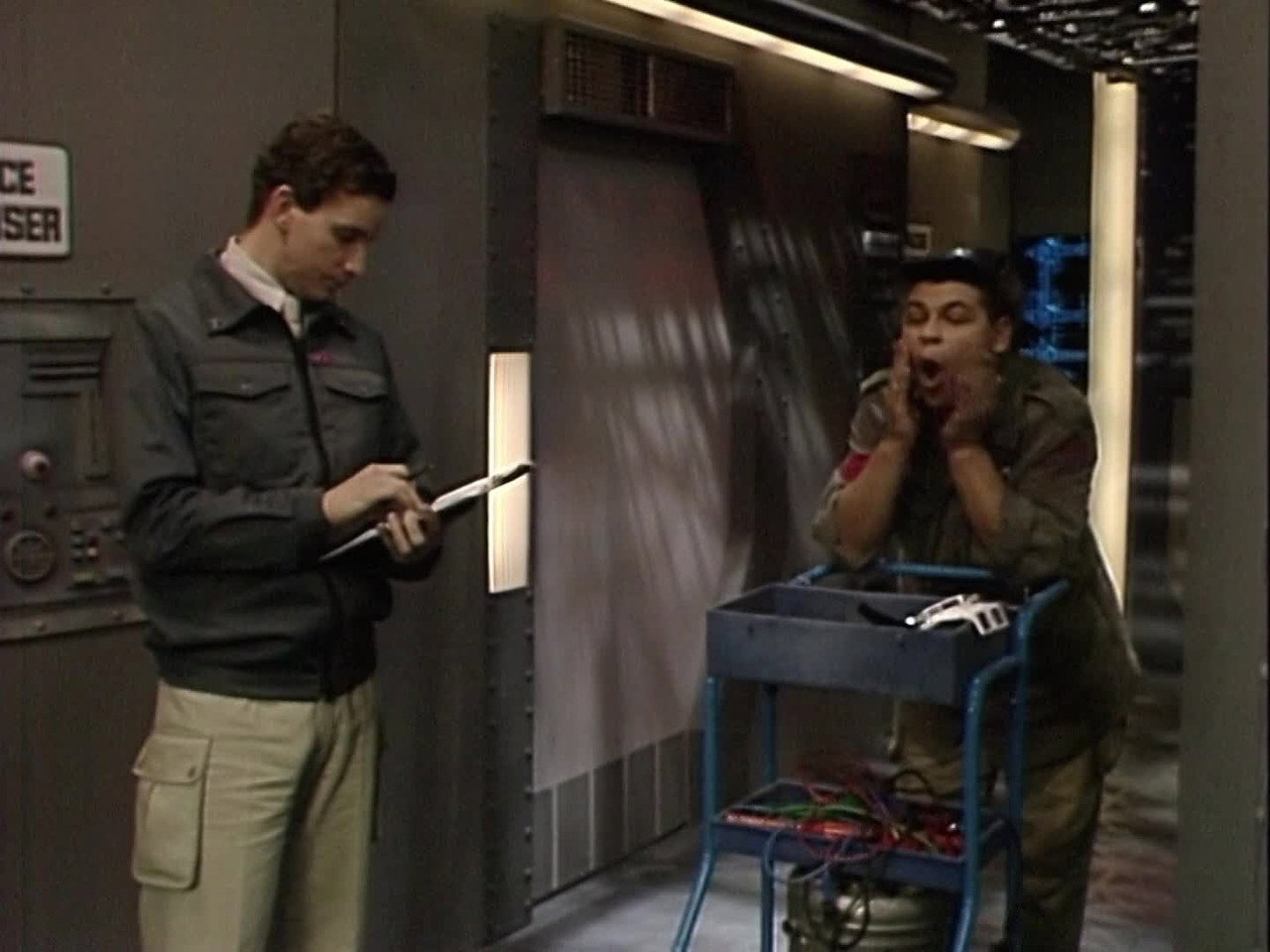

The story in 5 beats
- Bottom of the ladder
Lister lounges about the mining ship Red Dwarf dreaming of a farm on Fiji. Rimmer, his uptight boss, sits an exam and faints.
- The cat in the hold
Captain Hollister finds out Lister has smuggled aboard a pet cat called Frankenstein. Lister won't hand it over, so he goes into stasis.
- Three million years
Holly lets Lister out. He was meant to be in for 18 months. A radiation leak killed the crew, and he had to wait for it to die down.
CompanySpoiler · tap to reveal
Rimmer is back as a hologram who can't touch anything, and something has been living in the hold all this time.
The slime's coming homeSpoiler · tap to reveal
The creature thinks Lister is a god. Lister sets a course for Fiji, three million years away.
Why it still matters
Everything Red Dwarf became starts here. Dave Lister is the lowest-ranking crewman on a vast mining ship, a chicken-soup-machine repairman with a pet cat he isn't supposed to have. His boss is Arnold Rimmer, who takes the maintenance job far more seriously than anyone should. For the first ten minutes it plays like a sitcom set in a grey, grubby office that happens to be in space.
Rob Grant and Doug Naylor wrote the script in 1983, and the BBC turned it down three times before BBC North picked it up. Then an electricians' strike stopped recording in 1987. What finally reached 5.1 million viewers in February 1988 is mostly reshoot footage, made in a spare studio slot after the writers decided parts of the first version weren't working.
Watch it for the setup the show leaned on for decades: the writers' rule of no aliens, a computer with a claimed IQ of 6000 who isn't all there, and two men who would never choose each other's company. Norman Lovett's Holly, a bored head on a screen, is a small miracle of deadpan.
A crew of three and a half
The crew died of a leak of Cadmium II, set off after Rimmer botched a drive plate repair without Lister's help. Holly, the ship's computer, has brought Rimmer back as a hologram, and Rimmer spends the reunion blaming Lister. Then a sleek, preening humanoid strolls in: the descendant of Frankenstein, sealed in the hold with three million years to evolve. Lister names him Cat and feeds him Krispies.
Cat believes Lister is "Cloister the Stupid," the god who will lead his people to the promised land of "Fuchal." As the last human alive, Lister sticks to the plan he always had. He tells Holly to set a course for Fiji, and the slime's coming home. The joke underneath is that nothing about these people has changed except that there is no one left to tell them off.
Behind the scenes
- Grant and Naylor wrote the script in 1983 at a cottage in Wales belonging to Naylor's father. Their agent Paul Jackson championed it, and the BBC rejected it three times before BBC North took it on.
- A BBC electricians' strike halted the first attempt to record the series. The episode was finally recorded on September 27, 1987, at BBC Manchester.
- The writers used a spare seventh recording slot to reshoot scenes they felt didn't work. About two-thirds of the broadcast episode comes from the reshoot, and the original version later appeared as The End: The Original Assembly on the 2007 Bodysnatcher Collection DVD set.
- Norman Lovett auditioned for Rimmer and was offered Holly as a voice-only part. He talked the writers into putting his face on screen, so earlier Holly scenes were re-edited.
- Designer Paul Montague went for a grey submarine look, down to grey bunks and cigarette packets. Clare Grogan is credited as C. P. Grogan because another Equity member had her name.
- Howard Goodall's opening theme parodies 2001: A Space Odyssey, and Jenna Russell sings the end theme. On streaming, "See You Later Alligator" has been swapped for the football chant "Here We Go" because of music clearance.
- Hugh Hebert in The Guardian wasn't won over. He called it "harmless waffle" and thought the studio audience sounded very young.
The thread
A sci-fi parody that grew a heart, and the lonely-survivor stories it sits among.
Came before
Shares DNA with
Revisited
DNA strand
Last Person on Earth
Most last-man stories are about crushing loneliness. Red Dwarf gives the last man a hologram he can't stand, a cat who thinks he's God and a computer going senile, and makes the loneliness the punchline. It still lands, because Lister has lost everyone he knew and the show never quite lets you forget it.
Every great sci-fi story is built from a handful of strands like this one. Each strand page explains how it works and traces it across shows, books and films.
If this one stayed with you
Where to go next, and why.
Watch · Film
Dark Star (1974)
John Carpenter's scruffy crew, bored out of their minds on a long mission. Grant and Naylor drew on it, and you can see where some of the Red Dwarf boredom came from.
Watch · The Twilight Zone
"Time Enough at Last"
Another lowly man who outlives everyone. It plays the same situation with no laugh track at all.
Read · Novel
The Hitchhiker's Guide to the Galaxy — Douglas Adams
An ordinary British bloke who loses his planet and gets dragged round space by people he didn't pick. If you liked Lister, you'll like Arthur Dent.
Sources
- “The End,” Red Dwarf (official site)
- “Red Dwarf Series I,” Red Dwarf (official site)
- “Red Dwarf, Series 1, Episode 1: The End,” British Comedy Guide
- Rhianna Evans, “Red Dwarf Series 1 retrospective,” British Comedy Guide, 2024
- Dan Tessier, “Red Dwarf: Three Million Years On,” Television Heaven
- “The End (Red Dwarf),” Wikipedia