
More from the episode

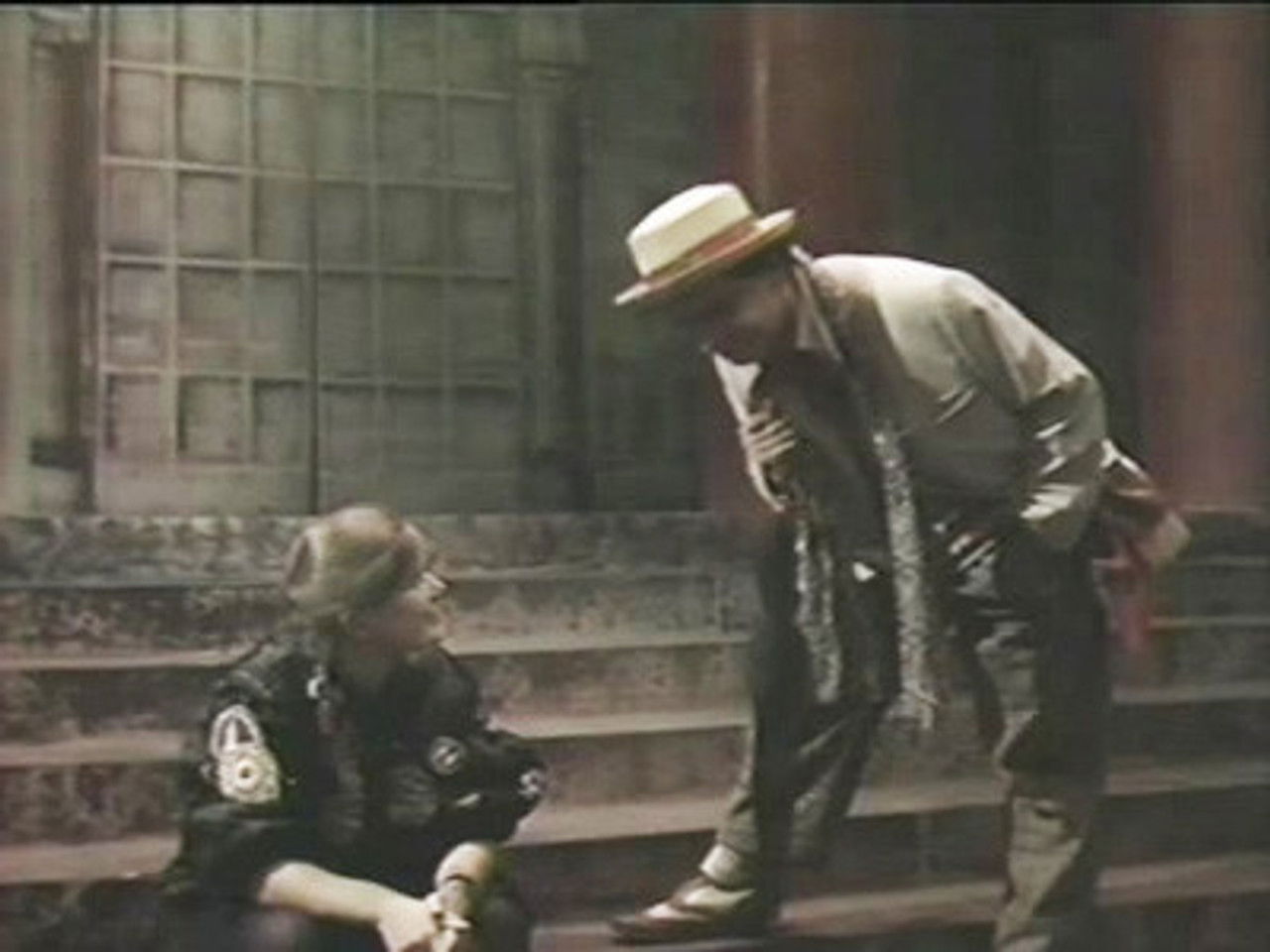
The story in 5 beats
- Smile, or else
The Doctor and Ace arrive on Terra Alpha to find out why it is so relentlessly cheerful, and catch the Happiness Patrol painting the TARDIS pink.
- Helen A
The colony's ruler wants unhappiness wiped out. She has a rat-dog called Fifi and the Kandy Man, a robot of sweets built by her adviser Gilbert M.
- Singing the blues
Out of the Waiting Zone, the Doctor and Ace pick up allies: Susan Q, a patrolwoman who has had enough, the harmonica player Earl Sigma, and the Pipe People below the city.
Down toolsSpoiler · tap to reveal
The Doctor stirs up protest, and the regime starts to fall apart: Fifi is buried by sugar and the Kandy Man is caught in his own fondant surprise.
Tears for FifiSpoiler · tap to reveal
Helen A runs for her rocket and finds that her husband and Gilbert M got there first. The Doctor tells her happiness means nothing without sadness.
Why it still matters
This is the serial in which Doctor Who went after a sitting Prime Minister. Script editor Andrew Cartmel and writer Graeme Curry agreed that it should be an attack on Margaret Thatcher, and Helen A, the ruler who wants every frown on her planet gone, was intended as a caricature of her. Sheila Hancock, who hated Thatcher "with a deep and venomous passion", accepted the part only on condition that she could model her performance on Thatcher as closely as possible. When the Doctor calls on the colony's drones to down tools, it was meant to recall the 1984–85 miners' strike.
It looks unusual, too. The whole thing was made in the studio, and the production team even thought about broadcasting it in black and white to suit the film noir mood, though Sylvester McCoy only heard about that after filming. The executioner is the Kandy Man, a robot made of sweets. The Discontinuity Guide spotted a gay subtext too: "there's entrapment over cottaging, the TARDIS is painted pink, and the victim of the fondant surprise is every inch the proud gay man, wearing, as he does, a pink triangle."
It has gained admirers since. Patrick Mulkern gave it five stars in the Radio Times and called it a "clever and funny satire"; DVD Talk's John Sinnott called it a "minor masterpiece"; Graeme Burk and Robert Smith put it in Who's 50, their 2013 book of stories to watch. Not everyone buys the politics. In Doctor Who: A British Alien? Danny Nicol grants that Hancock reminds you of Thatcher, but argues that Helen A's death squads, executions and state sugar factories "bear no relation to Thatcher's" policies.
Happiness needs sadness
Earl's harmonica brings down an avalanche of crystallised sugar that crushes Fifi in the pipes, and the Kandy Man ends up stuck in a flow of the same fondant surprise he used to kill killjoys. With the revolution beyond her control, Helen A heads for her escape rocket, only to find that Gilbert M and her husband, Joseph C, have already taken it. The Doctor stops her and tries to explain that happiness can't exist without sadness. She sneers that she'll find a place with no tears, then sees Fifi dying on a bench and weeps.
The woman who outlawed sadness ends the story crying over her dog. Helen A's husband leaves with another man, which fits the reading The Discontinuity Guide found throughout. As the Patrol repaints the TARDIS blue, Susan Q and Earl stay behind to sing the blues, and the Doctor tells a worried Ace that "happiness will prevail." In 2011 Rowan Williams, then Archbishop of Canterbury, mentioned the story in his Easter sermon on happiness and joy.
Challenge the DNA
Is The Happiness Patrol too obvious a satire?
Or skip ahead to our reading
It's obvious on purpose, and that's part of the fun. Helen A was meant as a caricature, and the story never hides it. The Doctor's argument with her at the end is what gives it weight.
Behind the scenes
- Cartmel and Curry agreed early on that the serial should attack Thatcher. The subtext was "back-pedalled slightly" at first, then strengthened at Sheila Hancock's urging; she accepted Helen A only if she could model the performance on Thatcher.
- In February 2010 the Sunday Times and the Daily Telegraph both ran stories on the serial's anti-Thatcher agenda. The Telegraph reported that the Doctor urging the drones to down tools was an allusion to the 1984–85 miners' strike and other industrial disputes then in recent memory.
- The entire serial was shot in the studio in July and August 1988.
- McCoy told Doctor Who Magazine in 2010 that the team had considered broadcasting the story in black and white for a film noir atmosphere, and that he only learned of it after filming had finished.
- A fan myth says the third episode was meant to be animated. According to the BBC's episode guide, that was never the case.
- The three parts drew 5.3, 4.6 and 5.3 million viewers.
- It came out on DVD on May 7, 2012, paired with Dragonfire in the "Ace Adventures" box set.
The thread
Enforced cheer, a ruler who outlaws sadness, and a show willing to point at Downing Street.
Came before
Shares DNA with
Left its mark on
DNA strand
The State Knows Best
Terra Alpha's government has decided how its people should feel and enforces it with a patrol and an executioner made of sweets. Curry's joke is that a regime this cheerful is still a police state, and the Doctor answers it with the blues and a strike.
Every great sci-fi story is built from a handful of strands like this one. Each strand page explains how it works and traces it across shows, books and films.
If this one stayed with you
Where to go next, and why.
Watch · Star Trek
"The Return of the Archons"
Another planet where contentment is compulsory, and another visitor who refuses to go along with it.
Watch · Black Mirror S3
"Nosedive"
The forced smile updated for the age of five-star ratings, with a pastel look that would suit Terra Alpha.
Watch · Doctor Who
"The Sun Makers"
Robert Holmes's tax satire from 1977. Watch the two side by side to see how Doctor Who did politics a decade apart.
Read · Novel
Brave New World — Aldous Huxley
The classic novel of a state that keeps its citizens happy by policy, and what it costs them.
Your next episode
Three directions to go from here, all on Sci-Fi DNA.
More of this feeling
The Sun Makers
Doctor Who
Another satire about a planet run for the comfort of its rulers.

Same question, different answer
The Obsolete Man
The Twilight Zone
A state that decides which feelings you're allowed.

Something completely different
Silver Nemesis
Doctor Who
A silver statue, three rival gangs and Windsor.
Sources
- “The Happiness Patrol,” Wikipedia
- “The Happiness Patrol: Part 1,” BBC
- Stephen Adams, “Doctor Who 'had anti-Thatcher agenda',” The Daily Telegraph, 2010
- Marc Horne, “Doctor Who in war with Planet Maggie,” The Sunday Times, 2010
- Patrick Mulkern, “Doctor Who: The Happiness Patrol,” Radio Times, 2012
- John Sinnott, “Doctor Who: The Happiness Patrol,” DVD Talk, 2012
- “Sheila Hancock,” Wikipedia