
More from the episode

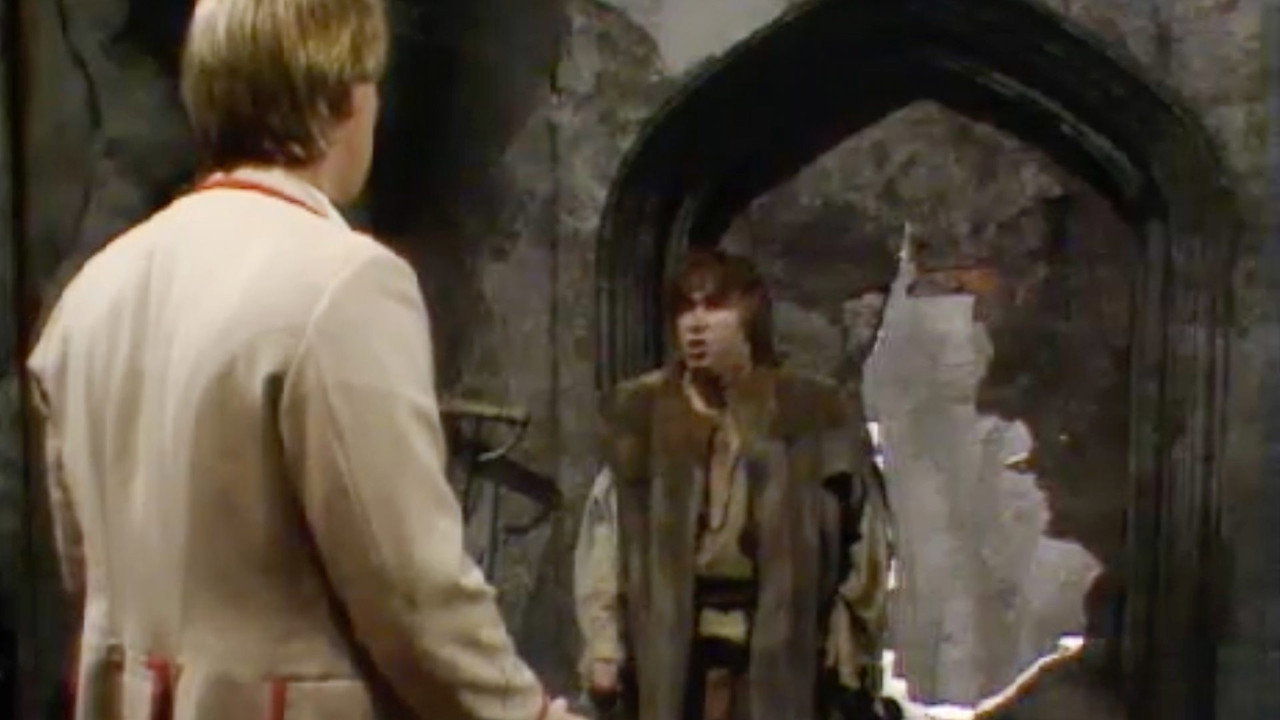
The story in 5 beats
- A visit to Grandad
The Doctor sets course for Little Hodcombe in 1984, so Tegan can spend some time with her grandfather, Andrew Verney.
- Soldiers in the lane
The TARDIS seems to land in the 17th century. It's a re-enactment of the English Civil War, run by the village magistrate, Sir George Hutchinson.
- Queen of the May
Tegan is taken prisoner, put in 17th-century costume and made Queen of the May, who is to be burned alive at the climax of the celebrations.
- Something under the church
The Doctor learns the war games are feeding the Malus, a creature that lives on psychic energy, and that the final battle is meant to be fought for real.
The last battleSpoiler · tap to reveal
Sir George orders Colonel Wolsey to kill the Doctor. Wolsey has other ideas, and the Doctor's side sets out to stop the Malus.
Why it still matters
Every English village in Doctor Who seems to have something alien buried under it, and Little Hodcombe's is the Malus, a creature that feeds on psychic energy. Eric Pringle's idea is a neat one: a village re-enactment of a Civil War battle, staged for fun, turns out to be dinner. The longer the locals play Roundheads and Cavaliers, the stronger the thing under the church gets.
It is also a story squeezed hard. Pringle first offered it as a four-parter called War Game, and it was judged not to have enough in it for four episodes, so it was pared down to two. Along the way it was briefly called Poltergeist, which gives you a fair idea of the mood they were after. What survives is fifty minutes of country lanes, costumed militia and a magistrate, Sir George Hutchinson, played with great relish by Denis Lill.
Behind the camera it was the end of a long run. The production designer, Barry Newbery, had worked on Doctor Who on and off since its very first story in 1963, and after The Awakening he took early retirement from the BBC. Part one drew 7.9 million viewers.
The battle that was meant to be real
Once Sir George is out of sight, Colonel Wolsey refuses his order, frees Tegan and throws in his lot with the Doctor. With Turlough, the schoolteacher Jane Hampden and Wolsey beside him, the Doctor takes on the Malus and puts a stop to Sir George.
Then, with the village quiet again, Tegan finally gets what she came for and talks the Doctor into staying in Little Hodcombe for a while. The ending moves fast, which is where you most feel the cut from four parts to two, but the image of a whole village playing at war until the game turns serious is the bit that sticks.
Challenge the DNA
Would The Awakening have been better at four parts?
Or skip ahead to our reading
Probably, and the ending is where you feel it. The setup is strong and the village games are memorable. Two parts leave the finale rushed.
Behind the scenes
- Eric Pringle first submitted the story as a four-parter called War Game. When it came back to the production office in the 1980s, it was judged too thin for four episodes and cut to two, going through the working title Poltergeist before becoming The Awakening.
- Pringle pitched a second story alongside it, The Darkness, which is thought to have included the Daleks. It was never made.
- Two villages stood in for Little Hodcombe: Shapwick in Dorset and Martin in Hampshire.
- Production designer Barry Newbery had worked on Doctor Who on and off since its very first story in 1963. After The Awakening he took early retirement from the BBC, which made it his last professional job.
- The two parts went out on consecutive nights, January 19 and 20, 1984, to 7.9 and 6.6 million viewers. An omnibus repeat on July 20, 1984 drew 4.4 million.
- Pringle wrote the novelisation for Target Books, published in 1985. On DVD the story was paired with The Gunfighters in the 2011 Earth Story set.
The thread
An English village, a war replayed for fun, and something underground that likes it a little too much.
Came before
Shares DNA with
DNA strand
Us vs. Them
Little Hodcombe splits itself into two armies for a bit of local colour, and something under the church grows fat on how seriously everyone takes it. The Malus doesn't need a real enemy, only people willing to pick a side.
Every great sci-fi story is built from a handful of strands like this one. Each strand page explains how it works and traces it across shows, books and films.
If this one stayed with you
Where to go next, and why.
Watch · Doctor Who
"The Dæmons"
The Pertwee-era version of the same village nightmare, with a dig, a white witch and much more room to breathe.
Watch · Star Trek
"Day of the Dove"
A creature that lives on conflict and keeps two sides at each other's throats, this time aboard the Enterprise.
Watch · Film
The Wicker Man
If the Queen of the May business is what got under your skin, this is the film that does village ritual properly.
Read · Novelisation
The Awakening — Eric Pringle
Pringle's own prose version of his script, for anyone curious about the story beyond the two-part cut.
Your next episode
Three directions to go from here, all on Sci-Fi DNA.
More of this feeling
The Dæmons
Doctor Who
Another English village with something old stirring under the church.
Same question, different answer
A Hundred Yards Over the Rim
The Twilight Zone
A man from 1847 walks over a hill and into another century.

Something completely different
Frontios
Doctor Who
The last human colony, falling meteorites and a hole in the ground.
Sources
- “The Awakening (Doctor Who),” Wikipedia
- “Doctor Who season 21,” Wikipedia
- “Eric Pringle,” Wikipedia
- “Doctor Who Guide: broadcasting for The Awakening,” Doctor Who News
- “The Awakening,” Doctor Who Locations
- “Barry Newbery: Production designer who worked on 'Doctor Who' for more than 20 years with the first five Time Lords,” The Independent, 2015
- “Doctor Who: The Awakening - Episode 132,” DVD Talk