
More from the episode


The story in 5 beats
- The appraisal
Liam leaves a work review and replays it on the way home, over and over, looking for how it went wrong.
- Dinner
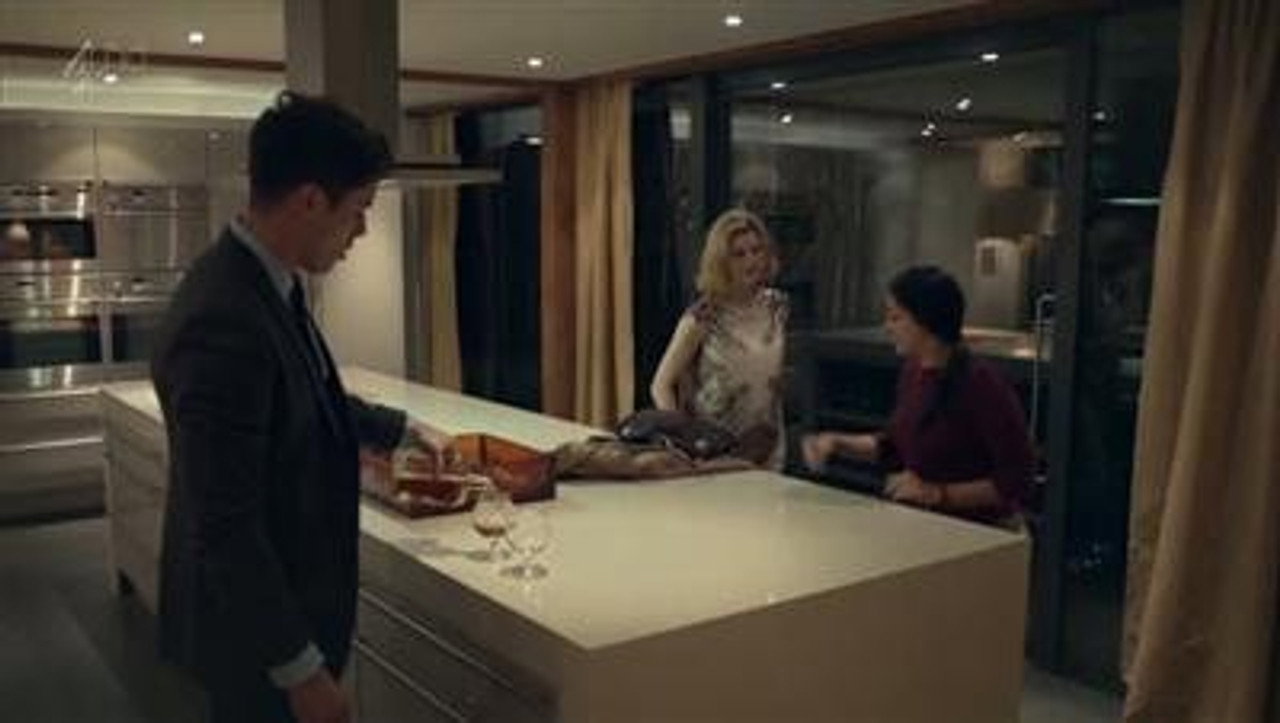
At a friend's dinner party, Ffion seems very comfortable with Jonas, a guest Liam has never liked. One woman at the table has no grain at all; hers was cut out and stolen.
- The re-do
At home, Liam replays the evening on the TV. Ffion's account of her history with Jonas shifts every time he asks.
Jonas's houseSpoiler · tap to reveal
Liam drives over drunk to make Jonas delete his recordings of Ffion. He finds something worse.
The bladeSpoiler · tap to reveal
Alone in an empty house, Liam watches the old happy memories, then decides he can't live with the machine.
Why it still matters
The gadget is small: a grain behind the ear that records your life, and a little remote to scroll through it. Airport security asks to see your last week. Your partner can ask to see your afternoon. Liam, a lawyer coming home from a bad work review, goes to a dinner party, sees his wife Ffion laughing a bit too easily with an old flame, and that's the whole plot. It isn't about the technology going wrong. It works perfectly. What goes wrong is Liam, who can now rewind a glance forty times until it means what he's afraid it means.
It's the only episode of the first series that Charlie Brooker didn't write. Jesse Armstrong, who co-created Peep Show, pitched it as a story about how much relationships depend on being able to forget things. Critics in 2011 noticed it played less like science fiction than a description of phones and social media, and the grain only looks more familiar every year. Toby Kebbell's performance is the reason it hurts: jealous, funny, pathetic and frightening, sometimes in the same replay.
What Liam finds
Liam wakes up in his crashed car and replays the night he can barely remember. He beat Jonas and made him delete every recording of Ffion, and in the middle of it he saw one Jonas hadn't deleted: Ffion and Jonas in bed together. He goes home and forces Ffion to admit it, then forces her to play the memory. After a fight with Liam around the time their daughter was conceived, she slept with Jonas.
Some time later, Liam wanders an empty house, replaying memories of Ffion and the baby. Then he takes a razor blade and tweezers and cuts the grain out from behind his ear. The screen goes black. Charlie Brooker has said the moral is that Liam shouldn't have gone looking for something that was only going to hurt him, and that the baby is Liam's. Plenty of viewers still read that last part the other way.
The Question Underneath
Would you want to remember everything exactly as it happened?
Perfect memory gives Liam an endless supply of evidence to worry at, and every replay feeds the suspicion. Forgetting, the episode suggests, is part of how people forgive each other, and a relationship can't breathe when every glance can be rewound. The grain makes Liam's jealousy easier to act on, but the jealousy was already his.
Challenge the DNA
Was the grain the problem, or Liam?
Or skip ahead to our reading
Liam, with a very good shovel. The grain doesn't make him jealous; it just never lets him stop.
Behind the scenes
- Executive producer Annabel Jones was looking for a satirical writer whose stories "still have meat." Armstrong had been thinking about how fast computer memory was growing, and pitched an idea about the value of being able to forget.
- The first draft was much bigger. Brooker had suggested side effects of the grain, like people going to the cinema to have affairs because grains are switched off there for copyright reasons. It was cut down to a "domestic bubble."
- The world was designed for around 2050 with a deliberately mid-century feel. Production designer Joel Collins avoided gadget-shine, and the crew nicknamed the grain's little remote the "pebble."
- Director Brian Welsh had little industry experience and was recommended by producer Barney Reisz. He gave Kebbell and Whittaker private notes, so neither knew how the other would play a scene.
- Armstrong kept the film rights. In 2013, Robert Downey Jr. and George Clooney were both reported to be bidding, and Downey's company Team Downey got the option. By 2018 Armstrong said it was stuck in development hell.
The thread
Older stories about the cost of a perfect memory, and the devices that made this one feel like next year.
Came before
Shares DNA with
Left its mark on
DNA strand
Memory & Identity
This strand usually worries about losing memories. "The Entire History of You" worries about keeping all of them. Liam's problem is that nothing ever fades, so every doubt can be replayed until it hardens into proof, and a marriage that survived on forgetting has nothing to stand on.
Every great sci-fi story is built from a handful of strands like this one. Each strand page explains how it works and traces it across shows, books and films.
If this one stayed with you
Where to go next, and why.
Watch · Film
Eternal Sunshine of the Spotless Mind (2004)
A couple erase each other from memory. It's the mirror image of the grain, and a lot kinder about what memory is for.
Read · Short story
"The Truth of Fact, the Truth of Feeling" — Ted Chiang
Lifelogs that let you search your past, told alongside a story about the arrival of writing. It asks the same question as the episode and gives a more hopeful answer.
Watch · Film
The Conversation (1974)
Gene Hackman replays one recorded conversation until he no longer knows what he heard. The analog ancestor of Liam's re-dos.
Your next episode
Three directions to go from here, all on Sci-Fi DNA.

More of this feeling
Be Right Back
Black Mirror
Another quiet Black Mirror about love, loss and what gets recorded.

Same question, different answer
The Inner Light
Star Trek: The Next Generation
What are memories worth? Picard gets a whole lifetime of them, and a gentler answer.

Something completely different
The Trouble with Tribbles
Star Trek
After that, something with no marriages in it. Kirk versus fur.