
More from the episode
The story in 5 beats
- The farmhouse
Stripe's squad raids a farmhouse where roaches are hiding. He makes his first kills, and the squad burns the place down.
- Glitches
Afterward his implant starts misfiring, first in his dreams, then in the field. Tests find nothing wrong.
- The housing block
A sniper kills the squad leader. Inside, Stripe stops Hunter from shooting a woman and a boy, and runs with them.
The caveSpoiler · tap to reveal
Catarina tells him what the roaches really are, and what MASS has been doing to his eyes.
The choiceSpoiler · tap to reveal
Arquette shows Stripe what he did at the farmhouse and gives him a choice: reset his memory, or relive it forever.
Why it still matters
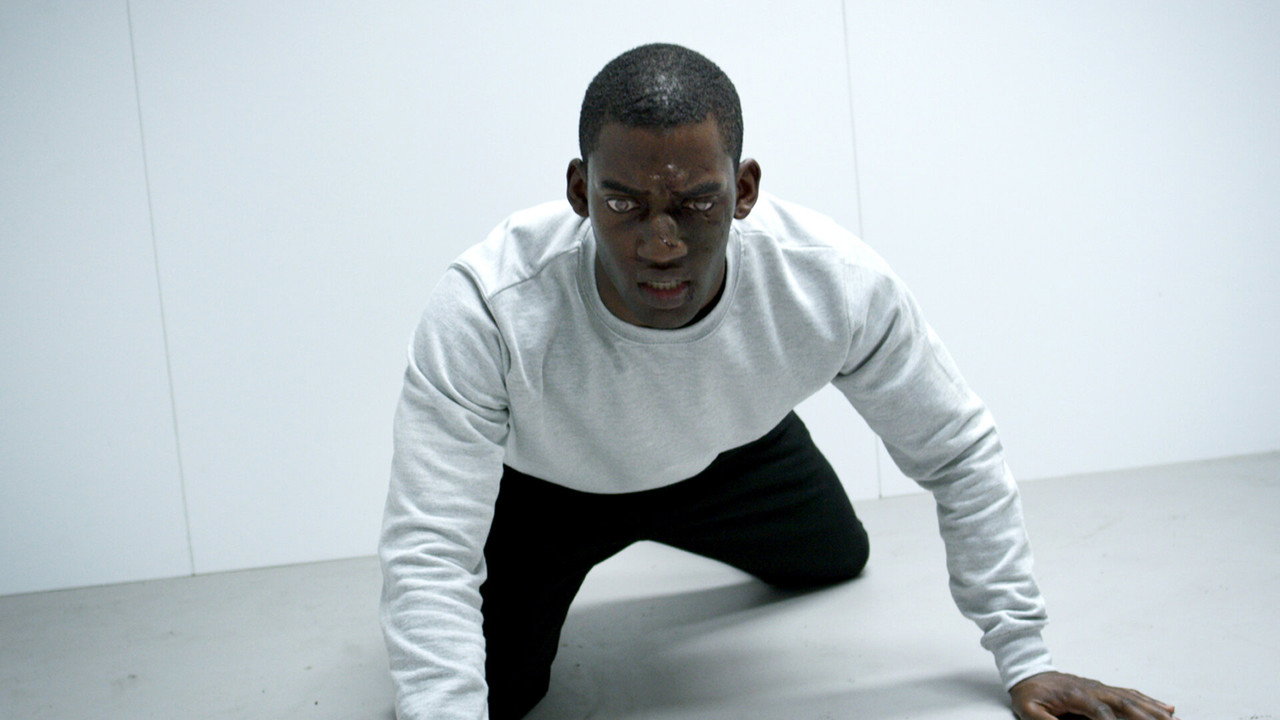
Stripe is a new recruit in a squad sent out to clear villages of roaches, pale, snarling creatures with sharp teeth. Every soldier has MASS, a neural implant that feeds data straight into what they see, augmented-reality style. Malachi Kirby, a fan of the show, played Stripe as "naive, vulnerable and with a sense of doubt" instead of a hard man, and the whole hour runs on that doubt.
It's the most straightforward war story Black Mirror has told, and critics compared its single-idea structure to The Twilight Zone. The pleasure is in watching the world through Stripe's implant and noticing where it seems to be smoothing things over. Then Michael Kelly turns up as a calm military psychologist, and the episode gets very quiet and very uncomfortable.
What MASS hides
The roaches are people. MASS alters the soldiers' senses so that one ethnic group appears inhuman, which lets them kill without hesitating or feeling remorse. The government calls it "genetic cleansing." The local villagers see the victims as human and still call them roaches. Hunter kills Catarina and her son, and Stripe wakes in a cell, where Arquette explains that an LED device caused the glitch, and that Stripe agreed to all of this before his memory was wiped.
His options: have MASS and his memory reset, or go to prison and rewatch the farmhouse raid, seen clearly this time, for his whole sentence. In the last scene a decorated Stripe walks up to the house from his dreams, smiling through tears. We see that it's dilapidated and empty. Brooker called the ending "oblique" and said he had no definitive answer. Kirby thought Stripe kept his memories and switched MASS back on; Kelly thought he'd been wiped and only we see the truth.
Behind the scenes
- It began in 2010 as "Inbound," an alien-attack story that turned out to be a Norwegian invasion. Rejected for series one, it was reworked over the years into this.
- The title comes from S.L.A. Marshall's 1947 book Men Against Fire, which claimed that most Second World War soldiers never fired their rifles. Critics have since questioned that figure. Brooker also read Dave Grossman's On Killing.
- Konnie Huq had Brooker watch John Pilger's 2010 documentary The War You Don't See, about the Iraq War. Brooker said it made the story "more urgent and human."
- The word "roaches" echoes the columnist Katie Hopkins, who called refugees "cockroaches" during the mid-2010s refugee crisis.
- Michael Kelly had worked with director Jakob Verbruggen on House of Cards. Arquette was always meant to be sympathetic.
- The roach makeup, with ill-fitting clothes, swollen features and black contact lenses, earned Kristyan Mallett and Tanya Lodge a 2017 Make-Up Artists and Hair Stylists Guild nomination.
The thread
A disputed book about soldiers who won't shoot, a war documentary, and other stories where the enemy isn't what you were told.
Came before
Shares DNA with
DNA strand
Us vs. Them
Plenty of us-vs-them stories ask who the monsters are. This one asks what it takes to make ordinary people see monsters, and its answer is uncomfortably low-tech: a label and a filter you agreed to wear. The implant does what propaganda already does, only faster.
Every great sci-fi story is built from a handful of strands like this one. Each strand page explains how it works and traces it across shows, books and films.
If this one stayed with you
Where to go next, and why.
Watch · Film
Starship Troopers (1997)
Critics reached for it straight away. It has bugs, recruitment posters and a cheerful war machine, all played as satire.
Watch · Black Mirror
"Playtest"
The same season's other story about tech wired straight into someone's perception, and how little they can trust what they see.
Read · Book
On Killing by Dave Grossman
One of the books Brooker read for the episode, on how armies train people to do something most of them resist.
Read · Novella
Enemy Mine
A soldier stranded with the enemy he was trained to hate. Critics compared Stripe's crisis to it.