More from the film



Who this is for
You've finished Looper and want the rules and the ending laid out, including the bits the film waves away on purpose.
What it covers
- Loopers, silver, gold and closing the loop
- Who the Rainmaker is and how he's made
- What Joe does at the end and why it works
- Why the film refuses to explain its time travel
Spoiler boundary
The whole film, including the ending. Mentions Primer (2004) as a comparison, without spoilers.
Show the full explanationHide the explanationContains spoilers: The whole film, including the ending.
How to read the labels
- Confirmed in the work
- Shown or stated on screen or on the page.
- Creator explanation
- What a writer or director has said outside the work.
- Interpretation
- A reading of what it means. Reasonable people differ.
- Unresolved
- The work doesn't answer this.
- Continuity contradiction
- The work says two things that don't fit together.
The short answer
In 2074, tracking makes it nearly impossible to get rid of a body, so crime bosses send their victims back to 2044, where hired killers called loopers shoot them on arrival. When a looper's contract ends, his own future self is sent back to be killed by him. That's closing the loop, and it pays in gold instead of silver.
Old Joe escapes his own execution and goes hunting for the Rainmaker, the future crime lord who closed all the loops and, in Old Joe's timeline, caused his wife's death. The Rainmaker is a boy called Cid, who has powerful telekinesis. When Old Joe is about to kill Cid's mother, Sara, Young Joe sees that this is exactly what will turn Cid into the Rainmaker. He shoots himself. Old Joe vanishes, Sara lives, and Cid gets the chance to grow up differently.
How looping works
Confirmed in the work In 2044, loopers kill targets sent back from 2074, where tracking systems make disposing of bodies nearly impossible. They're paid in silver bars strapped to the victim.[1]
Confirmed in the work When a looper's contract ends, his older self is sent back to be killed by him. The payment is gold, and that's called closing the loop.[1]
Confirmed in the work Some people in 2044 have weak telekinesis. Cid's is far stronger than anyone else's, including his mother's.[1]
Confirmed in the work The body as a record. When the bosses catch Joe's friend Seth, they carve an address into his younger self's arm and then cut away parts of him. His older self, on the run, finds the words and the missing limbs appearing on his own body.[1]
The Rainmaker
Confirmed in the work In Old Joe's future, the Rainmaker is a powerful telekinetic who overthrows the five crime bosses and starts closing all the loops.[1]
Confirmed in the work Old Joe tries to find and kill the three children born in a particular hospital on the Rainmaker's birthday. Young Joe works out that one of them is Cid.[1]
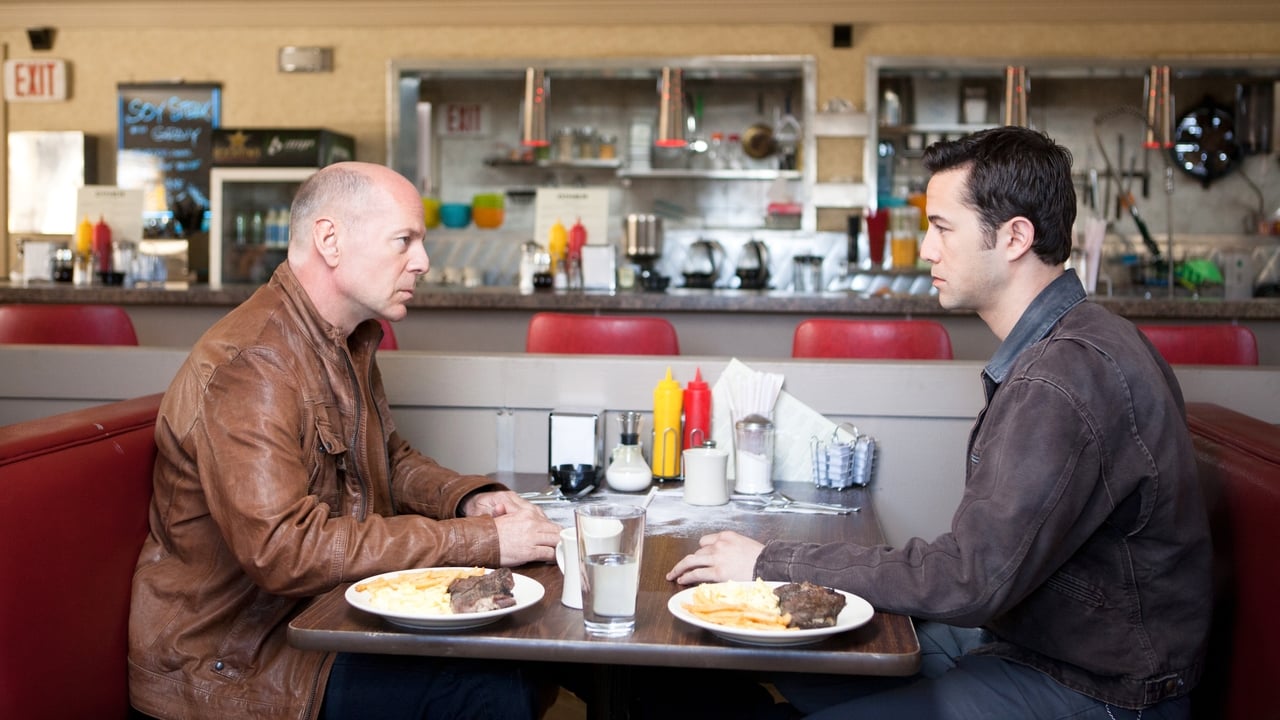
Interpretation The diner scene plants the idea the ending pays off: Old Joe's own violence could be what makes the Rainmaker. A child who watches his mother shot by a stranger from the future has every reason to grow up into the man Old Joe fears.
The ending
Confirmed in the work Old Joe threatens Sara and Cid. Young Joe, unable to stop him any other way, kills himself, which erases Old Joe from existence and saves Sara.[1]
Interpretation Why it works. It's the only move that removes Old Joe from the board without another act of violence in front of Cid. Joe gives up thirty years, including the marriage that drove Old Joe, so that a child gets a mother instead of a reason.
Unresolved Whether Cid still becomes dangerous. The film ends on a hope, with nothing guaranteed.
Why the film won't explain its time travel
Confirmed in the work In the diner, Old Joe tells his younger self that he doesn't want to talk about time travel, because they'd be there all day making diagrams with straws.[2]
Creator explanation Rian Johnson has said he wanted a character-driven film about people dealing with time travel, not one that spends its running time on the rules. He set it against Primer, which he described as being about working the mechanics out.[1]
Creator explanation He has also said his characters don't use time travel and don't know how it works. They just live with what it does.[3]
Continuity contradiction So some things don't add up if you push them, such as how the future that sent Old Joe back survives his erasure. The film treats that as beside the point.
Behind the scenes
The Question Underneath
Can you stop a cycle of violence by being the one who refuses to pass it on?
Old Joe believes he can save the woman he loves by killing a child before that child grows up. Young Joe slowly sees that this is how monsters get made. The film is a gangster story and a time-travel story, but its real subject is a choice about what kind of man to be.
Where to go next
More of this feeling
Help Me Understand
Bruce Willis again, sent back in time on a mission he doesn't fully understand.
Same question, different answer
Help Me Understand
Another time-travelling agent whose job keeps leading him back to himself.
Something completely different
Help Me Understand
The film Rian Johnson named as the opposite of his: all mechanics, worked out in detail.
How it connects
- Similar story mechanism12 Monkeys (1995) Help Me Understand
A man from the future comes back to deal with a catastrophe at its source, and finds the past doesn't cooperate.
- Similar themePrimer (2004) Help Me Understand
Rian Johnson used Primer as his example of the opposite approach to time travel on film.
Sources
- Looper (film) · Wikipedia · accessed 2026-11-20
- Looper at 10 · The Ringer · accessed 2026-11-20
- Looper director Rian Johnson talks about time travel, Bruce Willis, and nostalgia · Yahoo Movies · accessed 2026-11-20
Plot summaries are in our own words. Labels mark what the work shows, what its makers have said, and what is our reading. Last reviewed 2026-11-20. Spot an error? Tell us.