More from the episode

The story in 5 beats
- Two pieces become one
On a beach in Côte d'Ivoire, biology professor Solomon Merkmallen finds a metal artifact covered in inscriptions. Set beside a second piece, the two fuse together and sink into a nearby Bible.
- The wrong Dr. Sandoz
Merkmallen flies to the U.S. to meet biologist Steven Sandoz, who owns a third piece. A man posing as Sandoz kills him. The real Sandoz finds the body and runs.
- Writing in Navajo
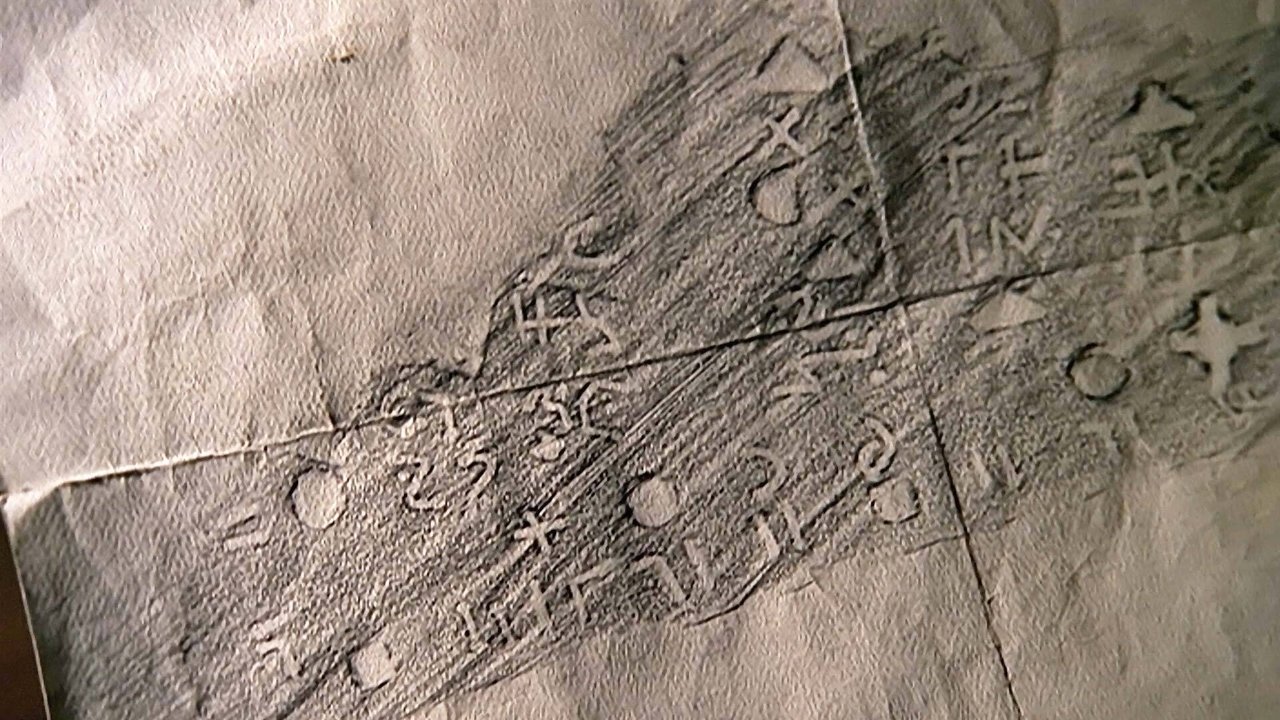
Skinner hands the agents a rubbing of the artifact. Mulder explains both scientists believed in panspermia, and his friend Chuck Burks finds that the inscriptions are in Navajo.
Who killed MerkmallenSpoiler · tap to reveal
Mulder's head starts to pound after he studies the rubbing, and soon he can hear other people's thoughts. That's how he learns a Dr. Barnes killed Merkmallen.
New MexicoSpoiler · tap to reveal
A photo in Sandoz's apartment leads Scully to New Mexico and Albert Hosteen, the old Navajo code talker, now dying of cancer.
Why it still matters
The sixth-season finale opens a new branch of the show's mythology, and it asks a bigger question than the series had tried before: where human life came from in the first place. Chris Carter had long been interested in the idea that something from outside the planet played a part in the great extinctions of millions of years ago, and he and Frank Spotnitz built the episode on the ancient astronaut theory, the notion that visitors from elsewhere reached Earth in ancient or prehistoric times and made contact with humans. According to the official season guide, the writers also saw a scientific basis for aliens as a way to bring Mulder's belief and Scully's science closer together.
Critics split hard. Zack Handlen of The A.V. Club gave it a B, liked the premise, and called the result "ambitious, but it doesn't exactly make sense, which is pretty much where [the mythology] is at now," while admitting the ending left him wanting to know what came next. Robert Shearman, in Wanting to Believe, gave it two stars out of five and felt it recycled old story lines. Paula Vitaris of Cinefantastique was harsher still, describing it as if someone had taken the script of "Anasazi", "changed the plot a bit, and then stripped it of virtually all human interest."
Part of something much bigger
In New Mexico, Scully runs into Sandoz, who explains that Hosteen had been helping him translate the Navajo inscriptions and that they include passages from the Bible. He later phones her to say the artifact also holds information about human genetics. Mulder decides that Sandoz is being framed and that the artifact gives off some kind of radiation. His condition gets worse until he collapses and is taken to hospital with abnormal brain activity, convinced the artifact may prove that aliens created humanity.
Diana Fowley, who has stayed at Mulder's side, secretly gets in touch with the Smoking Man. Alex Krycek finds Sandoz and kills him. Scully flies to the shore in Côte d'Ivoire and reaches the end of the trail: the artifact is a piece of a crashed alien ship, and the wreck lies partly uncovered in the sand.
Challenge the DNA
Was Mulder right to trust Sandoz?
Or skip ahead to our reading
Mulder decides Sandoz is being framed, and the episode follows him. It leaves how much Sandoz knew an open question.
Behind the scenes
- Carter said that early in the show's run he met one of the people leading the project to map the human genome, and the conversation interested him enough to tie genetics into the alien story.
- Carter wrote the script in Vancouver while he was making the pilot for his next series, Harsh Realm, and faxed copies to the crew.
- The African coast is Leo Carrillo State Park in California, where the weather allowed the crew only about 45 minutes of filming a day. The university scenes were shot at UCLA. The ship was digital and cost about $150,000.
- The alien writing was modeled on the 1965 Kecksburg UFO incident in Pennsylvania, when local residents found a large acorn-shaped object in the woods bearing writing that resembled Egyptian hieroglyphs.
- Hosteen Etsity, who had advised on "The Blessing Way", oversaw how the Navajo symbols were used.
The thread
Where the Navajo thread started, a film built on a similar idea, and other stories that wonder whether somebody seeded us.
Came before
Shares DNA with
DNA strand
First Contact & Invaders
For six years the show's aliens were visitors and invaders. This one wonders whether contact happened long before anyone kept records, and follows a script that turns up on a beach, in a Bible and in Navajo.
Every great sci-fi story is built from a handful of strands like this one. Each strand page explains how it works and traces it across shows, books and films.
If this one stayed with you
Where to go next, and why.
Read · Nonfiction
Chariots of the Gods? by Erich von Däniken
Erich von Däniken's 1968 bestseller gave the ancient astronaut theory its large audience, and the episode's premise comes straight out of that tradition.
Watch · Doctor Who · Season 15
"Image of the Fendahl"
A skull that seems twelve million years old wakes something up in an English priory, and the question of how far back humanity's story goes turns dangerous.
Read · Novel
Childhood's End by Arthur C. Clarke
Clarke's aliens arrive looking like something out of humanity's oldest myths, and the book slowly explains why.
Your next episode
Three directions to go from here, all on Sci-Fi DNA.
More of this feeling
Contagion
Star Trek: The Next Generation
It has the same thrill of an ancient language that turns out to be far more dangerous than anyone thought.
Same question, different answer
Emissary
Star Trek: Deep Space Nine
It asks what happens to a sceptic when ancient writings seem to point straight at him.
Something completely different
Three of a Kind
The X-Files
For something lighter, watch the Lone Gunmen talk Scully into a government convention in Las Vegas.