More from the episode
The story in 5 beats
- A doctor from her past
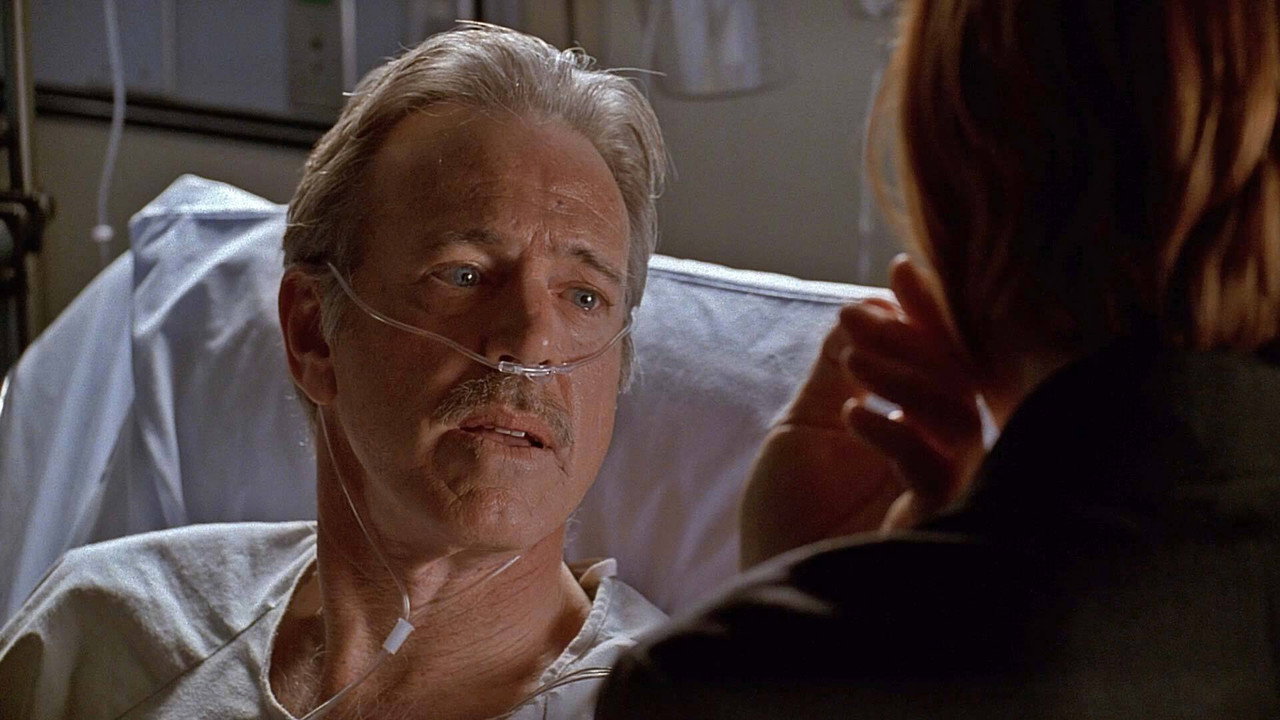
A chain of coincidences leads Scully to Daniel Waterston, the professor she had an affair with at medical school. He has a heart problem nobody can diagnose, and she wonders if she chose wrong.
- The woman in the crosswalk
Mulder, on his way to England to look at crop circles, asks Scully to visit his contact Colleen Azar. On the drive, a woman steps out in front of her, and braking saves Scully from a passing semi.
- Maggie and Colleen
Waterston's daughter Maggie can't stand the sight of Scully. Azar sees she's in crisis and talks about Buddhism, the collective unconscious and auras. Scully waves her off, then comes back to listen.
A walk through ChinatownSpoiler · tap to reveal
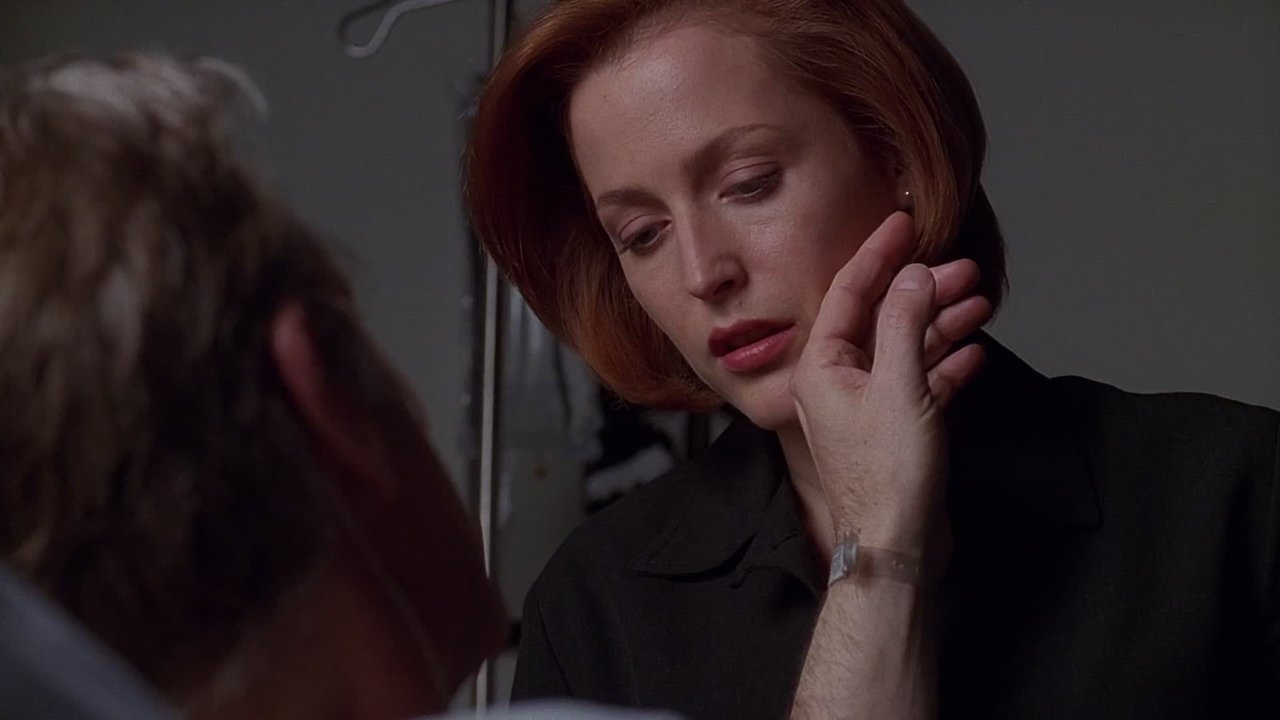
Scully's defibrillator saves Waterston but leaves him in a coma. In Chinatown she follows the woman from the crosswalk into a Buddhist temple and has a vision of what ails him.
The healerSpoiler · tap to reveal
Azar and a healer treat Waterston, and he recovers completely. He tells Scully he still wants her. She knows she isn't the person she was back then, and says no.
Why it still matters
This is Gillian Anderson's episode in every sense: she wrote it and directed it, the only episode of the series she did both on, and it was the first X-Files episode directed by a woman. She had asked Chris Carter during the sixth season whether she could write something drawn from her own interest in "Buddhism and the power of spiritual healing," a "deeply personal X-File" in which Scully "is taken down a spiritual path when logic fails her." Carter approved the outline because it was "personal and quiet," which is a fair description of an X-File with no case and no monster in it.
That made it one of the most divisive hours of the season. Emily St. James, writing for The A.V. Club, called it "a curious failure" and still couldn't hate it, because something at its centre was so "pure and unadorned." Robert Shearman gave it one star out of five, and Cinefantastique's Paula Vitaris complained that it "plays havoc with Scully's motivations." Fans were warmer: the producers got calls and letters saying viewers "loved the vulnerability and quiet determination" Scully showed. Academics have taken it seriously too. Theresa L. Geller, in her 2016 book on the series, reads it as Anderson's feminist intervention in her own character, a story in which Scully is changed "by women she does not know."
Two days out of town
Sitting on a bench outside the hospital, Scully thinks she sees the woman from the crosswalk again, and it turns out to be Mulder. Later, in his apartment, she tells him what happened. He teases that he left town for two days and she spoke to God in a Buddhist temple and God spoke back; she answers, "I didn't say God spoke back." As he drifts into talk about fate bringing the two of them together, he turns and finds she has fallen asleep.
That conversation explains the opening, which the story flashed back from: Scully dressing in front of a mirror while Mulder lies in his bed, half under the sheets. The episode is implying they have slept together. Anderson said on the DVD commentary that she hadn't meant to imply it; Frank Spotnitz and the crew felt it was natural for the relationship to have got there. Erin McKenna, in The Philosophy of The X-Files, reads the scene as a metaphor for Scully's science and Mulder's openness finally meeting.
Challenge the DNA
Did Scully make the right choice all those years ago?
Or skip ahead to our reading
She ends up telling Mulder what happened, and the episode frames it as a choice she would make again. It still lets the road not taken linger.
Behind the scenes
- Anderson wrote the outline in one sitting. Her first draft ran 15 pages too long and had no fourth act, so Carter and Spotnitz worked with her to finish it, though both later said most of the script "was all Gillian."
- Networks were already asking her to direct, and she wanted to do it first on The X-Files. Carter didn't confirm her as director until the rewrites were done, and Kim Manners prepared her with exercises such as making a shot list for every scene.
- Scully's meditation was first built with clips from earlier episodes floating in animated bubbles. The crew found them too "hokey" and switched to a slit-scan effect. For her vision of Waterston's heart, Nicolas Surovy lay on a platform in front of a blue screen, and a prosthetic beating heart filmed separately was combined with him by motion control.
- Anderson chose Moby's "The Sky Is Broken", from his 1999 album Play, because its lyrics fit the idea of the script. She sent composer Mark Snow CDs of music she liked to work from, and added a gong, which she called "very Tibetan."
- It was watched by 12.18 million U.S. viewers, and in the UK by 580,000 on Sky1, the channel's seventh most-watched programme that week.
The thread
The earlier Scully episode its title may answer, the old melodrama it quotes, and other stories about chance and the life not lived.
Came before
Shares DNA with
DNA strand
Memory & Identity
Scully meets the man she might have built a life with and has to look at the woman she was in medical school. The question the episode keeps asking is whether the person she became was her own choice or something she was steered toward.
Every great sci-fi story is built from a handful of strands like this one. Each strand page explains how it works and traces it across shows, books and films.
If this one stayed with you
Where to go next, and why.
Watch · Film
Brief Encounter (1945)
David Lean's story of two married strangers who meet by chance at a railway station and have to decide what their feelings are worth.
Read · Nonfiction
Synchronicity by C. G. Jung
Jung's essay on meaningful coincidence, from the thinker behind the collective unconscious that Colleen Azar talks Scully through.
Read · Novel
The Celestine Prophecy by James Redfield
The 1990s bestseller built on the idea that coincidences are messages, the same notion Scully keeps bumping into.
Your next episode
Three directions to go from here, all on Sci-Fi DNA.
More of this feeling
Parallels
Star Trek: The Next Generation
It has the same quiet wonder of glimpsing the lives you might have led.

Same question, different answer
Hang the DJ
Black Mirror
It asks whether the meetings that shape our lives are really chance at all.

Something completely different
Fight Club
The X-Files
For broad comedy, watch two lookalike women in Kansas cause chaos whenever they meet.