
More from the episode

The story in 5 beats
- Randolph Street again
At work and at home, Horace can't stop reminiscing about his childhood street. Laura and his mother have had enough.
- Nothing has changed
He goes back and finds the street unchanged, with the same boys from 28 years ago, still ten years old.
- The watch at the door
Horace drops his watch on the street. Later the doorbell rings at home and a boy hands it to Laura.
The birthdaySpoiler · tap to reveal
Fired from his job, Horace skips his own surprise party to go back one more time. The boys are angry he never invited them.
Ten againSpoiler · tap to reveal
Horace becomes a boy, and the gang beats him up. Laura comes looking for him, and he grows back into himself.
Why it still matters
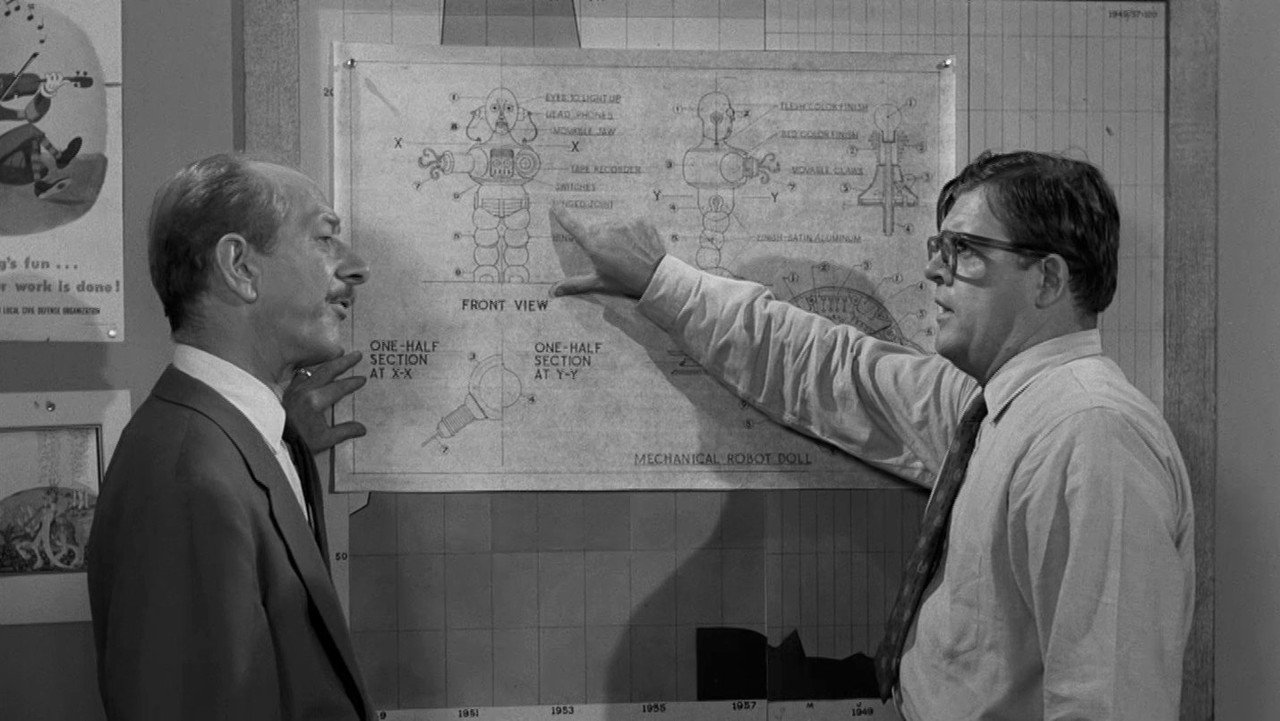
Horace Ford is 38, designs toys for a living and talks about Randolph Street the way other men talk about a lost love: the street games, the gang of boys, the summers. His wife Laura has heard it all, his mother has heard it longer, and his boss is running out of patience. One night he goes back, and the street is exactly as he left it, down to the faces.
This is a Reginald Rose script, and it started life as a live drama on Studio One in 1955. Serling had passed on it once because it was too close to his own "Walking Distance." It's a fair point, and the comparison is the best way in: where Martin Sloan's hometown is golden, Rose takes a harder look at the memories Horace keeps polishing.
This is one of the most argued-over episodes of the hour-long season. Pat Hingle's Horace is loud, needy and childish, which is the point, and many viewers can't stand an hour of him. Watch it as a portrait of a man coming apart and it plays better than its reputation.
What Randolph Street was really like
On his last visit Horace follows the boys into an alley, where they complain that he didn't invite them to his birthday party. Then he is ten years old again, and the friends he has been romanticizing for an hour turn on him and beat him up. The childhood he sold to everyone was a cleaned-up version. Back at the party, young Hermy turns up with Horace's watch, and this time it's the Mickey Mouse watch he wore as a boy.
Laura runs to Randolph Street, finds the boy and turns away for a second, and when she looks again he's her husband. They walk home together, Horace promising to stop living in the past. Rose didn't write it that way at first. In his original ending Hermy brings the watch back to Laura and Horace stays lost in the past. The happier version was added after the network and producer Herbert Hirschman saw the cut, and the shift is easy to spot: it's Laura who states the moral out loud.
Behind the scenes
- Reginald Rose's play aired live on Studio One on June 13, 1955, directed by Franklin Schaffner, with Art Carney as Horace, Leora Dana as Laura and Jason Robards as Leonard O'Brien. Rose said Carney's performance was as fine as any he'd seen on television.
- Serling turned the play down in August 1959 because it was too much like his own "Walking Distance." It came back to the show in the fourth season under producer Herbert Hirschman.
- A Canadian version aired on General Motors Presents in Toronto on March 27, 1960, with Alan Young as Horace.
- The episode was filmed as Rose wrote it, with the downbeat ending. After seeing it, Hirschman and the network asked for a revision, and Rose wrote the scene where Laura pulls Horace back.
- Rose said the story was about how the funny, tender childhood memories we cling to are often distorted and unreal.
- Pat Hingle later played Commissioner Gordon in four Batman films. Ruth White, who plays his mother, is Mrs. Dubose in To Kill a Mockingbird.
- It was later adapted for The Twilight Zone Radio Dramas with Mike Starr.
The thread
A live TV play from 1955, Serling's own trips home, and a long line of stories that distrust nostalgia.
Came before
Shares DNA with
Left its mark on
DNA strand
Memory & Identity
Horace has built his whole sense of himself on a memory, and the episode takes him back to check it. The past he finds corrects the one he's been selling, and it works because everyone has a Randolph Street they tell too often.
Every great sci-fi story is built from a handful of strands like this one. Each strand page explains how it works and traces it across shows, books and films.
If this one stayed with you
Where to go next, and why.
Watch · The Twilight Zone S1
"Walking Distance"
The same trip home, told by Serling with far more tenderness for the past. Watching them back to back is the best argument for both.
Watch · Film
Peggy Sue Got Married (1986)
A grown woman lands back in her teenage years and gets a clear look at what she misremembered. Warmer than Horace's trip, and funnier.
Read · Novel
Dandelion Wine by Ray Bradbury
A boy's summer in a small town, written by a man who loved his childhood as much as Horace does, and who knew how dark its corners were.
Sources
- “The Incredible World of Horace Ford,” Wikipedia
- “The Incredible World of Horace Ford,” The Twilight Zone Vortex, 2020
- “The Twilight Zone, Season 4, Episode Fifteen: The Incredible World of Horace Ford,” Great Books Guy, 2022
- Bill Bria, “The 5 Worst Episodes Of The Twilight Zone, Ranked,” /Film, 2024
- Oktay Ege Kozak, “Every Episode of The Twilight Zone, Ranked from Worst to Best,” Paste, 2023
- “The Twilight Zone, Season 4 episode guide,” TVmaze