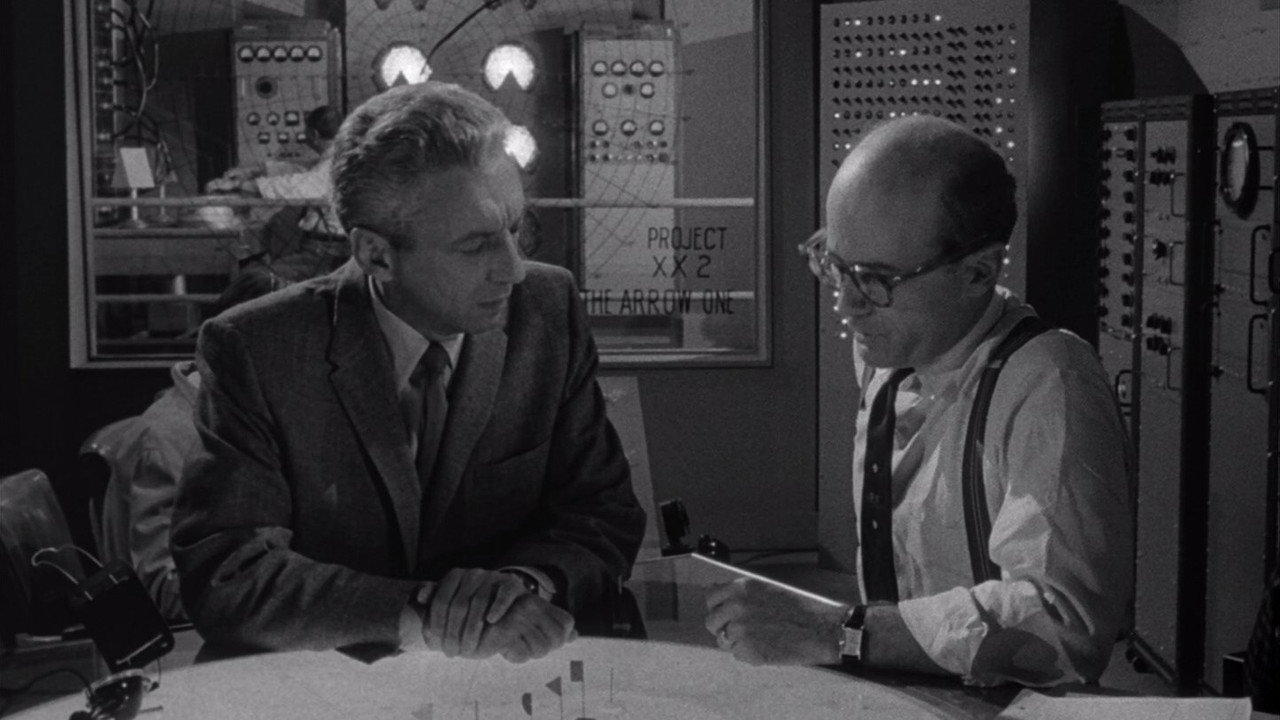
More from the episode

The story in 5 beats
- Arrow One crashes
A spaceship launches. Four of the eight crew survive the crash on what they take to be an asteroid.
- The water
The water won't go far. Corey says it's a waste to give any to the badly hurt crewman, and Colonel Donlin insists they're still a crew.
- Corey comes back alone
Donlin notices that Corey's canteen has more water in it than when he left, and forces him at gunpoint to show where Pierson is.
A diagram in the sandSpoiler · tap to reveal
They find Pierson badly hurt. He draws something in the sand and dies. Donlin drops his gun, and Corey picks it up and shoots him.
Over the ridgeSpoiler · tap to reveal
Corey sets out alone, all the water now his. From the top of a ridge he sees a road, telephone poles and a sign for Reno, 97 miles away.
Why it still matters
Most of this half hour is a crash story that shrinks to one small, ugly question: who gets the water. Colonel Donlin wants discipline and shared rations. Officer Corey wants to know why anyone is wasting a drop on a dying man.
The idea came from outside the writers' room. Madelon Champion, who was not a professional writer, gave Serling the premise in a social setting, and he paid her $500 for it. Sources describe it as the one time he bought an idea that way. Serling wrote the teleplay, and Champion shares the story credit.
Watch it for the Death Valley landscape and for the stretch of mid-episode narration, which Serling rarely used.
Ninety-seven miles from Reno
The crew never left Earth. The Arrow One came down in the Nevada desert, and the sign Corey sees at the top of the ridge is what Pierson was trying to draw as he died. Before he shoots Donlin, Corey admits he attacked Pierson, so both deaths were over water. Corey ends the episode weeping, begging his dead crewmates to forgive him.
Serling's closing narration calls it a "practical joke perpetrated by Mother Nature" and puts the setting on a map: a desert ninety-seven miles from Reno, Nevada, on Earth. Corey's belief about where he is turns out to be false, and his decisions don't change with it. The argument is over what a man decides when he thinks nobody will ever find out.
The Earth-all-along ending has a famous descendant. Serling wrote a screenplay for Planet of the Apes (1968), and sources have long compared its twist to this one. He had also used this title for a prospective pilot idea, and elements of the script were reworked into the later episode "The Gift."
Behind the scenes
- Madelon Champion gave Serling the premise, and he paid her $500 for it. Although people often pitched him ideas for the show, he never made such a purchase again.
- Much of the episode was filmed in Death Valley, around Zabriskie Point. George T. Clemens was the director of photography.
- Besides the usual opening and closing narration, Serling narrates Corey's trek mid-episode. The next use of mid-show narration was in season 3's "I Sing the Body Electric."
- The title comes from the first line of Henry Wadsworth Longfellow's poem "The Arrow and the Song."
- No original score was written; the music was stock.
- Edward Binns, who plays Colonel Donlin, returned to the show in season 5's "The Long Morrow."
- A radio drama version starring Chelcie Ross was produced by Falcon Picture Group for The Twilight Zone Radio Dramas.
The thread
A Longfellow poem, and a spaceship that comes down somewhere it shouldn't.
Came before
Shares DNA with
Echoes and offshoots
DNA strand
The Cruel Twist
The twist changes where the story takes place, but Corey's crime stays the same. He murders for water on a world he thinks is lifeless, then finds out the nearest road was over the next ridge. The joke is on him, and so is the guilt.
Every great sci-fi story is built from a handful of strands like this one. Each strand page explains how it works and traces it across shows, books and films.
If this one stayed with you
Where to go next, and why.
Watch · Film
Planet of the Apes (1968)
Serling wrote a screenplay for it, and sources compare its ending to this one. If the last shot of the episode caught you out, watch the film that takes the idea to a much bigger stage.
Watch · Twilight Zone
"The Monsters Are Due on Maple Street"
If Corey's slide from selfish to dangerous interested you, this is Serling's other study of ordinary people turning on each other under pressure. It stays on one block and needs no spaceship.
Sources
- “I Shot an Arrow into the Air,” Wikipedia
- “I Shot an Arrow into the Air,” Justapedia (mirror of Wikipedia episode notes)
- “The Twilight Zone: "I Shot An Arrow Into The Air"/"The Hitch-Hiker",” The A.V. Club
- Brian Durant, “The Twilight Zone Vortex: "I Shot An Arrow Into the Air",” The Twilight Zone Vortex, 2011
- “Twilight Zone: I Shot An Arrow Into The Air,” The Logbook
- “I Shot an Arrow into the Air explained,” everything.explained.today
- “The Twilight Zone season 1 episode list,” Metacritic
- “The Twilight Zone: S1E15 Cast & Crew,” The Movie Database (TMDB)
- “The Twilight Zone: I Shot an Arrow into the Air,” The TV IV
- “I Sing the Body Electric (The Twilight Zone),” Wikipedia
- “The Gift (The Twilight Zone),” Wikipedia
- “Rod Serling's Unproduced Twilight Zone Pilot Finally Aired In Season 3,” SlashFilm
- “Three Classic Twilight Zone Episodes Foreshadowed Rod Serling's Script for Planet of the Apes,” SYFY Wire
- “The Twilight Zone (radio series),” Wikipedia
- “Edward Binns,” Wikipedia