More from the episode

The story in 5 beats
- Yard work
Arthur comes to the door on a neighbor's tip. Fenton, clearing out his attic, invites him up for a beer.
- The sword
Fenton shows off a Japanese sword he took in the war. Its inscription says the sword will avenge its owner.
- Just joking
Fenton's remarks get uglier, and each time he says he's kidding. The door won't open.
ConfessionsSpoiler · tap to reveal
Each man admits something about December 1941 and the war that followed.
BanzaiSpoiler · tap to reveal
The sword takes hold. When it's over, Fenton is dead, Arthur has jumped from the window and the door swings open.
Why it still matters
For decades this was the Twilight Zone you couldn't see. After its one CBS broadcast it was kept out of American syndication over its racial content, and it didn't air on US television again until a SyFy marathon in January 2016. Seeing it now, you can tell what it was reaching for and where it went wrong.
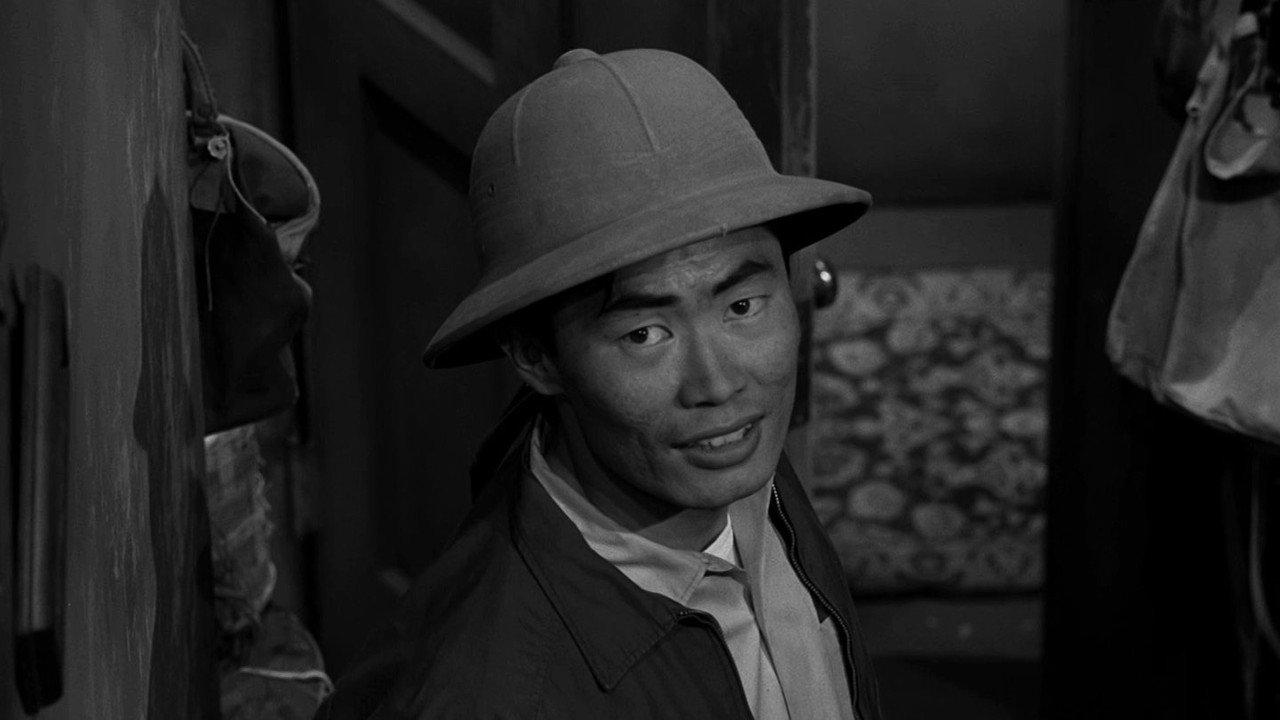
Serling's opening narration sets it up plainly: two men alone in an attic, a young Japanese American and a veteran of yesterday's war. Neville Brand's Fenton is out of work, drinking, and calls his guest "boy" while assuring him he's one of the good ones. George Takei, before his Star Trek years, plays Arthur Takamori with a quiet, stubborn dignity: "I'm a full-grown man and I answer to Arthur." The A.V. Club's Zack Handlen called Brand's performance charismatic and unsettling, and Martin M. Goldsmith's script lets Fenton be a whole, recognizable person without excusing him.
The trouble is what the script asks of Arthur, and that's below the spoiler line. Watch it as a well-acted, uncomfortable two-hander, and as a record of the kind of mistake a thoughtful show could still make in 1964.
What the two men confess, and why it caused an uproar
Arthur first says his father, who helped build Pearl Harbor, died trying to alert sailors. Then he breaks down: his father was a traitor who guided the bombers to their targets. Fenton has his own confession. The sword's owner had surrendered, and Fenton killed him anyway, saying the orders were to take no prisoners. He also admits he has lost his job, his wife is leaving, and he asked Arthur in because he didn't want to be alone. Then Arthur picks up the sword and means to kill him. In the struggle the blade ends up point-up and Fenton falls on it. Arthur shouts "Banzai!" and leaps out of the attic window, and the door they couldn't open drifts open on its own. Serling's closing narration names their common enemy: guilt.
The problem is the father's treachery. The episode invents a Japanese American traitor at Pearl Harbor, a false claim that history buffs objected to, in a country that had locked up Japanese American families during the war. Takei's was one of them: he was held in an internment camp as a boy. Takei later pointed out that nothing like it happened in real life, and that while The Twilight Zone isn't a fact-based show, it was taken literally by some. Asian American civil liberties groups objected, and CBS kept it out of reruns.
Behind the scenes
- CBS kept it out of the US syndication package after complaints. It returned to American TV on January 2, 2016, in SyFy's New Year's marathon, and is now on home video and streaming.
- Director Robert Butler wanted George Takei for the role, and Takei didn't have to audition. Three weeks earlier Butler had directed "Caesar and Me."
- Takei has said the episode had the distinction of airing only once, adding, "I missed out on my residuals on that one."
- Neville Brand served in the US Army in Europe in World War II and received the Silver Star and the Purple Heart. He'd played the guard Bull Ransom in Birdman of Alcatraz (1962).
- Martin M. Goldsmith also wrote the season's "What's in the Box?"
The thread
Two men, one war, and the prejudices that outlived it.
Came before
Shares DNA with
DNA strand
Us vs. Them
Fenton has spent the years since the war treating "them" as one thing, and the episode is at its best watching that habit run into a man who is as American as he is. It goes wrong when the script makes Arthur fit Fenton's picture after all, and that failure is part of why it's still worth seeing.
Every great sci-fi story is built from a handful of strands like this one. Each strand page explains how it works and traces it across shows, books and films.
If this one stayed with you
Where to go next, and why.
Watch · Film
Bad Day at Black Rock (1955)
A stranger asks a desert town about a missing Japanese farmer. Nearly a decade earlier, it took on the same wartime prejudice directly.
Watch · Twilight Zone S3
"The Shelter"
Another evening where ordinary decent people show what they think of each other once they feel threatened.
Read · Graphic memoir
They Called Us Enemy by George Takei
Takei's own account, drawn by Harmony Becker, of being taken from Los Angeles to the camps as a boy: the history this episode got wrong.
Sources
- “The Encounter (The Twilight Zone),” Wikipedia
- “The Twilight Zone (1959 TV series) season 5,” Wikipedia
- Zack Handlen, “The Twilight Zone: "The Encounter"/"Mr. Garrity And The Graves",” The A.V. Club
- “Why George Takei's Twilight Zone Appearance Went Unaired For Decades,” /Film
- “George Takei Starred In The Only Twilight Zone Episode That Was Banned From Syndication,” TVLine
- “Why George Takei's Twilight Zone Episode Was Once Withheld From Syndication,” Grunge
- “Before 'Get Out,' The Twilight Zone tried racism as a monster, and failed,” LAist (Off-Ramp)
- “The Twilight Zone: Season 5, Episode 31, The Encounter,” Great Books Guy
- Joseph Mallozzi, “Our Twilight Zone rewatch continues with season 5 episodes 29-32,”
- “Neville Brand,” Wikipedia
- “Bad Day at Black Rock (film),” Densho Encyclopedia
- “George Takei Recalls Time In An American Internment Camp In 'They Called Us Enemy',” NPR, 2019