More from the episode

The story in 5 beats
- The only ship
Eileen wants a slow crossing to save the marriage. The travel agent tries to talk them out of the Lady Anne, and she buys the tickets anyway.
- Please get off
On board, every passenger is old, and two of them offer the Ransomes money to give up their passage. They refuse.
- The McKenzies
Toby and Millie explain: this is the Lady Anne's last voyage, and its passengers all honeymooned on her. The Ransomes agree to separate in London.
Eileen disappearsSpoiler · tap to reveal
Eileen vanishes. Alan tears the ship apart looking for her, then finds her back in their cabin, and something changes between them.
The lifeboatSpoiler · tap to reveal
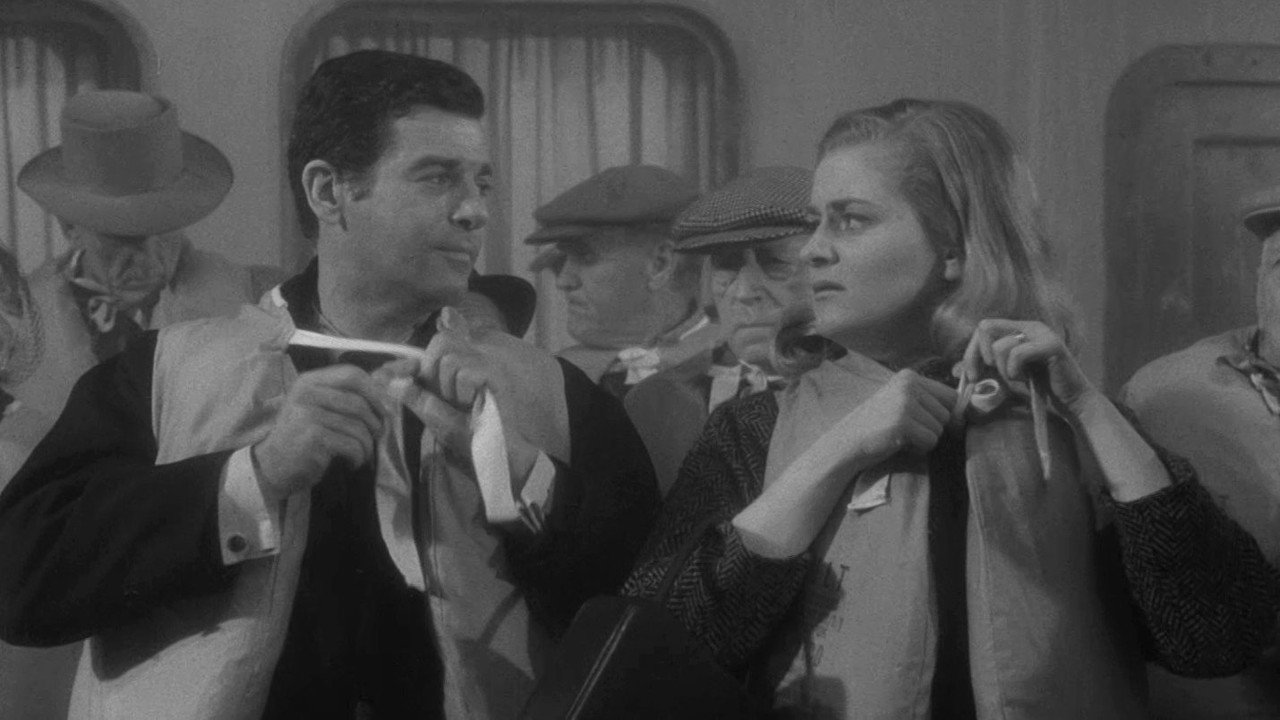
The engines stop. The captain puts the Ransomes into a lifeboat at gunpoint. A cutter picks them up, and the Lady Anne is never seen again.
Why it still matters
Alan Ransome is a busy financier with a business trip to London. His wife Eileen insists they go by sea, slowly, on the one ship available: the Lady Anne, old, out of fashion, and warned against by the travel agent. The tickets say New York to Southampton. Once aboard they find the passengers are all elderly, all oddly fond of the ship, and two of them offer cash to take the Ransomes' cabin.
This is Charles Beaumont's last Twilight Zone script, and there's very little fantasy on screen. Most of the hour is a marriage under a microscope, with the strangeness creeping in around the edges. Wilfrid Hyde-White and Gladys Cooper are the reason to watch, as Toby and Millie McKenzie, a couple who have been happy on this ship for a very long time and treat the Ransomes with exasperated kindness.
It's a quiet one and it takes its time, which divides people. The A.V. Club's Emily St. James thought it ran long and still gave it a B+, saying it works even if she couldn't quite say why. Give it the patience the McKenzies give the Ransomes.
A better port
When Eileen reappears, Alan throws his pocket watch out of the porthole, done with living by the clock, and the two of them fall back in love. That should be the end of their trouble. Instead the engines stop in mid-ocean, and Captain Protheroe orders the Ransomes into a lifeboat at gunpoint and sets them adrift. A cutter finds them hours later, as promised. No trace of the Lady Anne or anyone aboard is ever found.
The episode never says exactly what the ship is or where it's going, and that's its strength. The old passengers have chosen their last voyage together and decided the young couple aren't ready to join it. Serling's closing narration says the ship sailed off to a better port. St. James thought he spelled it out too plainly, though the hour before is vague enough that it barely matters. Beaumont's story ends harder: the ship catches fire and sinks.
Behind the scenes
- Beaumont adapted his own story "Song for a Lady," from his 1960 Bantam collection Night Ride and Other Journeys, the same book that held the stories behind "Perchance to Dream" and "The Howling Man."
- In the story the Ransomes are newlyweds, so there's no failing marriage, and Alan tells it in the first person. The story's ship is a rusting wreck; the episode's is old but beautiful.
- It was the last episode Beaumont wrote himself. He was seriously ill, and later scripts under his name were ghostwritten, mostly by Jerry Sohl and John Tomerlin.
- Gladys Cooper was making her second of three Twilight Zone appearances, after "Nothing in the Dark." Cecil Kellaway, who plays Burgess, had been in "Elegy." Alan Napier, the captain, later played Alfred on Batman.
- Robert Pittack shot it, and the score is by René Garriguenc, conducted by Lud Gluskin.
- It was later adapted for The Twilight Zone Radio Dramas with Martin Jarvis and Rosalind Ayres.
The thread
Beaumont's own story, old legends of ships that never arrive, and the Twilight Zone's other strange voyages.
Came before
Shares DNA with
Retold
DNA strand
Love Beyond Limits
The Lady Anne is a ship that keeps love going, and its passengers have stayed in love on it for decades. Beaumont sets one tired marriage among them and lets it catch fire again. The limit here is the last voyage, and the old couples understand it better than the young one.
Every great sci-fi story is built from a handful of strands like this one. Each strand page explains how it works and traces it across shows, books and films.
If this one stayed with you
Where to go next, and why.
Watch · The Twilight Zone S2
"Nick of Time"
Another young couple whose marriage is tested by something uncanny. The Twilight Zone Vortex rates the Ransomes as the show's best on-screen pairing since the one in this episode.
Watch · Film
An Affair to Remember (1957)
Two people fall for each other on an ocean crossing: the romance the Lady Anne seems built for.
Read · Short stories
Night Ride and Other Journeys by Charles Beaumont
Read "Song for a Lady" to see the bleaker voyage Beaumont first imagined, then stay for the stories that became other episodes.
Sources
- “Passage on the Lady Anne,” Wikipedia
- “Passage on the Lady Anne,” The Twilight Zone Vortex, 2020
- Emily St. James, “The Twilight Zone: "Passage On The Lady Anne"/"The Bard",” The A.V. Club, 2013
- “The Twilight Zone, Season 4, Episode Seventeen: Passage on the Lady Anne,” Great Books Guy, 2022
- Oktay Ege Kozak, “Every Episode of The Twilight Zone, Ranked from Worst to Best,” Paste, 2023
- “The Twilight Zone, Season 4 episode guide,” TVmaze