
More from the episode


The story in 5 beats
- A hot July
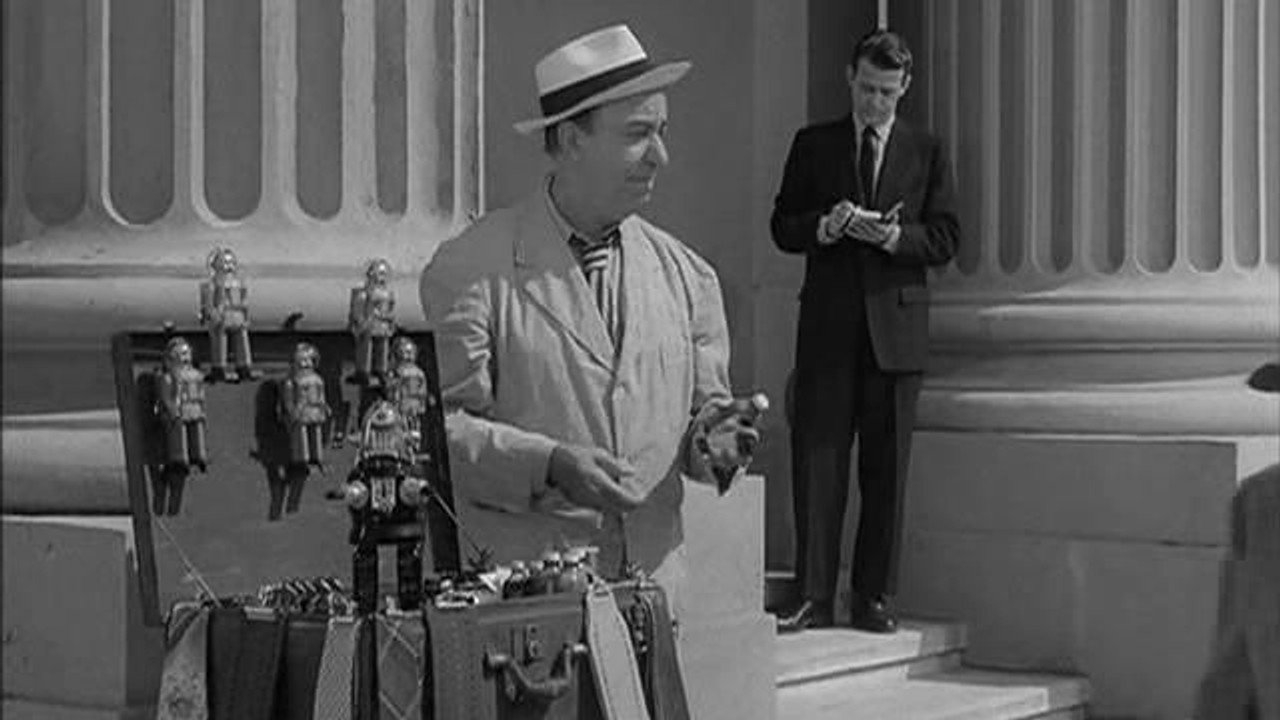
Lew Bookman sells toys and trinkets from a sidewalk table, and the kids in his neighborhood adore him.
- Mr. Death
A man in a suit turns out to be Death, and he has come for Lew at midnight.
- One for the angels
Lew begs for time. He has never made the great pitch of his life, and Death agrees to wait until he does.
Somebody has to goSpoiler · tap to reveal
Lew vows never to pitch again. Death explains the books must balance, and a little girl from Lew's building is next.
The pitchSpoiler · tap to reveal
Lew pitches Death himself and keeps him talking until midnight passes. Maggie lives, and Lew keeps his side of the deal.
Why it still matters
A week after the pilot sent Earl Holliman wandering an empty town, Serling used the second slot to show what else his new series could be: a warm, funny, sentimental fantasy with no spaceship in sight. The star is Ed Wynn, a vaudeville and radio comedian who had stunned audiences in 1956 as a broken-down boxing trainer in Serling's Playhouse 90 play Requiem for a Heavyweight. That performance made him a serious dramatic actor late in life. Serling is said to have built Lew Bookman for him.
Lew is a street pitchman, a fixture of a hot summer who sells small toys and trinkets and is adored by the neighborhood kids. Death, played by Murray Hamilton, shows up in a suit and carries himself like a punctual 1950s tax collector with a schedule to keep. Hamilton later turned up as Mr. Robinson in The Graduate and as the mayor in Jaws, and his dry, put-upon Death is half the fun here.
Reviewers tend to call this one warmhearted rather than essential. It's also the clearest early case of the show's habit of telling a human story through a fantasy premise. Watch how much of the episode is simply a salesman at work, and ask yourself what that skill is going to be worth by the end.
What the pitch buys
Lew reads the deal literally. Death can have him once he has made his pitch for the angels, so Lew decides never to make another pitch and thinks he has cheated his way out. The episode plays his dodging for laughs, with Death turning up ahead of him and scolding him. Then Death explains that someone has to go at midnight regardless. With Lew out of reach, he will take Maggie Polanski, the little girl from Lew's building, and a truck hits her.
Lew can't cancel the bargain, so he spends the one skill he has. He sets up his table and pitches Death himself, product after product, and the patter is so relentless that Death sweats and mops his forehead while the clock runs out. Death misses his appointment, Maggie is spared, and Lew goes with Death as he promised. Serling's narration calls him a man beloved by the children, and therefore "a most important man."
It's a gentle episode about dying. Lew's first trick is the self-interested kind of cleverness, and it puts someone else in danger. His last pitch is the same talent aimed at the right target, and it earns the title. The cheerful tone never turns grim, so Lew's exit comes across as bittersweet.
Behind the scenes
- Serling had already written a script called "One for the Angels" for the anthology series Danger, broadcast on September 14, 1954. In that version a down-on-his-luck sidewalk salesman tries to save his brother from hitmen. For The Twilight Zone he kept the title and the lead character and rewrote the rest around a fantasy premise.
- Serling reportedly wrote the part for Ed Wynn after the two worked together on Requiem for a Heavyweight. Wynn had been nervous about dramatic acting, and Requiem established him as an actor who could hold his own with the best.
- Wynn was reportedly paid $5,000 for the episode, among the highest fees of the series, while Murray Hamilton was paid $850.
- Because of Wynn's age, the night scenes were reportedly shot during the day with tarps pulled over the set to simulate darkness.
- Although it aired in October 1959, the story is set on July 19 and 20, 1960.
- Wynn's role in the 1959 film The Diary of Anne Frank earned him an Academy Award nomination for Best Supporting Actor. He returned to The Twilight Zone in season five for "Ninety Years Without Slumbering."
- Director Robert Parrish went on to direct "A Stop at Willoughby" and co-directed "The Mighty Casey" later in the first season.
The thread
A pitchman, a bargain with Death, and the earlier Serling script that started it all.
Came before
Shares DNA with
Adapted
DNA strand
Be Careful What You Wish For
Lew thinks he can get around his deal by reading it literally. Serling keeps the mood light and warm, then asks what cleverness is actually for. It works because Lew's one skill is exactly the thing the story needs from him in the end.
Every great sci-fi story is built from a handful of strands like this one. Each strand page explains how it works and traces it across shows, books and films.
If this one stayed with you
Where to go next, and why.
Watch · Playhouse 90
"Requiem for a Heavyweight" (1956)
If you liked Wynn here, this is the performance that made Serling want to write for him. It's a much heavier piece, and he's wonderful in it.
Watch · TZ S5
"Ninety Years Without Slumbering"
Wynn is back as another sweet old man in Serling's world, with time and death hanging over him again. It's a good pairing for a gentle double bill.
Watch · Film
The Seventh Seal (1957)
A man trying to buy time from Death with his wits, in a far darker key. Watch it if you liked Lew's bargaining and want to see the same idea played as a medieval fable.
Read · Novel
Mort — Terry Pratchett
Death as a hardworking professional with a schedule, played for warmth and comedy. It's the closest book to the tone of Hamilton's performance.
Sources
- “One for the Angels,” Wikipedia
- “List of The Twilight Zone episodes,” Wikipedia
- “Ed Wynn,” Wikipedia
- “Rod Serling's Complete Filmography,” Rod Serling Memorial Foundation
- “The Twilight Zone: Season 1, Episode Two "One For The Angels",” Great Books Guy, 2021
- “The Twilight Zone Vortex: "One for the Angels",” The Twilight Zone Vortex, 2011
- “Twilight Zone Review: One For The Angels (Aired October 9, 1959),” Ringside Report
- “The Twilight Zone Vortex: "Ninety Years Without Slumbering",” The Twilight Zone Vortex, 2025
- “The Twilight Zone S1:E2 - One for the Angels - Cast & Crew,” The Movie Database (TMDB)