
More from the episode

The story in 5 beats
- A cry in the night
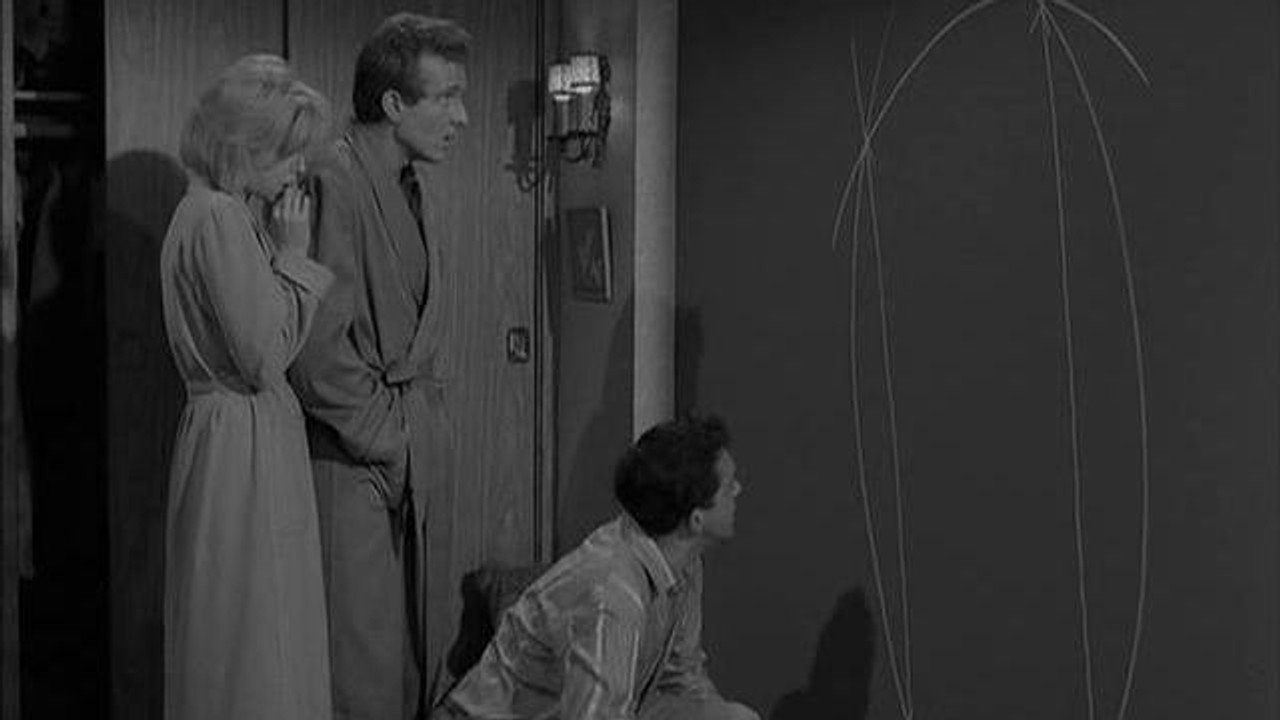
Chris and Ruth wake to Tina whimpering. Her voice is close by. She isn't in her bed, or under it, or anywhere they look.
- Bill
Chris calls his friend Bill, a physicist. The family dog, Mack, is barking at nothing.
- The wall
Bill's hand goes through the wall behind the bed. He chalks the outline of an opening and warns them not to follow her in.
ThroughSpoiler · tap to reveal
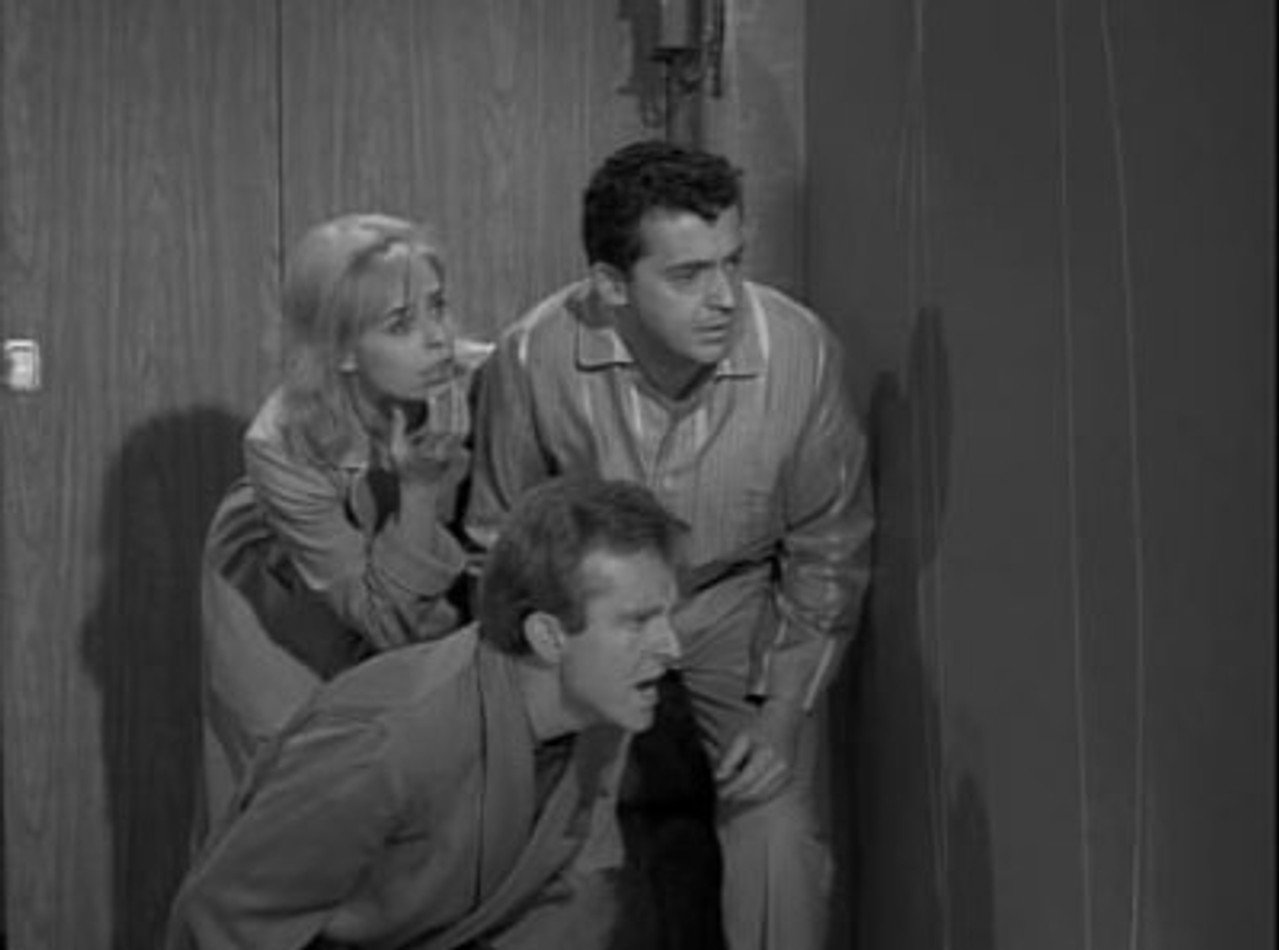
Mack goes in after Tina. Then Chris reaches for them and falls halfway into a tilting, shifting space.
Seconds to spareSpoiler · tap to reveal
Bill hauls Chris, Tina and the dog back out while the opening shrinks behind them.
Why it still matters
Every parent knows the half-second of panic when a child isn't where they should be. Richard Matheson stretched that half-second into twenty-five minutes. Chris and Ruth Miller wake to their daughter Tina calling for them. Her voice is right there in the bedroom, and her bed is empty. So Chris phones the one friend who might know what to do, a physicist named Bill.
Matheson got the idea from his own house. His young daughter fell out of bed one night and rolled underneath it, against the wall, and for a moment he and his wife could hear her and couldn't find her. "It was bizarre, and that's where I got the idea," he told Marc Scott Zicree. The episode works because it plays the impossible like a household emergency: the friend arrives in the middle of the night and starts thinking out loud.
Listen, too. Bernard Herrmann wrote an original score for strange instruments, flutes and harps and a viola d'amore, and it does a lot of the work the 1962 effects budget couldn't. The A.V. Club gave the episode an A and called it "a wonderful, pulpy symbol for the growing paranoia of the times."
Into the fourth dimension
Bill's theory is that Tina has rolled through a doorway into a fourth dimension, a place unlike the three we live in, and that anyone who follows her could be lost for good. They send Mack in, hoping the dog can lead her back. Then Chris, against Bill's warnings, reaches in and tumbles partway through into a crystalline space that keeps turning.
Bill keeps hold of him the whole time and pulls Chris, Tina and Mack back into the bedroom. When he checks the wall, the opening has shrunk to almost nothing: a few seconds more and Chris could have been caught half in each world. The family is safe, though the closing narration admits that nobody ever did explain the opening.
Behind the scenes
- Matheson's short story first appeared in Amazing Stories in 1953. He adapted it himself about a decade later.
- Bernard Herrmann's original score uses an unusual chamber group: four flutes (doubling piccolo, alto and bass flute), four harps, one percussionist and a viola d'amore. It has since been played as a concert suite.
- Director Paul Stewart was a founding member of Orson Welles's Mercury Theatre and played Raymond, the butler, in Citizen Kane, which was Herrmann's first film score.
- Tina's voice from the other side belongs to Rhoda Williams.
- Charles Aidman, who plays Bill, had been an astronaut in the Season 1 episode "And When the Sky Was Opened." He later narrated the 1985 Twilight Zone revival.
- Matheson praised Aidman and Stewart. His one complaint, as SlashFilm reports, was that the fourth dimension could have looked stranger.
The thread
A real night in the Matheson house became a story, then an episode, then a haunted-house blockbuster and a Disney ride.
Came before
Shares DNA with
Left its mark on
DNA strand
Is Any of This Real?
The scary idea here is a small one: the wall behind your child's bed might not be solid. Matheson puts a hole in an ordinary house and lets a calm physicist talk the parents (and us) through it. After this, every dark gap between a bed and a wall looks a little different.
Every great sci-fi story is built from a handful of strands like this one. Each strand page explains how it works and traces it across shows, books and films.
If this one stayed with you
Where to go next, and why.
Watch · Film
Poltergeist (1982)
If the voice from nowhere got under your skin, this is the same nightmare at blockbuster size: a family, a house, and a little girl somewhere they can't reach.
Read · Short story
"Little Girl Lost" — Richard Matheson
The original, short and plain-spoken. You can see how much of the episode's feel was already in Matheson's prose.
Watch · Twilight Zone S2
"Long Distance Call" (1961)
Another Zone episode about parents and a child being pulled somewhere they can't follow, this time through a toy telephone.
Sources
- “Little Girl Lost (The Twilight Zone),” Wikipedia
- Zack Handlen, “The Twilight Zone: "The Fugitive"/"Little Girl Lost",” The A.V. Club, 2013
- Peter Martin, “Exploring The Twilight Zone, Episode #91: "Little Girl Lost",” ScreenAnarchy, 2011
- Devin Meenan, “A Terrifying Twilight Zone Episode Was Inspired By A Writer's Real-Life Incident,” SlashFilm, 2024
- Jeremy Smith, “One Twilight Zone Episode Inspired A Horror Classic – And One Very Annoyed Writer,” SlashFilm, 2024
- Josh Weiss, “Did This Twilight Zone Episode Inspire Tobe Hooper's Poltergeist?,” SYFY WIRE
- James Grebey, “Every Twilight Zone Episode The Simpsons Parodied in "Treehouse of Horror",” SYFY WIRE, 2024
- “Episode guide: The Twilight Zone,” epguides.com