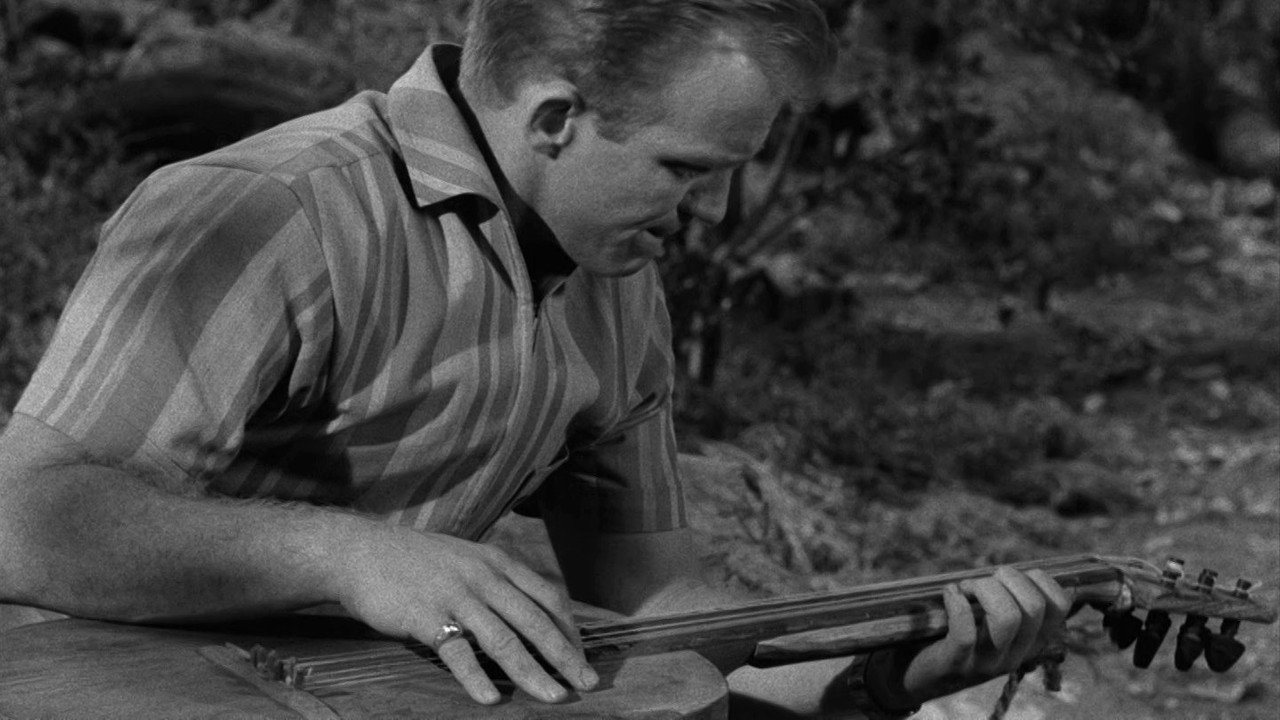
More from the episode

The story in 5 beats
- Shopping for a song
Floyd Burney offers an old man money for an original tune. The old man won't sell, and warns him off.
- A voice in the woods
Floyd follows singing through the trees and walks right past something he doesn't stop to read.
- Mary Rachel
By a lake he finds the singer. She won't sell the song, so he charms her into singing it for his tape recorder.
A new verseSpoiler · tap to reveal
Billy Rayford arrives with a rifle and dies in the struggle. When Floyd plays the tape, the song describes it.
The last verseSpoiler · tap to reveal
Billy's brothers hunt Floyd to the old man's shop, and the song ends where it always does: at his grave.
Why it still matters
People come to this one for the song. "Come Wander with Me," by Jeff Alexander and the episode's writer Anthony Wilson, is sung by Bonnie Beecher in her television debut, and it has outlived nearly everything else about Season 5. The recording turns up in Vincent Gallo's The Brown Bunny, on the Late Night Tales: Air compilation and in the 2024 Netflix series Baby Reindeer. If you've heard it somewhere and wondered where it came from, this is the answer.
The story around it is murkier, and the critics have said so. Gary Crosby plays Floyd Burney, the "Rock-A-Billy Kid," who treats folk music as raw material, and Richard Donner shoots the woods as a smoky, half-dreamed place where nothing quite adds up. The A.V. Club found it more frustrating than memorable, and The Twilight Zone Companion said its twists and turns make it "virtually incoherent." It's still worth the half hour for the mood, for Beecher, and for watching the show try something it hadn't quite done before: a ghost story told as a ballad.
A ballad that writes itself
The song Floyd steals is his own story, and it keeps adding verses as he lives them. After he kills Billy Rayford, the tape describes the killing and then Billy's three brothers finding the body and swearing revenge. Mary Rachel begs Floyd to stay, hoping it will be different "this time." When he asks whether there have been other men, she says it has always been him. He runs, looks back, and sees her in black, mourning him already.
The brothers corner him in the old man's shop among the instruments, and he's shot. The camera goes back to the tombstone Floyd passed on the way in: "Floyd Burney, the Wandering Man." Serling's closing narration says he got eternal top billing after all, in the folk songs of the Twilight Zone. The implication, never spelled out, is a loop: Floyd keeps coming back, keeps stealing the song, and keeps ending up in it.
Behind the scenes
- According to The Twilight Zone Companion, Liza Minnelli auditioned for Mary Rachel and was turned down. MeTV reports producer William Froug told her the part wasn't for her, while Donner said the choice of Beecher was his.
- It was the last episode filmed for the original series, though it aired third from last.
- Gary Crosby was Bing Crosby's son. Carol Serling and Douglas Brode have called his Floyd the small screen's first Bob Dylan-style folkie.
- Bonnie Beecher reportedly dated Bob Dylan at the University of Minnesota in 1961, and in 1965 she married Wavy Gravy. She wasn't a professional singer.
- Anthony Wilson went on to create The Invaders and Land of the Giants.
- Jeff Alexander reused the melody as an instrumental in his score for Day of the Evil Gun (1968).
The thread
Murder ballads, haunted songs and the music that outlived its episode.
Came before
Shares DNA with
Where the song went next
DNA strand
Time Loops & Timelines
The loop is never explained, only hinted at in one line of Mary Rachel's: she hopes it will be different this time. The song is the record of every time before, and Floyd, who came to take a song, is the one being written down.
Every great sci-fi story is built from a handful of strands like this one. Each strand page explains how it works and traces it across shows, books and films.
If this one stayed with you
Where to go next, and why.
Watch · Twilight Zone S4
"Jess-Belle"
Another trip into the Appalachian hills, with a love story and a curse. It gives the folk setting the full hour this one could have used.
Watch · Twilight Zone S2
"Shadow Play"
A man who knows he's caught in a repeating nightmare and can't convince anyone. If Mary Rachel's "this time" stuck with you, start here.
Read · Short stories
Who Fears the Devil? — Manly Wade Wellman
Silver John wanders the Appalachian hills with a silver-strung guitar, collecting songs and running into things that ought not to exist: the same woods, seen by a wanderer who listens.
Sources
- “Come Wander with Me,” Wikipedia
- “Liza Minnelli wanted a key role on The Twilight Zone but could not pass the audition,” MeTV
- “Bonnie Beecher :: Come Wander With Me (The Twilight Zone),” Aquarium Drunkard, 2014
- Zack Handlen, “The Twilight Zone: "The Brain Center At Whipple's"/"Come Wander With Me",” The A.V. Club, 2014
- “The Twilight Zone: Season 5, Episode 34, Come Wander with Me,” Great Books Guy