
More from the episode
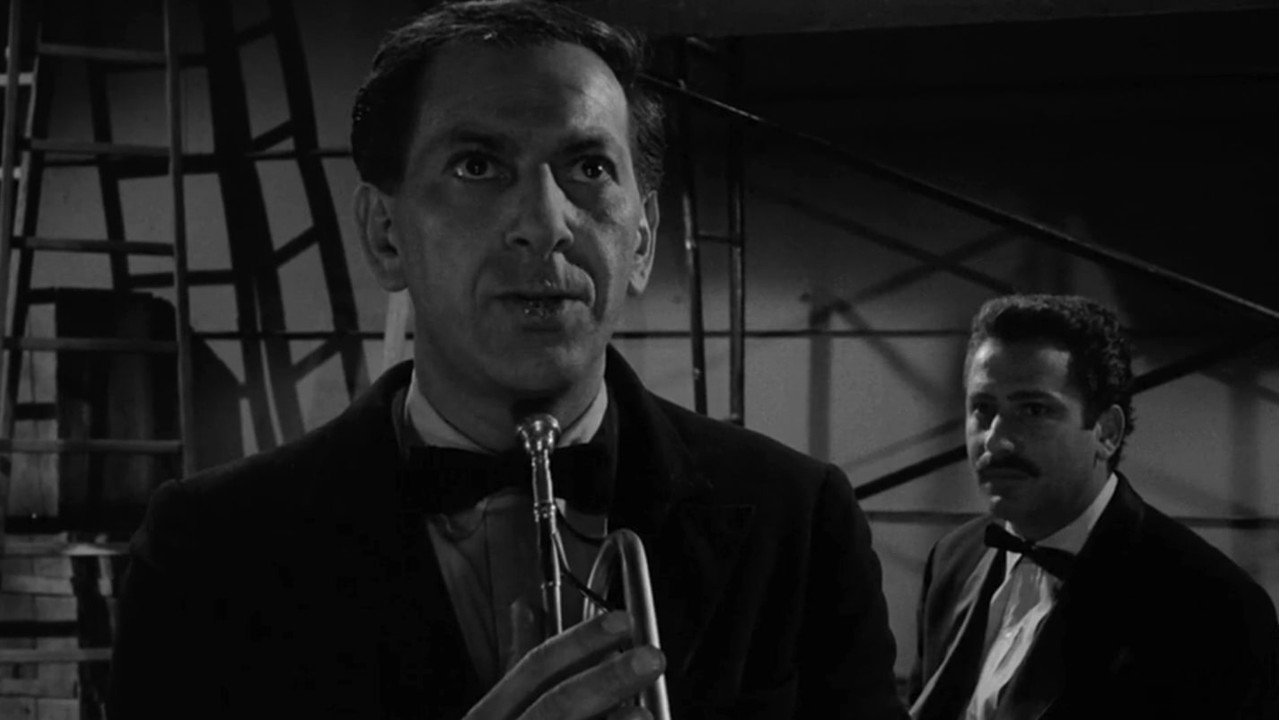
The story in 5 beats
- The alley
Joey, a trumpeter ruined by drink, begs the owner of his old club for a spot on stage. He's turned down.
- The pawnshop
Joey hocks his trumpet for far less than he hoped, then steps off a curb into the path of a speeding truck.
- Nobody sees him
He gets up unhurt, but a cop, a ticket seller and passersby ignore him, and the theater mirror shows no Joey.
Call me GabeSpoiler · tap to reveal
A trumpeter outside the club can see Joey. He calls himself Gabe, says the people in the street are dead, and offers Joey a choice.
Second chanceSpoiler · tap to reveal
Joey chooses life and wakes in the road. The truck driver hands him cash, he buys his horn back, and a new neighbor named Nan hears him on the roof.
Why it still matters
This is the first of Jack Klugman's four starring turns on The Twilight Zone, and it may be the gentlest. Joey Crown is a jazz trumpeter whose drinking has used up every favor in town, and the club owner who once admired him won't give him a set. Serling's opening narration describes a man whose life is a quest for impossible things, like flowers in concrete.
The whole story depends on Klugman, because it falls apart if you stop liking Joey. A.V. Club critic Zack Handlen called it "a lovely, low-key story" and credited Klugman for holding it up. Serling treats despair and alcoholism plainly, with no lecture. There's also more jazz here than in most episodes, from Baron's name-dropping of trumpet greats Harry James, Max Kaminsky and Billy Butterfield to the horn that carries through the night streets.
It sits well outside the twist-ending pile. People compare it to It's a Wonderful Life, and that fits its mood better than the show's usual dread. Watch the mirrors, the crowds and the way the street keeps moving without Joey in it.
Who Gabe is, and who's really dead
Joey assumes he died under the truck. He didn't. He's stuck in a limbo between the real and the shadow, and the people he walked past are the dead, who haven't realized it. Gabe says sometimes it's easier to let them carry on with the life they know. Then he offers Joey a choice and reminds him that either way you take what you get and live with it. When Joey asks his name, the answer is Gabriel.
Joey chooses life. He wakes in the road among onlookers, and the panicked truck driver presses money into his hand to keep things quiet. Joey spends it getting his trumpet back from the pawnshop. That night on his building's roof, a young woman hanging laundry tells him she's new to the city and loved his playing. He offers to show her around, and the episode ends with someone listening to him.
Serling's closing narration says life can be rich and full of beauty, like music, if a person pauses to look and listen. It's a modest moral, and the episode earns it by making Joey's lowest point and his small recovery feel equally ordinary. Whether Gabe is literally an angel or just the one person who can hear Joey is left for you to decide.
Behind the scenes
- Uan Rasey, a veteran studio trumpeter, played on the soundtrack; Klugman is only miming on screen.
- The no-reflection shot in the theater was meant to show Joey casting no reflection, but his reflection still slips through twice, in the ticket window and in a jukebox, according to Wikipedia.
- Klugman and Serling had first worked together in 1957, when Klugman played Art Carney's agent in Serling's Playhouse 90 drama The Velvet Alley.
- Klugman went on to star in four Twilight Zone episodes in all, a count he shares with Burgess Meredith. The others are "A Game of Pool," "Death Ship" and "In Praise of Pip."
The thread
Second-chance stories, years before the show asked a trumpeter to choose.
Came before
Shares DNA with
DNA strand
Is Any of This Real?
The street looks like the one Joey always knew, which is the unsettling part: everything seems normal until the cop doesn't answer and the mirror stays empty. You work out the rules alongside Joey, and the answer turns out to be kinder than the question.
Every great sci-fi story is built from a handful of strands like this one. Each strand page explains how it works and traces it across shows, books and films.
If this one stayed with you
Where to go next, and why.
Watch · Film
It's a Wonderful Life (1946)
If you liked the low-key, second-chance mood, this is a classic with a similar premise. A man at his lowest is given the chance to see his life differently.
Watch · Twilight Zone S4
"Death Ship"
If Klugman's performance is what stayed with you, he returns as a ship captain in a much grimmer episode, and he's just as good.
Read · Novel
The Midnight Library — Matt Haig
A person at the end of their rope lands in a place between living and not, with a chance to reconsider. It's the same hope as Joey's, stretched to novel length.
Sources
- “A Passage for Trumpet,” Wikipedia
- “The Twilight Zone Vortex: "A Passage for Trumpet",” The Twilight Zone Vortex, 2012
- “"A Passage for Trumpet" Episode Transcript,” The Key of Imagination
- Badfinger (Max), “Twilight Zone,” Power Pop blog, 2021
- “Twilight Zone episode review — 1.32 — A Passage for Trumpet,” Medium
- “The Twilight Zone: S1E32 - A Passage for Trumpet (1960) - Cast & Crew,” The Movie Database (TMDB)
- “The Twilight Zone: Season 1, Episode 32,” Rotten Tomatoes
- “The Twilight Zone: A Passage for Trumpet (TV) (1960),” FilmAffinity
- “The Twilight Zone season 1,” Wikipedia
- “The Velvet Alley (Playhouse 90),” Wikipedia
- “Jack Klugman,” Wikipedia
- “Jack Klugman's Twilight Times,” Rod Serling Memorial Foundation
- “The Twilight Zone: Season 1, Episode 32 script,” Subslikescript
- “The Midnight Library,” Wikipedia