
More from the episode

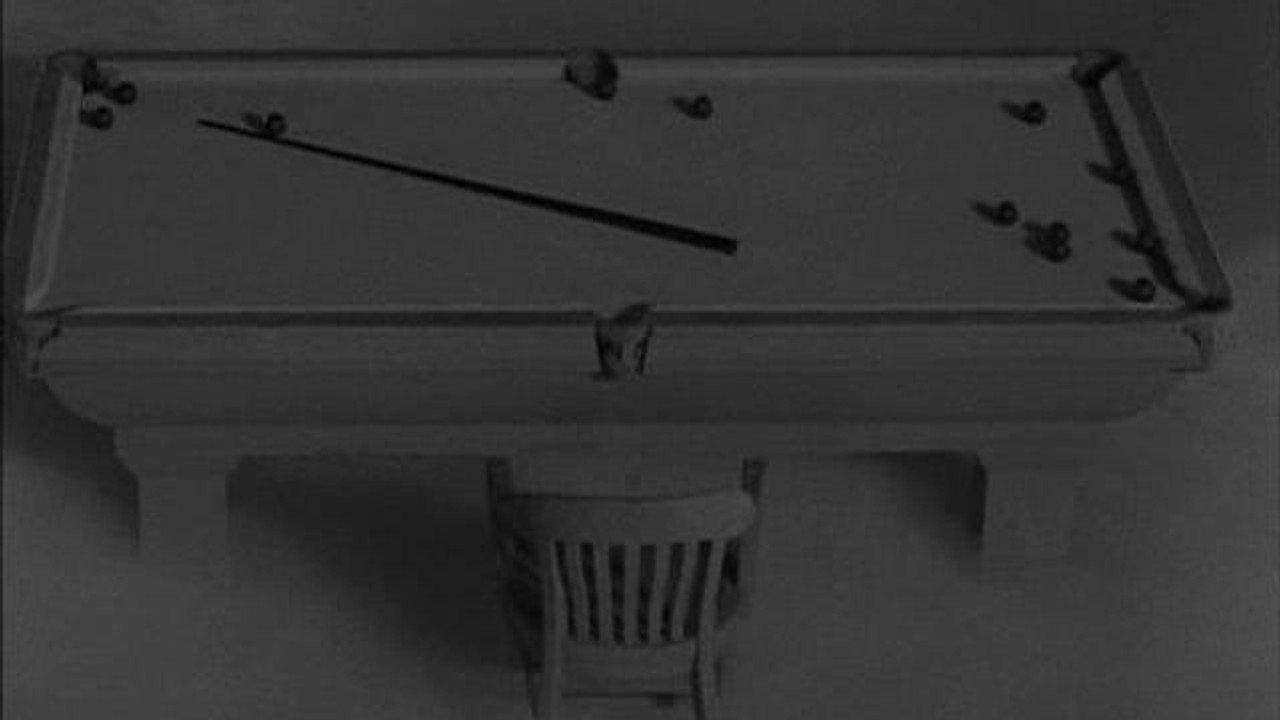
The story in 5 beats
- After hours
Alone at Lister's Pool Room, Jesse Cardiff complains that he'll never be called the best while people remember Fats Brown, and wishes he could play him.
- Fats walks in
Dead for 16 years, Fats appears, ready to play 14.1 straight pool. If Jesse wins, he's the greatest; if he loses, he dies.
- The needle
Fats needles him between shots: has Jesse ever had a life outside this room? Jesse calls it a trick to throw him off his game.
The last ballSpoiler · tap to reveal
On the final shot Fats misses and warns Jesse he may get more than he bargained for. Jesse sinks it and wins, and Fats thanks him before he vanishes.
The titleSpoiler · tap to reveal
After Jesse's own death, the challengers start calling him to pool halls to play, and he has to keep winning. Fats goes fishing.
Why it still matters
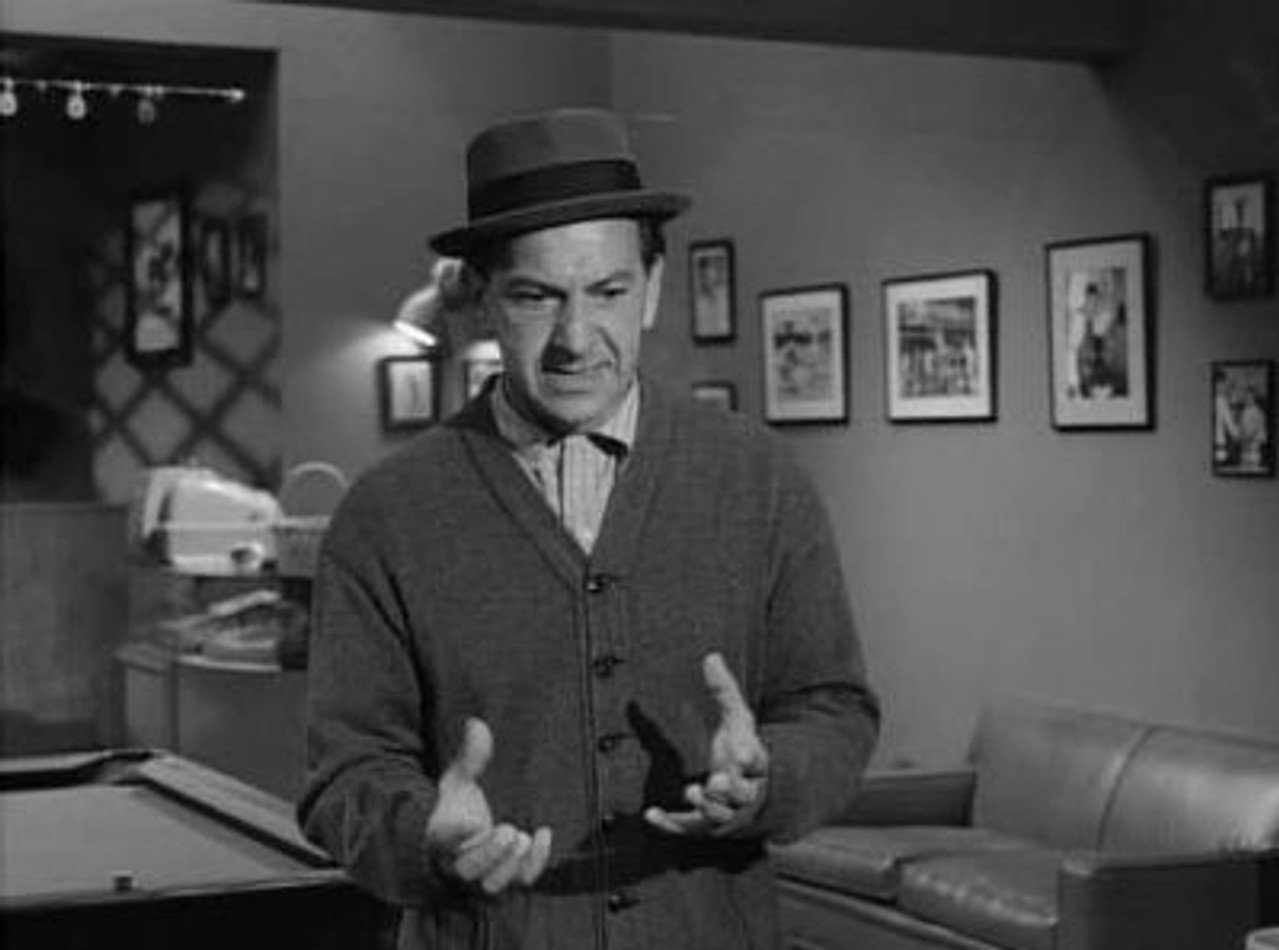
The episode is little more than two men at a pool table, and that's plenty. Jack Klugman plays Jesse Cardiff, a hustler who has given his whole life to the game and still lives in a dead man's shadow. Jonathan Winters plays James Howard "Fats" Brown, the legend himself, who turns up from the afterlife and names the stakes: win, and Jesse is the greatest who ever lived; lose, and he dies.
The joy is watching two very different performers circle each other. Klugman is all nerves and grievance. Winters, a comedian in what Kulik called his first dramatic role, is loose and amused and a little sad, a man who knows something Jesse doesn't. Director Buzz Kulik cast him on purpose to set off Klugman's intensity. The trash talk is great ("You're a big balloon, waiting for somebody to stick a needle in it"), and Zack Handlen at The A.V. Club gave it an A- for the two performances and the premise.
Serling described it as "the story of the best pool player living and the best pool player dead." It aired about a month after The Hustler opened in cinemas, so audiences in 1961 had pool sharks on the brain. George Clayton Johnson wrote it with a different ending in mind than the one that aired, and both are worth knowing.
What the champion has to do
Jesse wins, and Fats thanks him, which is the first sign that the miss on the last ball was deliberate. Being the greatest who ever lived turns out to be a job. Serling's closing narration explains that after Jesse's funeral he learned what being the best carries with it: whenever a challenger wants a game, wherever they are, he has to go and play, and keep winning, until somebody beats him. Fats, free at last, goes fishing. Handlen thought the twist didn't quite snap, thin gruel after all that passion, and it's true that the punishment arrives in narration rather than drama.
Johnson's script ended the other way. Jesse loses and lives, and Fats tells him he'll die the way all second-raters die, buried and forgotten without Fats laying a finger on him. Jesse vows to keep practicing until he can play the champion again. It's a tougher, more interesting ending. One reading is that the threat of death was a bluff to make him play his best. When the late-1980s Twilight Zone revival remade the episode, with Esai Morales as Jesse and Maury Chaykin as Fats, it used Johnson's ending.
Behind the scenes
- George Clayton Johnson wrote it. His other Twilight Zone scripts include "A Penny for Your Thoughts," "Nothing in the Dark" and "Kick the Can," and he co-wrote the novel Logan's Run.
- Buzz Kulik wanted a comedian opposite Klugman's intensity and considered Jack Warden before casting Jonathan Winters. He said it was Winters's first dramatic role and his first time on film.
- Winters felt out of his element on set, Kulik recalled. When he flubbed a line, he covered by improvising in character for 10 or 15 minutes. None of it made the final cut.
- The aired ending differs from Johnson's script, in which Jesse loses. The 1980s revival remade the episode in its 1988–89 season with Johnson's original ending.
- It aired about a month after the release of The Hustler.
- The match is straight pool, 14.1, played to 300 points.
The thread
Legends, hustlers and games played for more than money.
Came before
Shares DNA with
Remade
DNA strand
Be Careful What You Wish For
Jesse wishes for one game and gets it, then wins the thing he wanted most and finds out it has a job attached. The episode's trick is that the man granting the wish is the one person who knows what the prize costs, and he spends the whole game trying to tell him.
Every great sci-fi story is built from a handful of strands like this one. Each strand page explains how it works and traces it across shows, books and films.
If this one stayed with you
Where to go next, and why.
Watch · Film
The Hustler (1961)
A young hustler takes on the legendary Minnesota Fats in the film that was in theaters when this aired. It has the same smoke and the same obsession, for two hours.
Read · Novel
The Hustler, Walter Tevis
The novel the film came from. If Jesse's life of nothing but the table rang true, Tevis writes that hunger from the inside.
Watch · Film
The Seventh Seal (1957)
A knight plays chess with Death to buy himself time. Grander and stranger than a pool hall in Chicago, built on the same game.
Watch · The Twilight Zone
"A Nice Place to Visit"
A small-time crook suddenly can't lose at anything, which makes it a fine double bill with this one.
Sources
- “A Game of Pool (The Twilight Zone, 1959),” Wikipedia
- “A Game of Pool (The Twilight Zone, 1985),” Wikipedia
- Zack Handlen, “The Twilight Zone: "A Game Of Pool"/"The Mirror",” The A.V. Club, 2013
- “Jonathan Winters Hid His Twilight Zone Anxiety With Some Absolutely Wild Improv,” SlashFilm
- “George Clayton Johnson,” Wikipedia