
More from the episode

The story in 5 beats
- A message 200 years old
The Enterprise finds the recorder of the SS Valiant, lost two centuries ago. Its last log hints at a storm, a search for ESP records, and an order to self-destruct.
- The edge of the galaxy
Kirk takes the ship through the barrier to find out what happened. Nine crew die in the crossing, and it knocks out both Mitchell and Dr. Dehner.
- Silver eyes
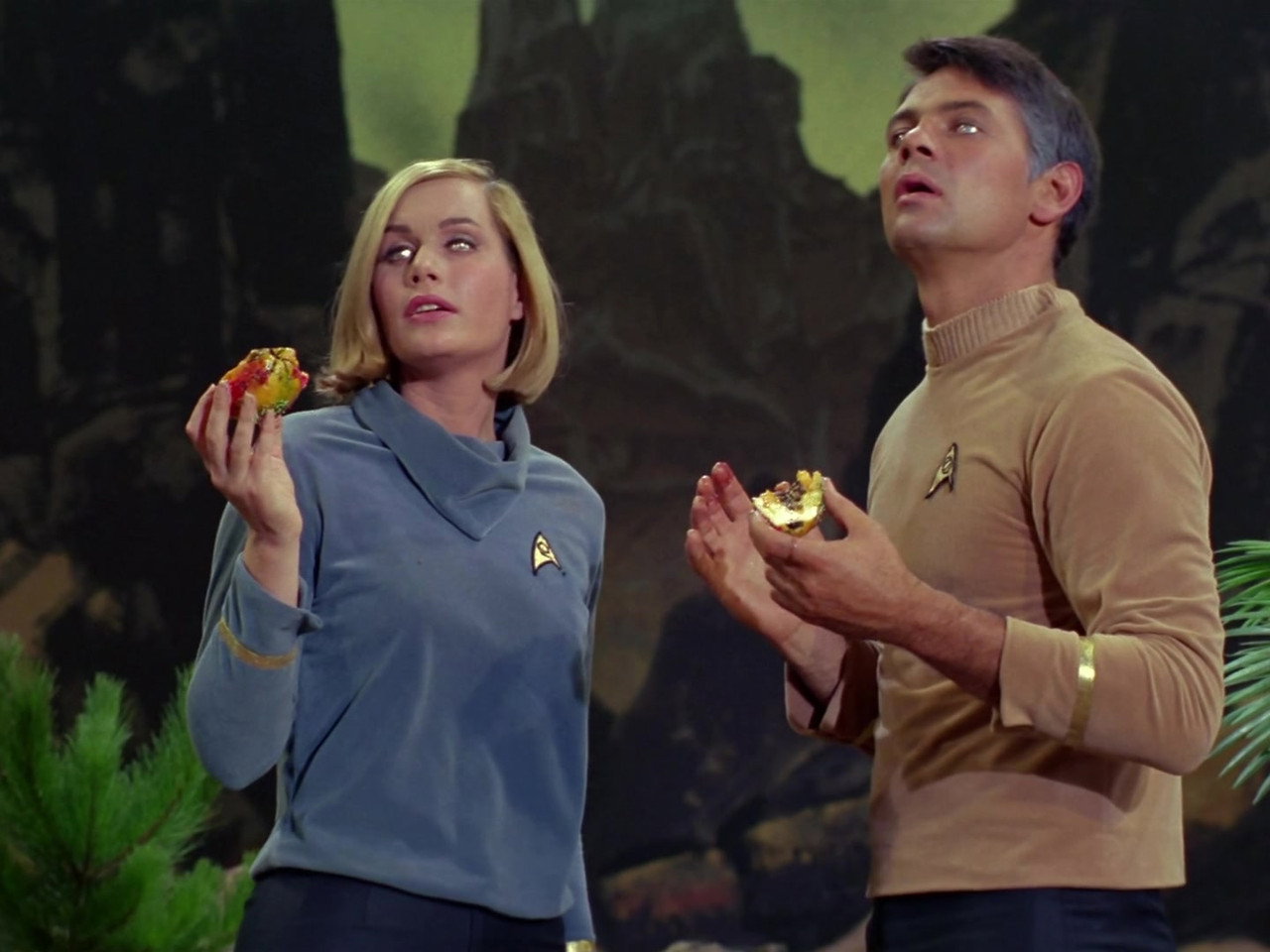
Mitchell wakes up with glowing silver eyes and new psychic powers. Each hour he's stronger, and less interested in the people around him.
Delta VegaSpoiler · tap to reveal
Kirk agrees to maroon Mitchell on a lifeless planet. Mitchell kills Kelso, escapes, and takes Dehner, who now has the same powers.
An open graveSpoiler · tap to reveal
Dehner turns on Mitchell and weakens him, dying in the attempt. Kirk brings a rockslide down on his old friend.
Why it still matters
NBC turned down the first pilot, "The Cage", as too cerebral, and then ordered a second one. This is it: the first episode filmed with William Shatner in the captain's chair, the first with James Doohan's Scotty and George Takei's Sulu, and the one with the fistfight Gene Roddenberry later said sold NBC on Star Trek. It aired third, but the series really starts here.
The story is simple. Lt. Cmdr. Gary Mitchell, the helmsman and Kirk's old friend, is hit by an energy barrier at the galaxy's edge and starts turning into something much more than human. Spock says, coolly, that they should kill him while they still can. Kirk refuses, and the whole hour runs on the gap between them.
Gary Lockwood is terrific as a man discovering he no longer has to be polite to anyone, and Sally Kellerman, years before MASH, plays the ship's psychiatrist, Dr. Dehner. Spot the rough edges: different uniforms, a different doctor, and Sulu working as the ship's physicist.
A friend who stopped being one
Spock works out what happened to the Valiant: its crew destroyed their own ship to stop someone who had been changed the same way. He wants Mitchell dead. Kirk won't do it and settles on marooning him on the planet Delta Vega instead. Mitchell is too strong by then. He kills navigator Lee Kelso, leaves Kirk and Spock on the floor, and walks into the hills with Dehner, whose eyes have turned silver too.
Kirk follows with a phaser rifle. Mitchell digs him a grave and tops it with a headstone, which is how we learn the captain's middle initial was R. in this episode. Kirk's appeal to Dehner's humanity reaches her, and she turns on Mitchell and weakens him before she dies. Kirk brings a rockslide down on Mitchell. In his log he reports that both gave their lives in performance of duty. Mitchell didn't ask for what happened to him, and Kirk wants his record to say so.
Behind the scenes
- NBC picked Samuel A. Peeples's script from three in the running for the second pilot. The others were "Mudd's Women" by Stephen Kandel and "The Omega Glory" by Roddenberry.
- Jeffrey Hunter declined to come back as Captain Pike. Lloyd Bridges and Jack Lord were considered before William Shatner was cast. NBC also pressed for Leonard Nimoy's removal, and Roddenberry kept Spock.
- James Doohan tried several accents for the engineer and decided an engineer ought to be Scottish.
- Shooting began July 19, 1965 and ended July 28 with the Kirk and Mitchell fight. A disturbed wasp nest stung much of the cast and crew, and Shatner needed extra makeup. It cost about $300,000, roughly half as much as "The Cage".
- The cinematographer was Ernest Haller, who had won an Oscar for Gone with the Wind and came out of semi-retirement for the job.
- The longer original cut, with act titles and a different opening narration by Shatner, was thought lost until a German collector found a print in 2009.
- It was the first episode of Star Trek the BBC showed in Britain, on July 12, 1969.
The thread
A second chance for a series that almost didn't happen, and a phrase that outlived it.
Came before
Shares DNA with
Left its mark on
DNA strand
Us vs. Them
The "them" here started out as one of us. Spock's logic says a man who is becoming a god is a threat to everyone, and Kirk's loyalty says he's still Gary. The episode never pretends Spock is wrong, which is why Kirk's last log entry carries so much weight.
Every great sci-fi story is built from a handful of strands like this one. Each strand page explains how it works and traces it across shows, books and films.
If this one stayed with you
Where to go next, and why.
Watch · Star Trek
"Charlie X"
Broadcast the week before, and the same problem from another angle: what do you do with someone aboard who can't be stopped, when he's barely more than a child?
Watch · Film
Akira (1988)
Two friends, one sudden surge of psychic power, and a city that pays for it. If Mitchell's slide stayed with you, this is the same arc at full volume.
Read · Novel
Slan by A. E. van Vogt
A pulp classic about telepaths hunted by the humans who fear them. Read it for the other side of Spock's argument.