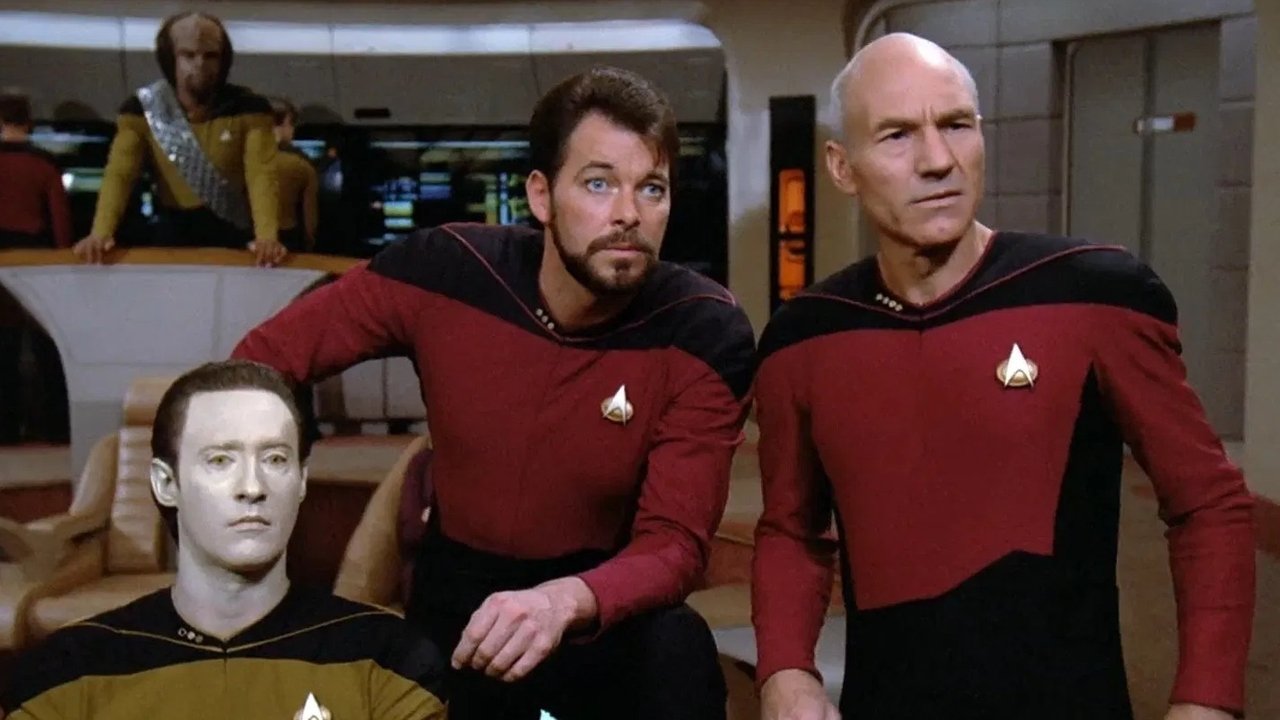
The story in 5 beats
- The hole
Exploring uncharted space, the Enterprise finds a void with no matter, energy or mass. Two probes go in and vanish, and then the darkness grows and swallows the ship.
- Ghost ship
The USS Yamato, the Enterprise's sister ship, drifts into view with no sign of life. Riker and Worf beam over and find corridors that shift around them and two bridges.
- Lab rats
Exits appear and fade before the ship can reach them. Troi and Pulaski work out what's going on: the Enterprise is someone's experiment.
NagilumSpoiler · tap to reveal
A face appears. It wants to learn about death, kills a crewman to begin, and then asks for half the crew.
Twenty minutesSpoiler · tap to reveal
Picard sets the auto-destruct rather than hand his crew over, and waits in his ready room with Satie playing.
Why it still matters
Most of this episode is a ship sitting in the dark, and it works better than it has any right to. The Enterprise flies into a hole where its sensors find no matter and no energy, and from then on nothing the crew sees can be trusted: a beacon they dropped turns up again though they've flown in a straight line, a sister ship appears drifting and empty, and exits close as they approach. It plays like a haunted-house story on a starship.
Patrick Stewart gets plenty to do as Picard, who goes from calm to furious to very quiet, and Data gets his best line of the early seasons, that the most valuable statement in science, the beginning of wisdom, is "I do not know." When the thing behind the dark finally shows itself, it's Earl Boen as a face on the viewscreen with a lot of questions about death.
It was Winrich Kolbe's first job as a director, and he went on to become one of Trek's busiest. Keith DeCandido called it claustrophobic, with its moments of tension and nastiness, which is fair. The A.V. Club saw it as a return to the original series' god-like beings.
Picard's answer
Nagilum is a being that has never encountered humans and wants to know how they work, especially how they die. It shows the crew what it means by killing Ensign Haskell, the new conn officer, and announcing it will need half of them for further study. Picard refuses. He and Riker set the auto-destruct for twenty minutes: if the crew is going to die, it won't be as lab specimens.
While the clock runs, Troi and Data come to his ready room, ask him about death, and try to talk him out of it. Picard sees that they aren't his officers at all. When he says the trick won't work, they vanish, the void vanishes, and the ship is back in normal space. He waits until he's sure before cancelling the countdown.
Nagilum gets a last word on the ready-room screen: the two species have nothing in common. Picard disagrees, since both are curious. The episode lets that hang, which is about as close as early TNG gets to admitting its own heroes went into the dark for the same reason.
Behind the scenes
- The part was apparently written for Richard Mulligan, and the character was named for him: "Nagillum" is Mulligan spelled backward. Earl Boen got the role, and the name lost an L.
- Jack B. Sowards's previous Trek credit was the script for Star Trek II: The Wrath of Khan.
- It was Winrich Kolbe's first time directing, and he became one of the franchise's most prolific directors.
- The title is borrowed from the last stanza of Robert W. Service's 1907 poem "The Spell of the Yukon."
- The episode opens with Worf's calisthenics program on the holodeck, an overgrown, abandoned industrial complex full of creatures, with Riker joining in. It has little to do with the plot, but the program comes back in "The Emissary."
- Worf's Klingon legend about a black creature that swallows starships returns in Voyager's "Bliss."
The thread
A poem for a title, a piece of piano music for a countdown, and a dark patch of space Trek kept going back to.
Came before
Shares DNA with
Left its mark on
DNA strand
Is Any of This Real?
Once the ship enters the void, every sensor reading, every escape route, even the officers who walk into Picard's ready room might be part of the test. The episode keeps the crew, and us, guessing which parts are real until Picard decides it doesn't matter and starts the countdown anyway.
Every great sci-fi story is built from a handful of strands like this one. Each strand page explains how it works and traces it across shows, books and films.
If this one stayed with you
Where to go next, and why.
Watch · Star Trek
"The Squire of Gothos"
The original series' version of a being with unlimited power and a lot of curiosity about this crew. It's sillier, and just as interested in how people behave when they're being toyed with.
Watch · Star Trek: TNG
"Where No One Has Gone Before"
If the drifting-off-the-map feeling was what you liked, this one takes the ship somewhere even stranger, where thoughts start becoming real.
Read · Poem
"The Spell of the Yukon", Robert W. Service
Where the title comes from. Read to the last stanza and you'll see why a story about an empty, silent place borrowed it.