More from the episode

The story in 5 beats
- The Botany Bay
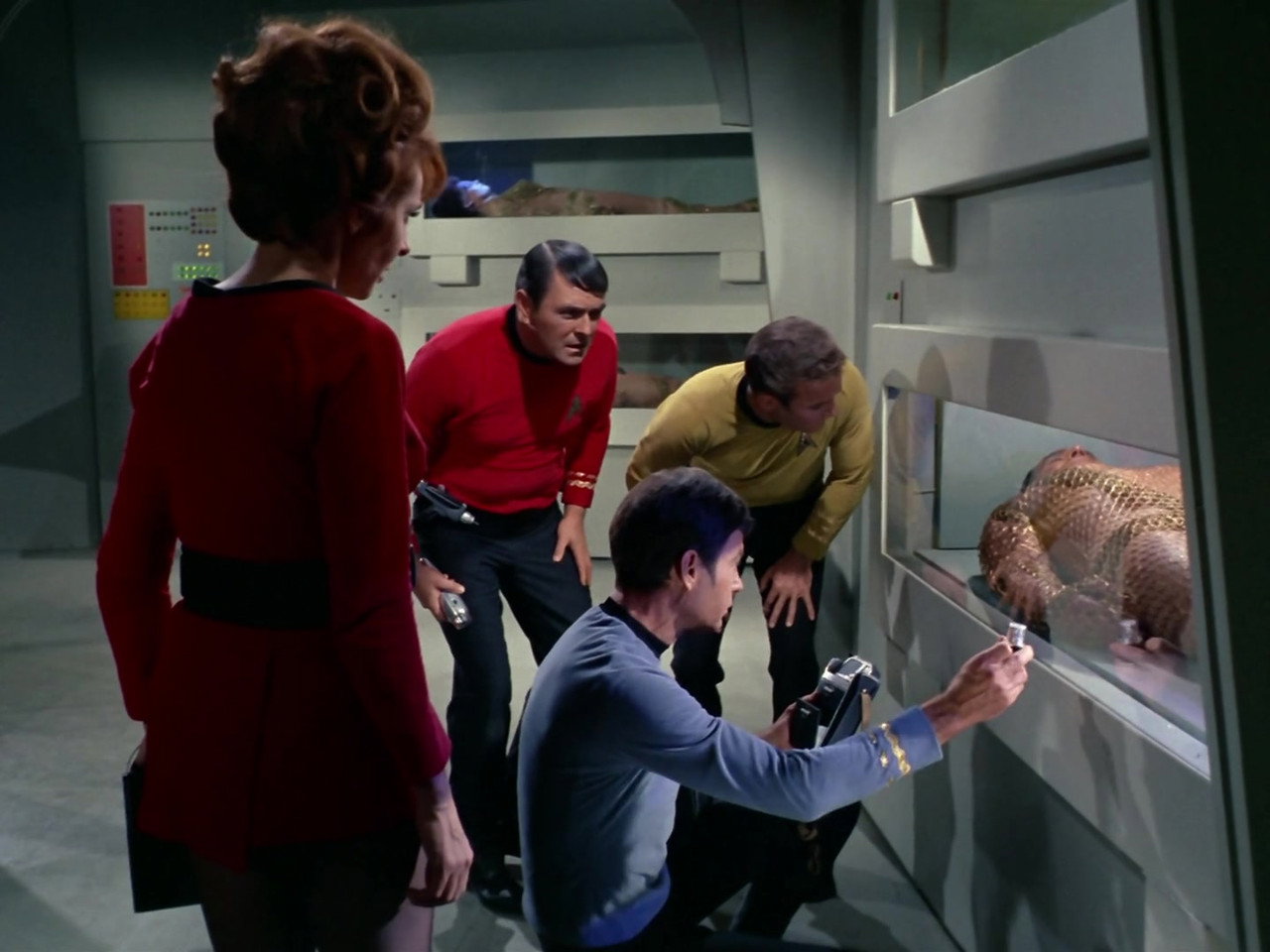
The Enterprise finds a twentieth-century ship adrift, its passengers asleep in suspended animation. Their leader is brought aboard for treatment.
- A name from history
Spock identifies the leader as Khan Noonien Singh, one of the engineered men who ruled much of Earth in the Eugenics Wars of the 1990s.
- Lieutenant McGivers
Khan charms the ship's historian, Lt. Marla McGivers, and she agrees to help him.
The ship changes handsSpoiler · tap to reveal
Khan revives his people and seizes the Enterprise, then puts Kirk in a decompression chamber to force the crew to submit.
ExileSpoiler · tap to reveal
McGivers frees Kirk, Khan is beaten, and Kirk offers him a hard, empty planet to tame instead of a prison.
Why it still matters
This is the one that gave Star Trek its best villain, though nobody knew it in 1967. Ricardo Montalbán plays Khan Noonien Singh, a man bred to be better than everyone else, and he plays him as a guest who has decided he owns the house: polite, amused and plainly sizing up Kirk from the first scene. Montalbán was the casting director's first choice, and you can see why.
The swagger sits on top of a real idea. The episode imagines that the late twentieth century produced a generation of engineered supermen who took over a chunk of the planet, and asks what you do with one when he wakes up in your sickbay. Khan works as a dark mirror of Kirk, a commander with all of Kirk's nerve and none of his limits.
It's also a good Scotty episode, the first to give James Doohan a proper share of the action. Watch it before The Wrath of Khan and the film lands twice as hard.
Better to reign
McGivers can't watch Kirk die, and she pulls him out of the chamber. Kirk and Spock flood the decks with anesthetic gas. Khan shakes it off and heads for Engineering to destroy the ship, and Kirk meets him there and knocks him out.
At the hearing, Kirk surprises everyone. He offers Khan and his people a choice: a penal colony, or exile on Ceti Alpha V, a harsh world they'd have to build from nothing. Khan takes the world, and invokes Milton's Paradise Lost to explain why ruling in hell beats serving anywhere else. McGivers goes with him rather than face a court-martial, and Spock wonders aloud what Khan will have made of the place in a hundred years, a question Star Trek II took up fifteen years later.
Behind the scenes
- Carey Wilber built the story on an idea he'd used on the 1950s show Captain Video and His Video Rangers: ancient Greeks with mythological powers waking up in space. For Star Trek he swapped the powers for genetic engineering.
- The villain went through several versions, including a Nordic space pirate, before Montalbán was cast. Gene Roddenberry picked the name Noonien partly because he hoped an old friend, Noonien Wang, would see it and get in touch.
- Montalbán and Madlyn Rhue had already played lovers on Bonanza. When Paramount wanted Rhue back for The Wrath of Khan, she had been diagnosed with multiple sclerosis, and McGivers was written out.
- Khan needed five costumes, more than any other guest character in the series, and William Ware Theiss had so little time that two of them reused earlier outfits.
- Roddenberry asked to be listed as the main writer. The Writers Guild said no, so Gene L. Coon got the main credit and Wilber the story credit.
- Matt Jefferies designed the Botany Bay, and the model and effects pushed the episode over budget, to $197,262 against a planned $180,000. The model came back a year later as the ore freighter Woden in "The Ultimate Computer".
The thread
A frozen conqueror, borrowed from a 1950s kids' show and a 1667 poem, who became the villain the franchise kept coming back to.
Came before
Shares DNA with
Left its mark on
DNA strand
Technology Outpaces Ethics
The science here is selective breeding, and the episode treats it as something humanity already tried and barely survived. Khan is what happens when you can build a better human but can't build one who wants to share power. The unsettling bit is how much Kirk, and the audience, enjoy his company.
Every great sci-fi story is built from a handful of strands like this one. Each strand page explains how it works and traces it across shows, books and films.
If this one stayed with you
Where to go next, and why.
Watch · Film
Star Trek II: The Wrath of Khan (1982)
The obvious next step and the best reason to see this episode first. Khan has had a long time to think about Kirk's offer.
Watch · Film
Gattaca (1997)
The same question from the other side: a world built around engineered people, seen by a man who wasn't one of them.
Read · Poem
Paradise Lost — John Milton
If Khan's last speech made you curious, Satan's first books are where it comes from, and he's every bit as persuasive.
Read · Novel
Brave New World — Aldous Huxley
A society that designs people for their roles, and how calm and reasonable it sounds from the inside.