The story in 5 beats
- Cyrano, badly
Barclay rehearses Cyrano de Bergerac with Crusher and can barely get his lines out. Then he and Geordi take a shuttle to inspect the Argus Array.
- The probe
An alien probe near the Array flashes the shuttle and knocks Barclay out. It follows the Enterprise and has to be destroyed.
- A night with Einstein
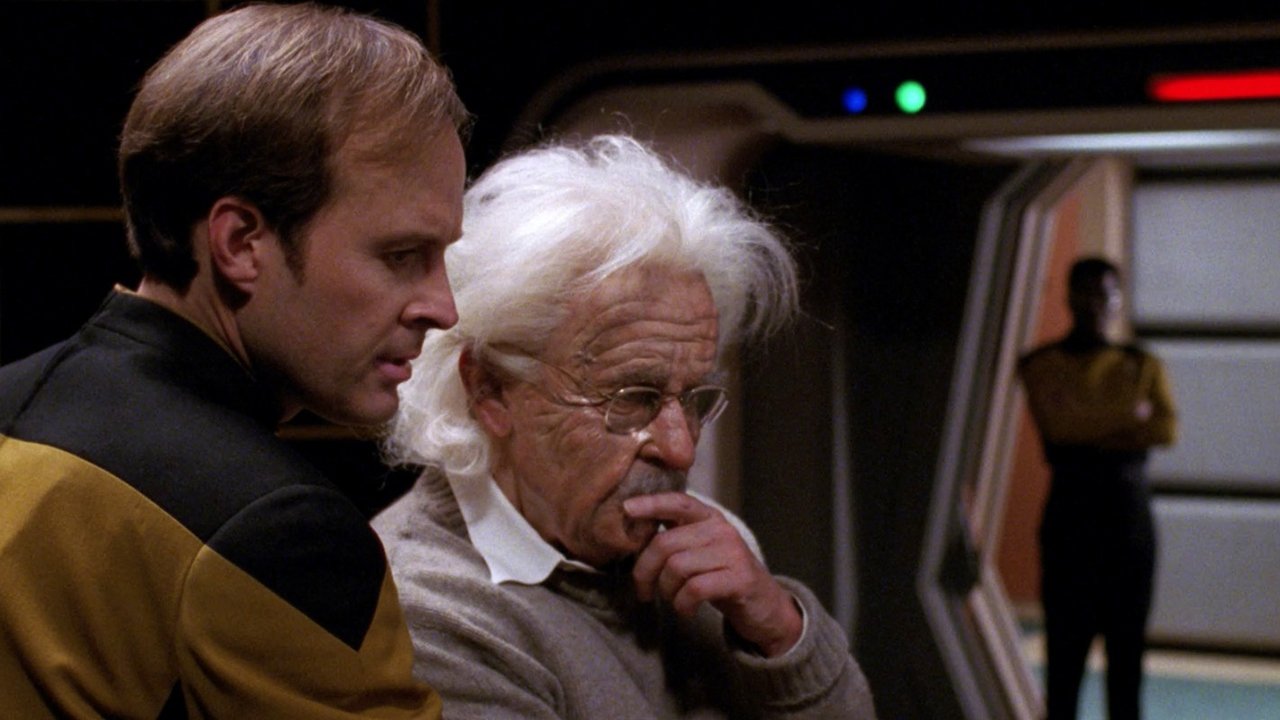
Barclay wakes up brilliant. Geordi finds he spent the night on the holodeck debating physics with Albert Einstein, and his Cyrano is suddenly superb.
Plugged inSpoiler · tap to reveal
Barclay builds a holodeck link that wires his mind into the ship's computer. When the crew tries to shut it down, he takes control.
The galactic centerSpoiler · tap to reveal
Barclay flings the Enterprise to the middle of the galaxy, where the people who sent the probe are waiting to say hello.
Why it still matters
Lieutenant Reginald Barclay first turned up in "Hollow Pursuits" as a shy engineer who hid from his crewmates on the holodeck. Here he's back, stammering his way through a rehearsal of Cyrano de Bergerac with Dr. Crusher, when a probe at the Argus Array knocks him out. He wakes up confident and brilliant, and he keeps getting smarter.
Plenty of stories have done the sudden-genius idea, and The A.V. Club's Zack Handlen called this one a Flowers for Algernon riff. What makes it fun is watching the crew deal with it: a calm, procedural debate over whether a crewmate who hasn't done anything wrong is now a danger, and Geordi's quiet irritation at his engineer outthinking him. Dwight Schultz plays both versions of Barclay well enough that you believe they're the same man.
Reviewers rate it highly: Keith R.A. DeCandido's Tor.com rewatch gave it an 8 out of 10.
An invitation, delivered by Barclay
Once he's merged with the computer, Barclay uses the warp engines to open a subspace field and throws the Enterprise some 30,000 light-years to the center of the galaxy, far faster than any ship should go. There the crew meets the Cytherians, a far more advanced civilization represented by a huge, floating head. They don't travel themselves. They send probes that reshape whoever finds them, so the visitors come to the Cytherians instead.
Barclay turns out to have been the Cytherians' delivery method all along. They release him from the computer, he goes back to his old self with his memories intact, and the Enterprise spends ten days trading knowledge before heading home. Den of Geek's James Hunt liked how gently the episode lands; Handlen found the same ending too free of consequences.
Behind the scenes
- Robert Legato directed, and he also oversaw the show's visual effects. He made the Cytherian's giant head appear to project out of the viewscreen so it could talk to Picard face to face.
- Earlier drafts made the Cytherians more menacing. The writers pulled back partly because a giant head at the galactic center already sounded like Star Trek V, and Ronald D. Moore said that was "the absolute last thing that we wanted to remind anyone of."
- Kay E. Kuter plays the Cytherian. He later took the title role in Deep Space Nine's "The Storyteller."
- David Coburn, the voice of Captain Planet, has a small part as Ensign Brower.
- Crusher's sideline as the ship's drama teacher comes back in "Disaster," "A Fistful of Datas" and "Frame of Mind."
- The Argus Array returns in "Parallels."
The thread
A shy man made briefly brilliant, a borrowed love scene from Cyrano, and a second trip to the middle of the galaxy.
Came before
Shares DNA with
Where it went next
DNA strand
Memory & Identity
The question under the technobabble is whether genius Barclay is still Barclay. He's bolder and kinder to himself, and the crew can't decide if he's grown or been replaced. At the end he keeps his memories and loses the rest, and the episode lets him decide what that's worth.
Every great sci-fi story is built from a handful of strands like this one. Each strand page explains how it works and traces it across shows, books and films.
If this one stayed with you
Where to go next, and why.
Read · Short story
Flowers for Algernon by Daniel Keyes
The story this episode keeps nodding at: an experiment makes a man brilliant, and he narrates what that does to him.
Watch · Star Trek: TNG S3
"Hollow Pursuits" (1990)
If you want to see where Barclay started, here he is hiding in holodeck fantasies before anyone on the crew takes him seriously.
Watch · Film
Limitless (2011)
A slicker, louder version of the same wish: a stuck man becomes the smartest person in every room, and has to deal with what comes with it.
Read · Play
Cyrano de Bergerac by Edmond Rostand
If Barclay's second, brilliant performance got you, read the whole thing. It's a play about a man who can only say what he feels through someone else.
Sources
- “The Nth Degree (Star Trek: The Next Generation),” Wikipedia
- Keith R.A. DeCandido, “Star Trek: The Next Generation Rewatch: "The Nth Degree",” Reactor
- Zack Handlen, “Star Trek: The Next Generation: "Identity Crisis"/"The Nth Degree",” The A.V. Club
- James Hunt, “Revisiting Star Trek TNG: The Nth Degree,” Den of Geek