The story in 5 beats
- Paradise
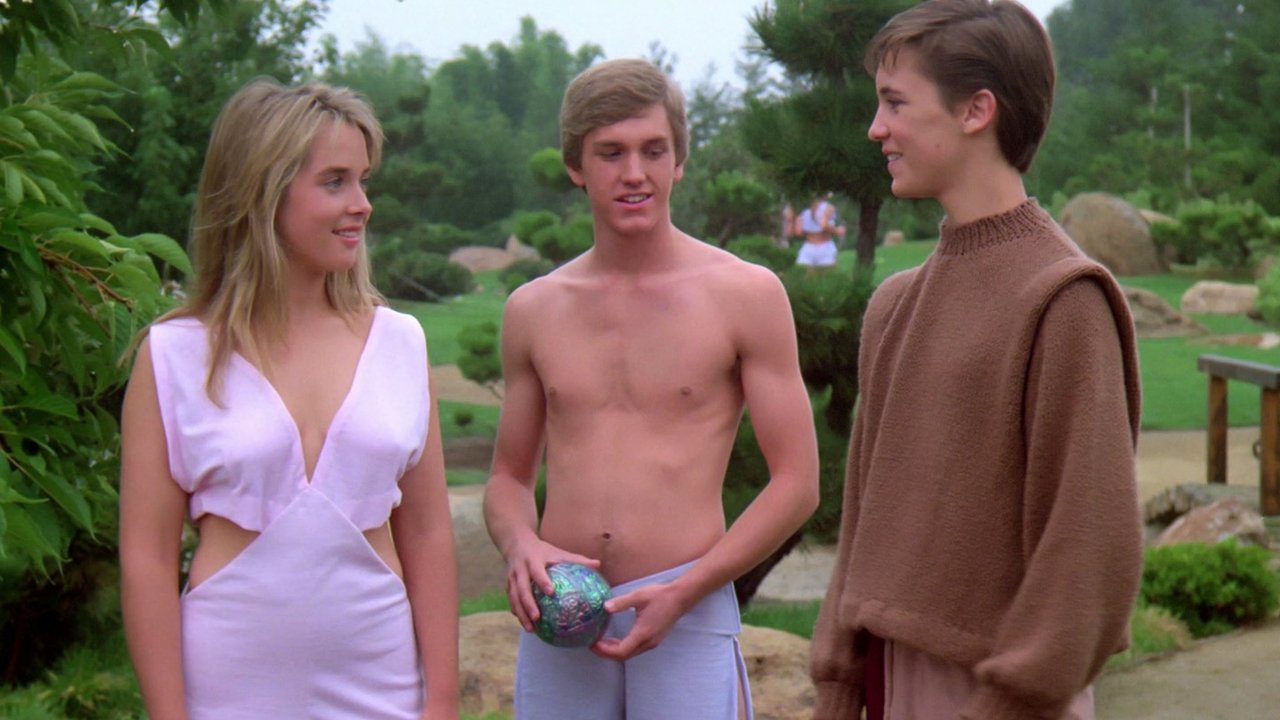
The Enterprise arrives at Rubicun III for shore leave. The Edo are friendly, fit and very affectionate.
- Something in orbit
Data spots an object in orbit that's only partly there. A ball of light appears on the bridge and warns Picard not to interfere with its "children."
- One wrong step
Playing ball with Edo teenagers, Wesley crashes into a greenhouse inside a punishment zone. A mediator moves to execute him.
God says noSpoiler · tap to reveal
Picard brings an Edo woman aboard to identify the being in orbit. It threatens the ship until she is returned.
No exceptionsSpoiler · tap to reveal
Picard orders Wesley beamed up anyway. The entity blocks the transporter, and Picard has to argue his case to a god.
Why it still matters
The Enterprise finds Rubicun III, a newly discovered world whose people, the Edo, are tanned, athletic, scantily dressed and extremely welcoming. It looks like perfect shore leave. Wesley Crusher goes down with the away team and wanders off to play with the local teenagers, and that's when the catch appears. The Edo keep their peace by marking out punishment zones, and anyone caught breaking the law in one is put to death.
Underneath the silliness, and there's a lot of it, this is a real moral puzzle. Picard is bound by the Prime Directive not to interfere with another culture's laws, and here those laws want to kill a boy he is responsible for. Above the planet floats something the Edo worship as God, and it has made clear it will protect them. Picard's answer, when Data points out that one life might be weighed against many, is one of the best lines of the first season: "I refuse to let arithmetic decide questions like that."
It was also TNG's first real trip out on location: the Edo village is a Japanese garden in Van Nuys.
Arguing with a god
The thing in orbit is the Edo's god in every way that counts: Data describes it as a collective being existing in several dimensions at once, acting as the Edo's caretaker. When Picard decides to risk its anger and beam Wesley up, it simply stops the transporter and repeats its threat. If the Enterprise wants to interfere with Edo law, the ship can share Wesley's fate.
Picard's defence is the point of the episode. He argues that there can be no justice when laws are absolute, and that any law worth keeping has to allow exceptions. The entity relents, the transporter works again and the away team comes home. As the ship leaves, Picard offers to move some colonists recently settled in a nearby system the entity claims. It declines, tells him to stay away from the Edo, and vanishes.
Behind the scenes
- John D. F. Black's original pitch was a story about capital punishment. After Roddenberry and Worley Thorne reworked it, adding the godlike entity and making the Edo sexier, Black took his credit under the pseudonym Ralph Wills.
- It was the first TNG episode filmed mostly on location. The village is the Japanese Garden at the Tillman Water Reclamation Plant in Van Nuys, used again in "The First Duty" and on Deep Space Nine.
- Planes from Van Nuys Airport were so loud that the actors re-recorded their lines in the studio.
- Wesley's crash into the greenhouse was filmed on the grounds of the Huntington Library in San Marino, California.
- Director James L. Conway came to it straight from the MacGyver episode "Jack in the Box."
- Josh Clark, who plays the conn officer, later played Lt. Joe Carey on Star Trek: Voyager.
- Keith R.A. DeCandido at Tor.com called the Edo "caricatures, and Eurocentrically offensive ones at that."
The thread
A perfect society, an absolute law, and the visitors who can't accept it.
Came before
Shares DNA with
DNA strand
The State Knows Best
The Edo don't seem oppressed. They're happy, and their god keeps the peace. The episode's question is what that order costs, and Picard's answer is that a law with no room for mercy isn't justice at all.
Every great sci-fi story is built from a handful of strands like this one. Each strand page explains how it works and traces it across shows, books and films.
If this one stayed with you
Where to go next, and why.
Read · Short story
"The Ones Who Walk Away from Omelas" — Ursula K. Le Guin
If Picard's line about arithmetic stuck with you, this short story asks the same question with no starship to beam anyone out.
Watch · Star Trek
"The Apple"
The original series' take on a beautiful planet whose people answer to an all-powerful guardian.
Watch · Black Mirror
"Nosedive"
Another society that looks lovely from the outside and has no patience for one mistake.