The story in 5 beats
- Kor's shroud
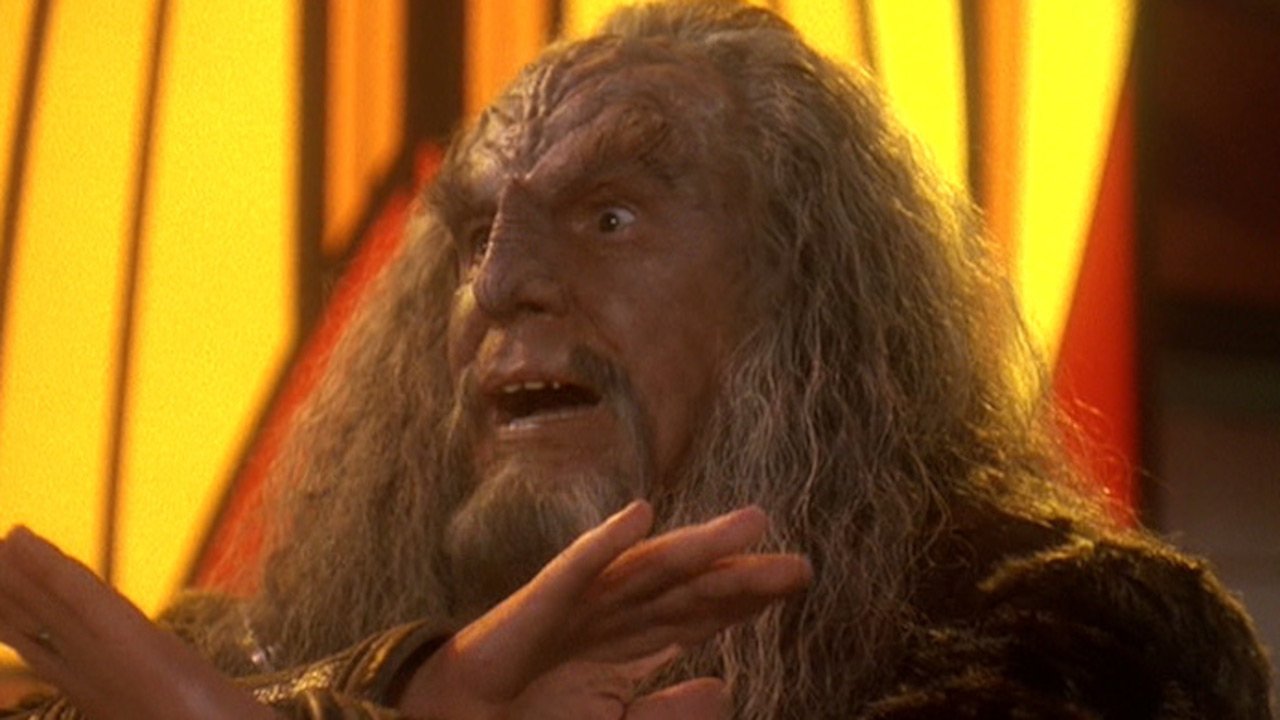
Kor is telling war stories in Quark's when Dax introduces him to Worf. He has a shroud he believes once held the Sword of Kahless, lost for centuries.
- A thief in his head
A Lethean attacks Kor in his quarters and reads his mind for the sword. Dax confirms the shroud is genuine, and the three take a runabout to the Gamma Quadrant.
- The vault
Under the planet's surface they find a hidden chamber and the sword. Then Toral, son of Duras, who hired the Lethean, attacks. They can't beam out, so they flee into the caves.
Two would-be emperorsSpoiler · tap to reveal
Kor talks about using the sword to overthrow Chancellor Gowron. Worf thinks he should be the one to lead. Then Kor slips over a cliff edge and will not let go of the sword.
The sword's fateSpoiler · tap to reveal
Dax helps Worf haul Kor back and keeps the sword herself. When Toral is subdued and the two Klingons go for each other again, she stuns them both with her phaser.
Why it still matters
Michael Dorn joined Deep Space Nine at the start of its fourth season, but the first eight episodes had been scripted before his casting was confirmed. This was the first one written after he arrived, according to the Deep Space Nine Companion, which makes it the first to put Worf at the center. It was directed by LeVar Burton, Geordi La Forge on The Next Generation, who directed 28 Star Trek episodes in all.
Burton described it as the Klingon version of a search for the Holy Grail. Hans Beimler, who turned Richard Danus's story into the teleplay, was careful not to give the sword any magic. "It's the concept of the sword that has the power," he said. "We could have said that some technology or magic gave the Klingons the feeling of power, but that would have been a cheap way to go." Whatever the sword does to the people around it, it does through what it means to them. Many fans wanted a technical explanation anyway, which disappointed the writers.
The rewatch reviews were kinder. Keith DeCandido of Tor.com gave it 8 out of 10 and called it "a strong story that understands the power of, well, strong stories." Zack Handlen of The A.V. Club likened the plot to The Treasure of the Sierra Madre, and Michelle Erica Green of TrekNation found it "admirable for a drama that takes place mostly walking through uninteresting cave sets."
Until the Empire is ready
Dax forces Toral to let the three of them get back to their ship. Once they're away from the planet, Kor and Worf work it out for themselves: if the sword could set two men as honorable as they are against each other, it would do the same to the whole Empire. They beam it into space and leave it to drift until the Klingons are ready for it.
That ending is Beimler's point made literal. The blade never changed anyone; the idea of it did, and the only cure was to send the idea away. Michelle Erica Green would rather Toral had stolen it at the last minute, so a later episode could pick the story up. The writers chose to let the legend float off.
Challenge the DNA
Were Worf and Kor right to give up the sword?
Or skip ahead to our reading
They were right, and it's a mature ending. The sword turns honourable men against each other. Letting it drift is the wise choice.
Behind the scenes
- Richard Danus had been executive story editor on the third season of The Next Generation when Ira Steven Behr joined that show's staff. He wrote "Deja Q" and co-wrote the teleplay for "Booby Trap," and the two became friends; it was Behr who gave him the chance to write for Deep Space Nine.
- Short on shooting time, Beimler cut some cave scenes that would have taken too long to set up. Kor, Worf and Dax are in almost every scene, so the crew couldn't save time by filming two at once. The caves were the standing sets on Paramount's Stage 18; Burton and director of photography Jonathan West used their depth to suggest a bigger labyrinth, and sand on the floor made them look different from earlier episodes.
- The sword had to look grander than an ordinary bat'leth. After John Eaves drew several designs, Dan Curry, who created the bat'leth on The Next Generation, made a new prop in hardened aluminium. Sculptor Dragon Dronet etched the blade by hand with dental tools, mixing the Damascus-steel pattern the producers asked for with his own idea of a topographic map, "as if you're staring down at mountains." He also made the stand, from Plexiglas painted to look like metal, with legs carved as targ feet.
- Burton coached Terry Farrell on how aggressive Dax should be with the two Klingons, a style the pair later nicknamed "Action Barbie."
- Composer David Bell borrowed from Richard Wagner: "Wagner opera vocabulary in the orchestrations, and... actually used Wagner tubas in the score." He gave the sword religious tones, saying, "If the audience isn't made to understand the spiritual importance of that weapon, then we have no episode."
- It drew a Nielsen rating of 6.9, tenth in its timeslot, according to TrekNation's figures.
The thread
An old Klingon from the 1960s, the legend of the Empire's founder, and the oldest story there is about treasure turning friends on each other.
Came before
Shares DNA with
DNA strand
Be Careful What You Wish For
Kor and Worf both want the sword more than anything, and the moment they have it, it starts to eat at them. The episode keeps the sword ordinary on purpose, so the only thing doing the damage is how much they wanted it.
Every great sci-fi story is built from a handful of strands like this one. Each strand page explains how it works and traces it across shows, books and films.
If this one stayed with you
Where to go next, and why.
Watch · Film
The Treasure of the Sierra Madre (1948)
John Huston's prospectors strike gold and then can't trust each other. It's the story Handlen saw under this one, with the cave swapped for a Mexican mountain.
Watch · Star Trek: TNG S6
"Rightful Heir" (1993)
Worf goes looking for a sign from Kahless and finds more than he bargained for. It's the other half of his relationship with the legend.
Watch · Star Trek: DS9 S2
"Blood Oath" (1994)
Kor's first trip to the station, with Koloth and Kang, and the oath that explains why Dax is so fond of him.
Read · Novel
The Treasure of the Sierra Madre by B. Traven
The 1927 novel John Huston adapted, for anyone who wants the gold-and-greed story at full length, in its original form.
Your next episode
Three directions to go from here, all on Sci-Fi DNA.
More of this feeling
Blood Oath
Star Trek: Deep Space Nine
Kor and Dax on another Klingon quest.
Same question, different answer
Rightful Heir
Star Trek: The Next Generation
What does a symbol mean to a people who need one?
Something completely different
Our Man Bashir
Star Trek: Deep Space Nine
Bashir plays a secret agent in the holosuite.
Sources
- “The Sword of Kahless,” Wikipedia
- “List of Star Trek: Deep Space Nine episodes,” Wikipedia
- “Star Trek: Deep Space Nine Rewatch: "The Sword of Kahless" (Keith R. A. DeCandido, 2014),” Tor.com
- “Star Trek: Deep Space Nine: "Little Green Men"/"The Sword Of Kahless" (Zack Handlen, 2013),” The A.V. Club
- “Retro Review: The Sword of Kahless (Michelle Erica Green, 2013),” TrekNation
- “The Treasure of the Sierra Madre,” Wikipedia