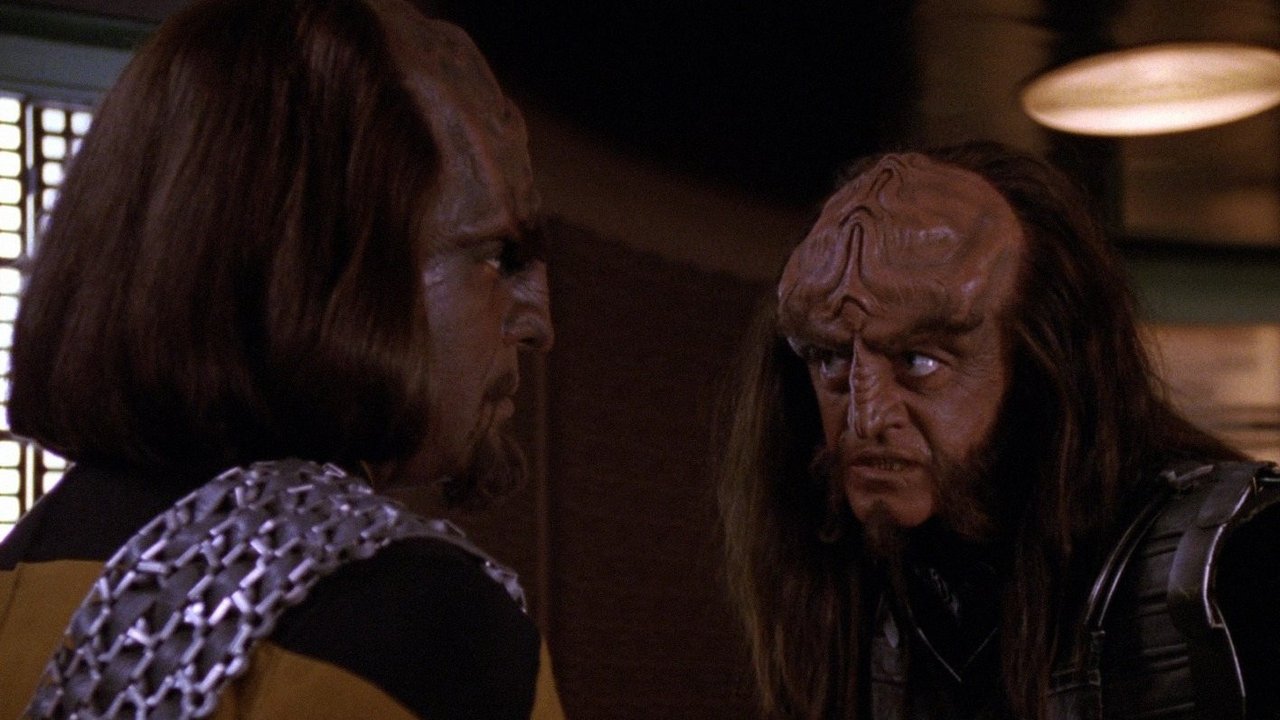
The story in 5 beats
- The installation
The Enterprise heads to the Klingon homeworld, where Picard, as Arbiter of Succession, is to install Gowron as head of the High Council.
- Gowron's fear
Gowron warns that the House of Duras, led by Lursa and B'Etor, is gathering support and could start a civil war.
- Worf and Kurn
Worf persuades his brother Kurn, who commands a ship, to back Gowron when the moment comes, in return for their family's honor.
A challengerSpoiler · tap to reveal
The Duras sisters present Toral, Duras's son, as a rival claimant. Picard must rule, and the sisters try tea and charm on him first.
Worf's choiceSpoiler · tap to reveal
Gowron becomes chancellor, the Empire splits, and Worf resigns from Starfleet to fight. In the shadows, a Romulan steps forward.
Why it still matters
TNG's 100th episode is a Klingon political drama: great houses, a contested succession, a council that can be bought, and Worf caught between his uniform and his blood. Ronald D. Moore, by then the staff's "Klingon guy," said he set out to show how power struggles over leadership would really work, and later called the whole run of Klingon stories world-building he hadn't planned.
It picks up the thread of "Sins of the Father," which left Worf's family name in disgrace. This time Picard is the Arbiter of Succession, bound to rule fairly, while Worf has every reason to want one outcome. The Duras sisters, Lursa and B'Etor, make their play for power here; Time later ranked them among Star Trek's best villains.
Moore said the story was first meant to close season three, before "The Best of Both Worlds" took that slot, and that Gene Roddenberry was against it at first because he thought the show was about Picard, not Worf. A year later it closed season four instead, on a cliffhanger.
To be continued
Picard accepts that Toral is Duras's son but rules that the boy has earned no standing of his own, so Gowron's claim stands. Many of Toral's supporters walk out. Gowron is installed and restores the honor of Worf's house.
Gowron then asks the Federation for help, and Picard refuses: it is a Klingon civil war. Worf argues that a Duras victory would hand the Empire to the Romulans, and when Picard still won't move, he resigns his commission to serve on Gowron's ship. Picard sends him off with an honor guard.
The last scene belongs to the Duras sisters, reporting to the Romulans who have been backing them all along. Their shadowy contact steps into the light, and she has the face of Tasha Yar, played again by Denise Crosby. Then the screen reads "To be continued," and viewers had the summer to work out how that could be.
Behind the scenes
- Moore said Michael Piller came up with the idea of the Duras sisters as the power behind the grab for the throne. Moore wrote them, and later brought them into his script for Star Trek Generations.
- Early on, Piller asked Moore to write a memo on the Klingons. Moore named John M. Ford's novel The Final Reflection among his inspirations.
- Moore created the Romulan character played by Denise Crosby and set her up in "The Mind's Eye" as a shadowy figure in the conspiracy.
- Asked about comparisons with Game of Thrones, Moore said he hadn't thought of it, but that serialized world-building like this was rare on a syndicated show.
- Variety ranked it the seventh-best TNG episode, and The Hollywood Reporter put it in its top 25.
The thread
The Klingon saga that led here, the novel that shaped its Klingons, and the civil war it set loose.
Came before
Shares DNA with
Where it led
DNA strand
Us vs. Them
Worf has spent four seasons as the Klingon among humans. Here the Empire splits, and he has to pick a side in a war his own captain won't touch, which means choosing between his two families.
Every great sci-fi story is built from a handful of strands like this one. Each strand page explains how it works and traces it across shows, books and films.
If this one stayed with you
Where to go next, and why.
Watch · Star Trek: TNG S3
"Sins of the Father" (1990)
If you came in cold, start here: it's where Worf takes on the dishonor this episode is trying to undo.
Read · Novel
The Final Reflection by John M. Ford
A Star Trek novel told from inside the Klingon Empire, and one of the books Moore drew on. If the politics here hooked you, it goes much deeper.
Watch · TV series
Game of Thrones (2011)
Houses, heirs and a contested throne, at much greater length. You'll recognize the shape.
Sources
- “Redemption (Star Trek: The Next Generation),” Wikipedia
- “Star Trek: The Next Generation season 4,” Wikipedia
- Keith R.A. DeCandido, “Star Trek: The Next Generation Rewatch: "Redemption" (Part 1),” Reactor, 2012
- Phil Pirrello, “Star Trek's Ron Moore reveals how he pulled a 'Game of Thrones' with a classic Klingon 'TNG' episode,” SYFY WIRE, 2021