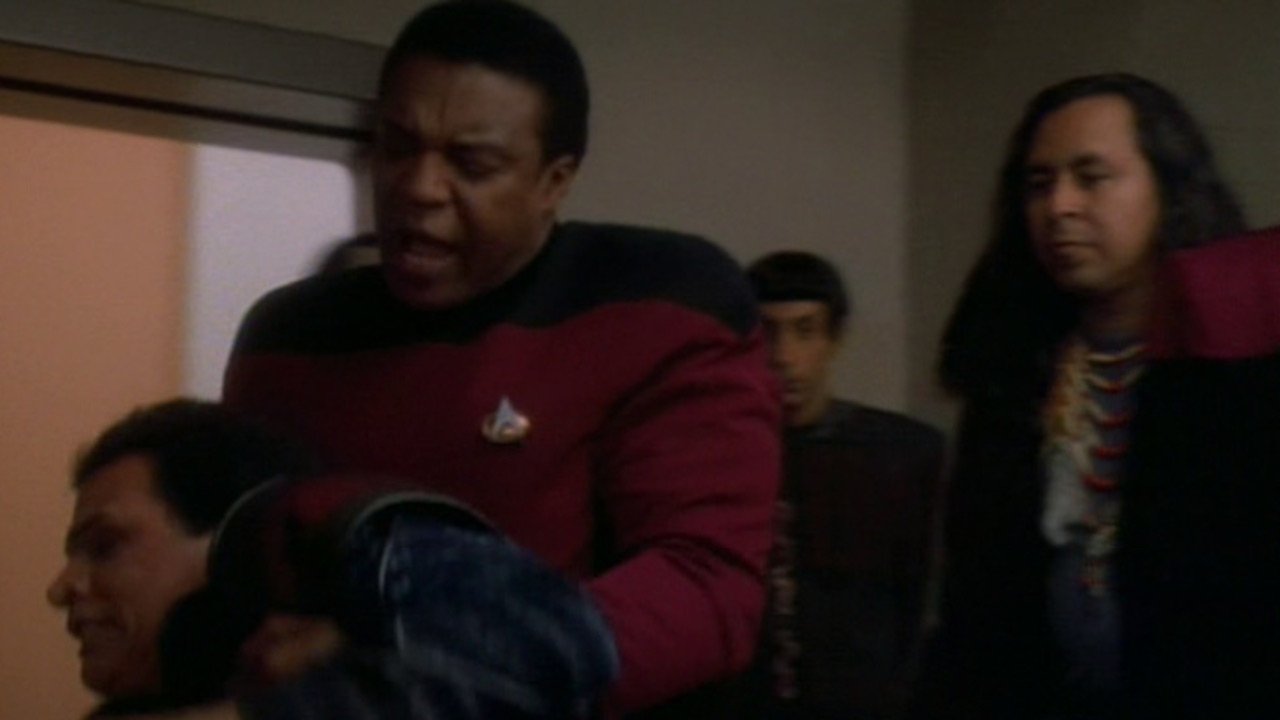
The story in 5 beats
- The Bok'Nor
A man in a Starfleet uniform tampers with equipment near a docked Cardassian transport. Soon after it leaves the station, it explodes with everyone aboard.
- An old friend
Starfleet sends Cal Hudson to help. In private he tells Sisko the Federation has left the border colonists to the Cardassians.
- Dukat, unofficially
Dukat is waiting in Sisko's quarters. On a runabout trip to the zone they see Cardassian ships attack a freighter, then an unknown Federation ship destroy them.
A confessionSpoiler · tap to reveal
Gul Evek plays the saboteur's recorded confession for angry colonists, then produces his body. Meanwhile a Vulcan named Sakonna asks Quark for weapons.
The BadlandsSpoiler · tap to reveal
Dukat is snatched from his guarded quarters by a group calling itself the Maquis. Sisko tracks them to the Badlands and finds Hudson in charge.
Why it still matters
This is where the Maquis come from. The treaty in TNG's "Journey's End" a few weeks earlier left Federation colonists living on the wrong side of a new border with Cardassia, and this two-parter asks what happens when those people stop waiting for Starfleet to protect them. The producers built the group with a third series in mind: Jeri Taylor said they knew they wanted "a renegade element" in Voyager, a ship carrying both Starfleet officers and the freedom fighters the Federation called outlaws. They named them after the French guerrillas of the Second World War.
Inside Deep Space Nine it's just as important. The writers wanted people who were different from Starfleet, and the episode hands their case to someone Sisko can't wave off: Cal Hudson, an old friend of his and of Dax's, now the Federation's attaché to the new demilitarized zone. Hudson thinks Starfleet has abandoned the colonists and is naive to trust the Cardassians, and the episode doesn't ask you to dismiss him either.
The other half of the fun is Sisko and Dukat sharing a runabout. Dukat comes "unofficially," without his government's knowledge, offering help nobody asked for, and Marc Alaimo plays every line as if he might mean it. Zack Handlen at The A.V. Club enjoyed that pairing, even if he found it hard to judge a first half on its own.
Hudson's side
Evek names the saboteur as William Patrick Samuels and says he committed suicide, which outrages the colonists. Hudson admits in private that Samuels may well have done it, but insists the colonists have a right to defend themselves. Back on the station, O'Brien confirms the bomb was made in the Federation. Sisko puts a guard on Dukat's quarters anyway, and Sakonna and a band of colonists take him regardless. A group calling itself the Maquis claims responsibility.
Sisko, Kira and Bashir follow the kidnappers to a planet in the Badlands, where armed Maquis surround them. Their leader steps out, and it's Cal Hudson. The friend who spent the episode warning Sisko about the Cardassians has been running the resistance himself, and that's where Part One stops. Handlen's complaint was that the cliffhanger has no real tension; what it has instead is Sisko facing someone he trusted, with the answers left for Part Two.
Challenge the DNA
Were the colonists right to defend themselves?
Or skip ahead to our reading
They had a real grievance, and Hudson makes the case well. The danger is that their fight could pull everyone in. The episode is fair to both sides.
Behind the scenes
- James Crocker wrote the teleplay from a story he shared with Rick Berman, Michael Piller and Jeri Taylor. Ira Steven Behr wrote Part Two.
- According to Erdmann and Block's Deep Space Nine Companion, the writers wanted people who were different from Starfleet, and a chance for crossovers between the shows. A director was pleased that actors came back as characters the audience already knew.
- Jeri Taylor said the group was created with Voyager in mind: "We knew that we wanted to include a renegade element in Voyager." The Companion says the Maquis were named after the French guerrilla fighters of the Second World War.
- David Livingston directed. StarTrek.com counts 62 Star Trek episodes for him, 17 of them on Deep Space Nine.
- Bernie Casey, who plays Hudson, played pro football for the San Francisco 49ers and the Los Angeles Rams before his film career. He was Felix Leiter in Never Say Never Again (1983).
- The episode earned a Nielsen rating of 8.6. In 1998 it came out on LaserDisc paired with "Blood Oath."
- In 2016 USA Today put it on a short list of episodes to get hooked on Star Trek, for bringing in the Maquis story that also runs through Voyager.
The thread
The treaty that made the Maquis, an earlier Starfleet officer who stopped trusting the peace, and the shows this story fed into.
Came before
Shares DNA with
Where it led
DNA strand
Us vs. Them
The peace treaty drew a line on a map, and this episode is about the people who woke up on the wrong side of it. Everyone has a reason: the colonists want to survive, Starfleet wants the peace, Dukat wants something he isn't saying, and Sisko is stuck in the middle with a friend who has stopped believing in the middle.
Every great sci-fi story is built from a handful of strands like this one. Each strand page explains how it works and traces it across shows, books and films.
If this one stayed with you
Where to go next, and why.
Watch · Star Trek: TNG S7
"Journey's End" (1994)
The treaty, the border and the settlers who refused to move. Watch it first and the colonists' anger here makes complete sense.
Watch · Film
Army of Shadows (1969)
Melville's film about the French Resistance, the original maquis, and the cost of fighting a war nobody official will fight for you.
Read · Novel
Army of Shadows by Joseph Kessel
The 1943 novel Melville adapted, written while the Resistance was still underground.
Your next episode
Three directions to go from here, all on Sci-Fi DNA.

More of this feeling
Journey's End
Star Trek: The Next Generation
Where the colonies on the Cardassian border first came up.
Same question, different answer
Errand of Mercy
Star Trek
Who has the right to tell people to stop fighting?
Something completely different
The Alternate
Star Trek: Deep Space Nine
Odo's mentor, a strange life form and a station on edge.
Sources
- “The Maquis,” Wikipedia
- “List of Star Trek: Deep Space Nine episodes,” Wikipedia
- “Maquis (Star Trek),” Wikipedia
- “Star Trek: Deep Space Nine Companion (Terry J. Erdmann and Paula M. Block, 2000),” Pocket Books
- “"Blood Oath"/"The Maquis, Part I" (Zack Handlen, 2012),” The A.V. Club
- “Star Trek: Deep Space Nine Rewatch: "The Maquis, Part I" (2013),” Tor.com
- “David Livingston On Directing Star Trek Episodes, Part 2,” StarTrek.com
- “Bernie Casey,” Wikipedia