The story in 5 beats
- Home, with a cane
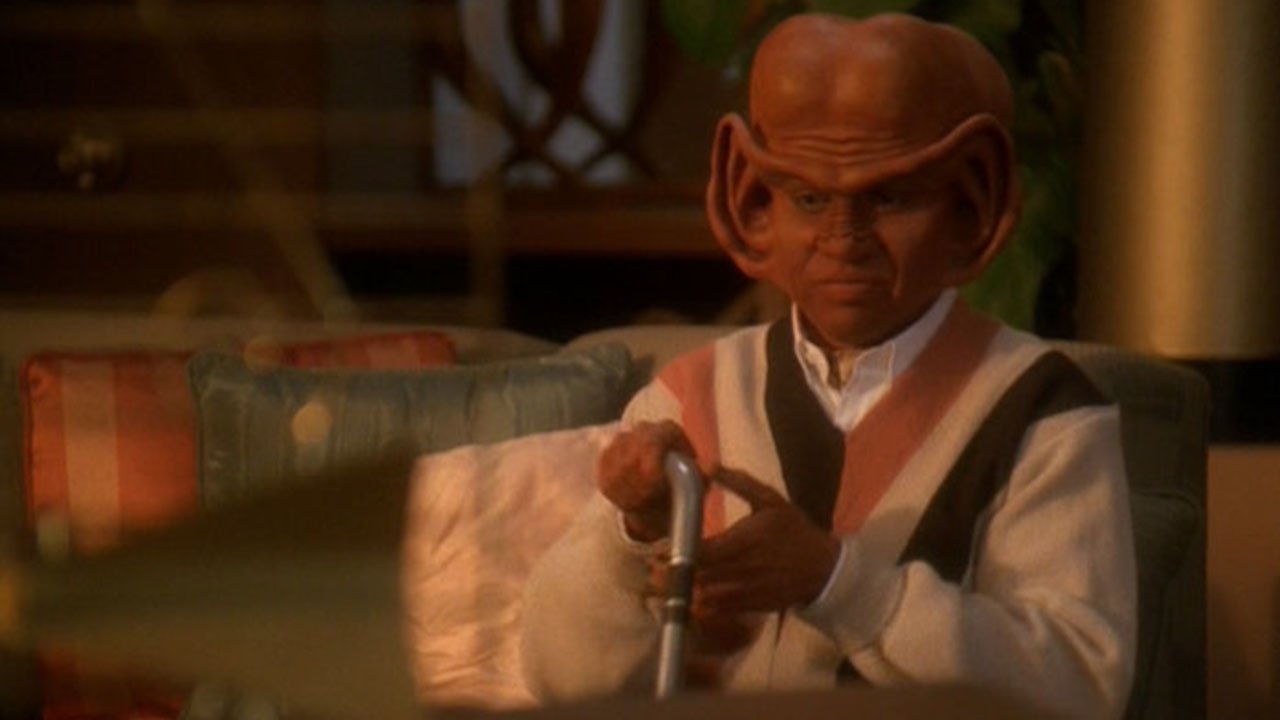
After weeks of rehab, Nog comes back to the station. His new leg hurts, he sleeps most of the day, and he plays Vic's recording of "I'll Be Seeing You" over and over.
- Going to the source
Jake has had enough of the song, so Nog goes to Vic's holosuite, hears it in every arrangement Vic knows, and talks his way into staying the night.
- Las Vegas, 1962
One night becomes weeks. Ezri, the station's counselor, lets it run. Nog does Vic's books, plans a new casino with him and needs his cane less and less.
Closing timeSpoiler · tap to reveal
Ezri reminds Vic that Nog needs to leave soon. Vic tells Nog to go. When Nog refuses, Vic switches his own program off.
Little by littleSpoiler · tap to reveal
In the empty holosuite, Nog admits what he's been hiding from. Vic tells him that if he stays, he'll still die: "not all at once, but little by little."
Why it still matters
This is Deep Space Nine's hour about what war leaves behind after the shooting stops, and it hands the whole thing to two characters who aren't in the opening credits: a young Ferengi officer and a holographic lounge singer. Nog's leg has been replaced and his body has mostly healed. The rest of him hasn't, so he retreats into the one place that feels safe, a fake 1962 Las Vegas where nobody gets shot. Keith R. A. DeCandido, in his Tor.com rewatch, said that making a story about those two into one of the show's most compelling hours shows how strong the ensemble was.
It's the episode Aron Eisenberg, who played Nog, called his favorite. He said in several interviews, among them the 2018 documentary What We Left Behind, that after it aired wounded veterans and veterans' organizations got in touch to thank him for showing a trauma that outlasts the injury. Wired called it the show's clearest commentary on post-traumatic stress, and when an asteroid was named for Eisenberg in May 2026, the citation picked this as his signature episode.
Vic pulls the plug
With his program running around the clock, Vic has been living a full life for the first time: sleeping, eating, seeing friends, running his business. He enjoys it so much that he forgets Nog is there to get better. When Ezri reminds him, he tells Nog it's time to leave, and when Nog won't, Vic shuts himself down. Nog tries to restart the program, and O'Brien explains that Vic can stop it from starting, then reminds Nog that everyone misses him.
Vic appears in the bare holosuite, and Nog finally admits what the injury did to him, and that he's afraid of dying. Vic's answer is that hiding in a lounge is just a slower way to die. Nog goes back to limited duty, and then he returns the favor: he arranges for Vic's program to stay on all the time, so the hologram who gave him his life back gets one of his own.
Challenge the DNA
Was Vic right to throw Nog out?
Or skip ahead to our reading
Vic tells him hiding in a lounge is just a slower way to die, and Nog finally says what he's afraid of. Then Nog repays him by keeping Vic's program running.
Behind the scenes
- David Mack and John J. Ordover first pitched it as "Everybody Comes to Quark's", set entirely in Quark's bar with three storylines, and sold it along with the idea that became "Starship Down". It bounced around the writers' room for a couple of years before it was rebuilt around Nog's injury and Vic's holosuite.
- Mack and Ordover rewrote the story for the new setup, and Ronald D. Moore then wrote the teleplay, cutting the other two storylines because he felt they got in the way of Nog's PTSD. DeCandido, a close friend of both writers, wrote that he was a little sad so little of the original pitch survived.
- Vic sings four songs: "I'll Be Seeing You" (also heard in "The Siege of AR-558"), "Just in Time", "I've Got the World on a String" and the title song, "It's Only a Paper Moon".
- Vic and Nog preferring The Searchers to Shane is an in-joke: The Searchers starred Jeffrey Hunter, who played Captain Christopher Pike in the original Star Trek pilot, "The Cage".
- Aron Eisenberg named it his favorite at the 2012 Star Trek Las Vegas convention. On May 4, 2026 the International Astronomical Union named asteroid (666312) Aroneisenberg after him; the citation calls this his signature episode and says his portrayal of Nog's war trauma was praised for its realism.
- Not everyone was won over. Zack Handlen at The A.V. Club praised Eisenberg and found the ending sweet, but wished the episode had dug into what it means for Vic to be conscious, and wasn't happy to see Nog's PTSD resolved within a single hour.
The thread
Where Nog's injury and Vic's lounge came from, and other stories about coming home from a war and about a fantasy that's easier than real life.
Came before
Shares DNA with
DNA strand
Is Any of This Real?
Most stories in this strand are about someone trapped in a fake world. Nog walks into his on purpose, because 1962 Las Vegas has no war in it, and the only one who can see what it's costing him is a character who doesn't exist. Vic knows he's a hologram, and he sees Nog more clearly than anyone on the station does.
Every great sci-fi story is built from a handful of strands like this one. Each strand page explains how it works and traces it across shows, books and films.
If this one stayed with you
Where to go next, and why.
Watch · Film
The Best Years of Our Lives (1946)
Three men home from the Second World War, one of them learning to live with hooks in place of hands. It sits with the same slow work of coming home that Nog faces, and it still holds up.
Watch · Star Trek: TNG S3
"Hollow Pursuits" (1990)
The lighter version: Reg Barclay is happier in his holodeck fantasies than with the real crew, and someone has to talk him out of them.
Watch · Star Trek: DS9 S6
"His Way" (1998)
Meet Vic properly. He's the hologram who knows he's a hologram, and the warmth he shows Odo here is what Nog leans on later.
Read · Book
The Things They Carried by Tim O'Brien
Linked stories by a Vietnam veteran about the war and the years after it. O'Brien is good on what survivors keep carrying, which is Nog's problem exactly.
Your next episode
Three directions to go from here, all on Sci-Fi DNA.
More of this feeling
His Way
Star Trek: Deep Space Nine
Vic Fontaine's first episode.
Same question, different answer
The Big Goodbye
Star Trek: The Next Generation
Can a holodeck world heal a real person?
Something completely different
Prodigal Daughter
Star Trek: Deep Space Nine
Ezri goes home to her family.
Sources
- “It's Only a Paper Moon (Star Trek: Deep Space Nine),” Wikipedia
- “List of Star Trek: Deep Space Nine episodes,” Wikipedia
- Keith R. A. DeCandido, “Star Trek: Deep Space Nine Rewatch: "It's Only a Paper Moon",” Tor.com, 2014
- Zack Handlen, “'It's Only a Paper Moon'/'Prodigal Daughter',” The A.V. Club, 2014
- Graeme McMillan, “WIRED Binge-Watching Guide: Star Trek: Deep Space Nine,” Wired, 2015
- “Star Trek: Las Vegas, Day 3 Recap,” StarTrek.com, 2012
- “WGSBN Bulletin Vol. 6 No. 7: (666312) Aroneisenberg,” International Astronomical Union, 2026
- Aaron Couch and Graeme McMillan, “'Star Trek: Deep Space Nine' – The 20 Greatest Episodes,” The Hollywood Reporter, 2016
- “Aron Eisenberg,” Wikipedia