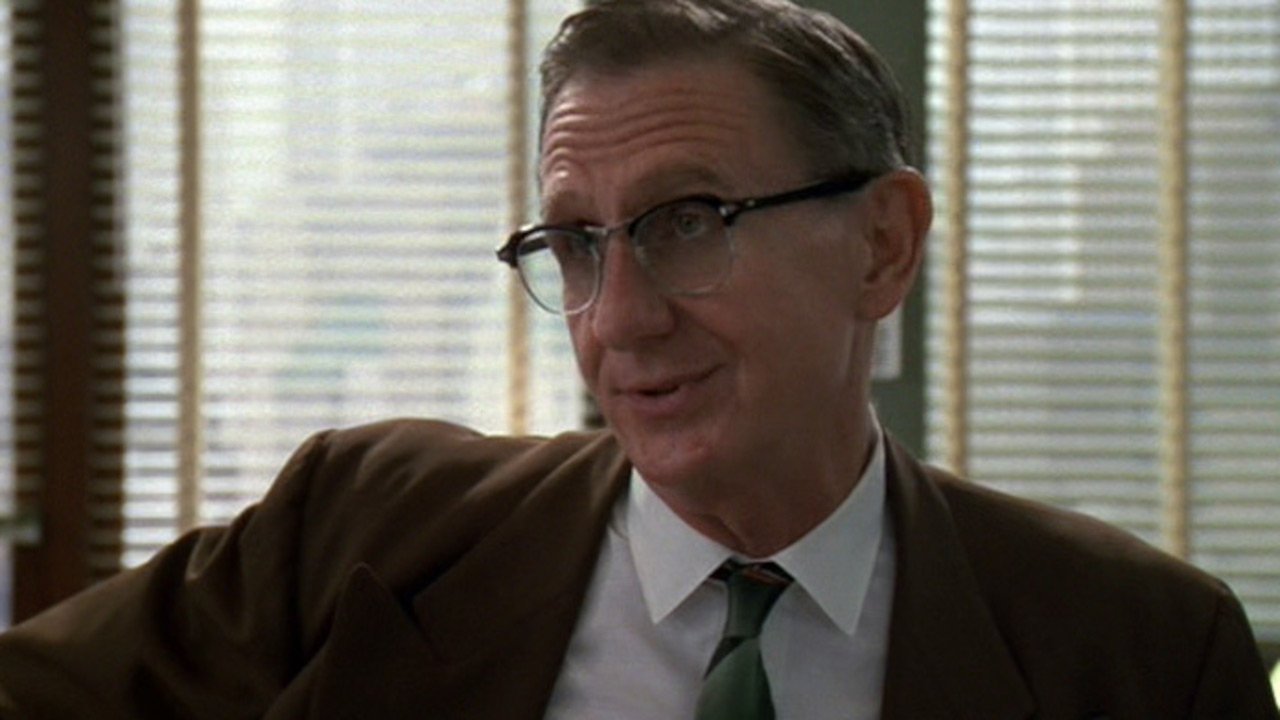
The story in 5 beats
- Thinking of quitting
After a friend's ship is destroyed in the war, Sisko considers leaving Starfleet. During a visit from his father, he starts having visions of another life.
- Incredible Tales
In 1953 New York, he's Benny Russell, a writer at a pulp magazine. A sketch of a space station gives him an idea. The editor tells him and Kay Eaton they're out of the staff photo.
- Write those words
Two cops harass Benny on the street. A preacher urges him to write, in the name of the Prophets. Benny finishes a story called "Deep Space Nine" about a Black captain.
The compromiseSpoiler · tap to reveal
The staff loves the story. The editor won't print a Black hero, until Macklin suggests a way out: make it all a dream. Benny takes the deal.
The dreamerSpoiler · tap to reveal
The night of the celebration, and the morning he comes back to work, go very differently from how Benny hoped. Then Sisko wakes up on the station.
Why it still matters
Star Trek had been making points about race since 1966, usually through aliens and allegory. Here Deep Space Nine drops the disguise. The racism is American, and it happens in a real decade. The Chicago Tribune praised it at the time for putting that racism on Earth and not on some far-flung planet, and a 2016 journal article by Lisa Doris Alexander singles it out as the franchise's most overt discussion of white supremacy and Black identity.
It's also Avery Brooks's episode in every sense. He plays Sisko and Benny Russell, and the producers wanted the director to be someone who had experienced racism himself, so he directed it too. The whole regular cast turns up as 1950s New Yorkers, and the actors who usually play aliens do it without their makeup for once, which Empire and Den of Geek both singled out as a pleasure. Wired's 2015 binge guide called it essential and probably the best episode of the show.
What keeps it from being a history lesson is how specific it is about publishing. Benny's editor never says the story is bad. He says the readers won't accept it. Gerry Canavan has compared the story to what happened to Samuel R. Delany, whose novel Nova was turned down for serialization by Analog's editor John W. Campbell because, Campbell said, readers wouldn't relate to a Black main character.
Both the dreamer and the dream
While Benny and Cassie are out celebrating, the two white policemen, Ryan and Mulkahey, shoot and kill Jimmy, the young hustler who laughed at the idea of colored people on the Moon. When Benny protests, they beat him badly. Weeks later he comes back to the office to learn the magazine's owner has pulped the whole month's issue rather than publish a story with a Black hero, even framed as a dream, and Benny is fired. He breaks down in the office and is taken away in an ambulance, and the preacher appears to tell him he is both the dreamer and the dream.
Sisko wakes on the station, deeply moved, and wonders whether somewhere, far beyond the stars, Benny Russell is out there dreaming of them. Allen Kwan, in a 2007 paper, gave the episode credit for facing racism more directly than any other but argued that ending on Benny's institutionalization weakens it, and noted the episode may once have had a more hopeful last scene. Jan Johnson-Smith has connected "the dreamer and the dream" to Martin Luther King Jr.'s "I Have a Dream" speech.
Challenge the DNA
Is Benny Russell a dream, or is Sisko?
Or skip ahead to our reading
The preacher says Benny is both the dreamer and the dream, and the episode leaves it there. Sisko wakes wondering if Benny is out there dreaming of them. The question is the point.
Behind the scenes
- Marc Scott Zicree, not a regular writer on the show, first pitched the story with Jake as the main character, and it didn't deal directly with race. He modeled the Kira and Bashir characters on the husband-and-wife writers C. L. Moore and Henry Kuttner, and O'Brien's on Isaac Asimov.
- It merged with an old idea of Robert Hewitt Wolfe's, "Cold and Distant Stars", about a present-day homeless man who believes he's a starbase captain and is drugged to stop the visions. Ira Steven Behr had passed on it in season 3 as too much of a gimmick and made "Past Tense" a time-travel story instead.
- Brooks went to the music spotting session to talk through what Benny would dance to and how it should be scored. The only other Star Trek director known to have done that was LeVar Burton. The ambulance that takes Benny away is dirty and old because, Brooks said, "that's what they would have sent."
- Behr worried how René Auberjonois would take being the only main cast member to play a bad guy. Auberjonois loved it. Armin Shimerman said his communist writer Herbert Rossoff was about as far from a Ferengi as you can get, and found acting without Quark's mask very bizarre. A memo on the office wall complains that no one would believe a cheerleader could kill vampires, a nod to Shimerman's other job as Principal Snyder on Buffy the Vampire Slayer.
- Brooks didn't stop when the assistant director called cut on Benny's breakdown, according to What We Left Behind (2019); Lou Race said he would have kept going for half an hour.
The thread
The real rejection it echoes, the shelved idea it grew from, and another story that asks which of a hero's two lives is the real one.
Came before
Shares DNA with
DNA strand
Dreams & Nightmares
Most dream episodes end with a shrug and a return to normal. This one gives Sisko's visions of 1953 as much weight as his life on the station, and never treats Benny Russell as a mere symptom. The dream is where the episode says the most about the waking world.
Every great sci-fi story is built from a handful of strands like this one. Each strand page explains how it works and traces it across shows, books and films.
If this one stayed with you
Where to go next, and why.
Read · Essay
"Racism and Science Fiction" — Samuel R. Delany
Delany's own account of the field's racism, published the same year this episode aired.
Watch · Star Trek: TNG S6
"Frame of Mind" (1993)
Riker keeps waking up in an asylum where his whole Starfleet life is a symptom. A colder puzzle-box take on the question of which world is real.
Your next episode
Three directions to go from here, all on Sci-Fi DNA.

More of this feeling
The Obsolete Man
The Twilight Zone
A librarian stands trial in a state that has decided he no longer counts, and Rod Serling gives him the same stubborn dignity Benny has.

Same question, different answer
Let That Be Your Last Battlefield
Star Trek
The original series tackles race the old way, through two aliens split black and white, and seeing it after Benny's story shows how far the show came.
Something completely different
One Little Ship
Star Trek: Deep Space Nine
Dax, O'Brien and Bashir come out of an anomaly in a runabout about four inches long, and the show has rarely been this playful.
Sources
- “Far Beyond the Stars,” Wikipedia
- “List of Star Trek: Deep Space Nine episodes,” Wikipedia
- “Star Trek: Deep Space Nine Nielsen Ratings – Season 6,” TrekNation
- “Nova (novel),” Wikipedia
- Zack Handlen, “Star Trek: Deep Space Nine: 'Far Beyond The Stars',” The A.V. Club, 2013
- Ed Gross, “The 50 best Star Trek episodes ever,” Empire, 2016
- Samuel R. Delany, “Racism and Science Fiction,” The New York Review of Science Fiction, 1998
- Graeme McMillan, “Wired Binge-Watching Guide: Star Trek: Deep Space Nine,” Wired, 2015