The story in 5 beats
- A face for the hologram
Dr. Zimmerman arrives to build a long-term medical hologram, and he's chosen Bashir as the model for its face and manner.
- The personality profile
The program needs a personality profile, so Zimmerman invites Bashir's estranged parents to the station to be interviewed, against Julian's wishes.
- Rom can't say it
Zimmerman sets his sights on Leeta and asks her to come back to Jupiter Station with him. Rom, who loves her, is too shy to say a word.
OverheardSpoiler · tap to reveal
Talking to the hologram, which they take for their son, Bashir's parents mention that they had him genetically enhanced as a child. Zimmerman and O'Brien hear it.
The dealSpoiler · tap to reveal
With his career on the line, Julian gets ready to resign, until his parents find another way out. Rom finally speaks up.
Why it still matters
It starts as a crossover gag. Robert Picardo, who played the Emergency Medical Hologram on Star Trek: Voyager, turns up on Deep Space Nine as Dr. Lewis Zimmerman, the hologram's brilliant, self-regarding creator, and briefly as the hologram too.
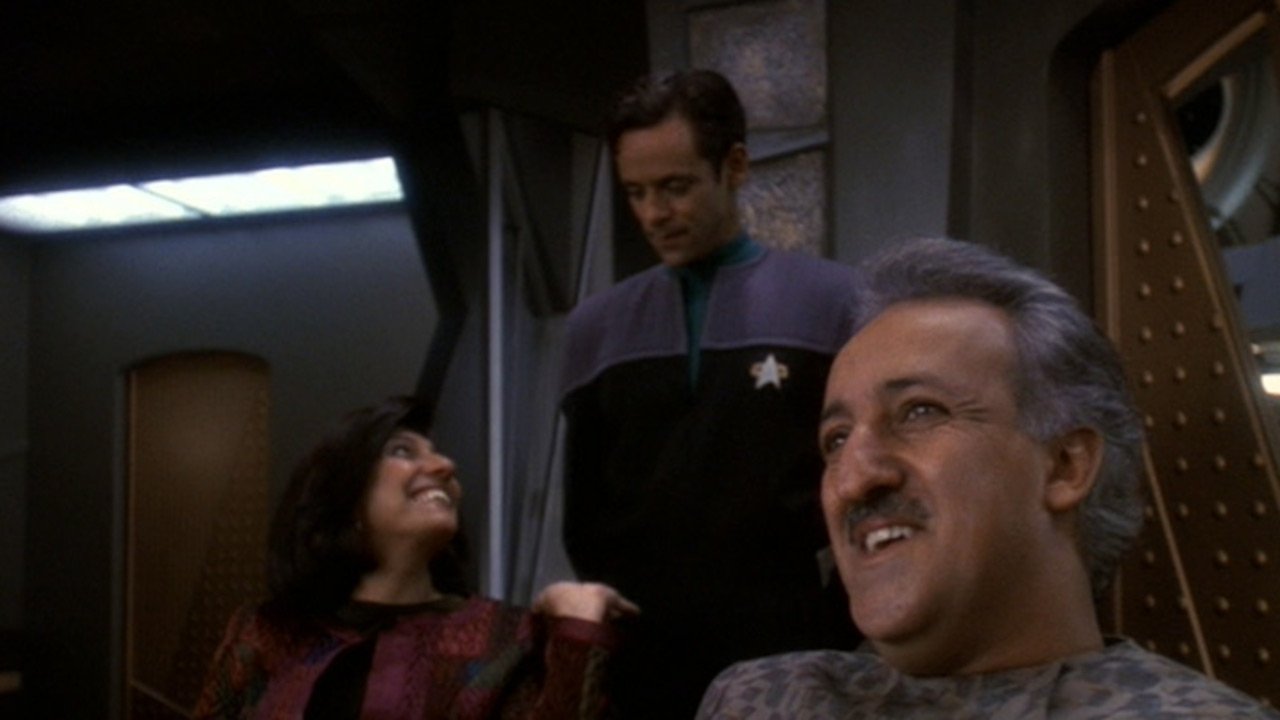
Once Bashir's estranged parents, Richard and Amsha, reach the station, the episode turns from comedy toward family drama, and that second half is what people remember it for. Running beside it is a sweet, silly subplot about Rom, Leeta and Zimmerman.
Jules
The secret Bashir has been guarding is that he was illegally genetically modified as a boy. He was a poor student, small for his age, and possibly had a learning disability; shortly before his seventh birthday his parents took him to a clinic for treatments that improved his body and his mind. At fifteen he found out what had been done and stopped using his birth name, Jules. With Zimmerman about to report it, Bashir sees no way out but to resign, because Starfleet bars genetically enhanced people from serving and from practicing medicine. He accuses his parents of giving up on the boy he was. They tell him they did it out of love, because they couldn't bear to watch him struggle.
Before he can hand in his resignation, his parents go to Sisko and strike a deal with the Judge Advocate General. Richard pleads guilty to illegal genetic engineering and accepts two years in a minimum-security prison, and Julian keeps his commission and his medical license. Julian makes some peace with his parents before they leave for Earth. Meanwhile Leeta is about to leave with Zimmerman when Rom finally tells her he loves her, and she stays. Zimmerman concedes to true love, then immediately starts chatting up a fellow passenger.
Challenge the DNA
Was Bashir right to keep his secret?
Or skip ahead to our reading
He had good reasons, and it came out regardless. The deal his father makes is the generous ending. Bashir gets to stay who he is.
Behind the scenes
- According to Cinefantastique, as cited by Wikipedia, the episode began as a way to bring Picardo over from Voyager.
- Fadwa El Guindi, who plays Amsha Bashir, was an anthropologist and a UCLA professor with no previous screen acting experience. She was invited to audition by Ron Surma, who had seen her in a community theatre production of Mahjar, a play she co-wrote and co-directed.
- Jimmy Diggs was a security guard at a Hollywood studio when Renegade producer Nicholas Corea, who knew he wrote science fiction, asked him for a story pitch. He went on to write the stories for seven Deep Space Nine and Voyager episodes.
- The title borrows Henry Morton Stanley's "Dr. Livingstone, I presume?", a line Stanley probably invented after the fact: it isn't in his journal from the meeting, and his biographer Tim Jeal argued he made it up to raise his standing.
- Reviews were mixed: Keith DeCandido gave it 7 out of 10 at Tor.com, Cinefantastique 2.5 out of 5 (as cited by Wikipedia), and Den of Geek ranked it ninth among the series' best in 2012.
The thread
Where Zimmerman and his hologram come from, and other stories about copying a real person.
Came before
Shares DNA with
DNA strand
Do Machines Dream?
Zimmerman's theory is that you can build a doctor's personality out of a profile: interview the people who know him, starting with his parents, and assemble a person from what they say. The episode plays it for comedy, with the real Bashir watching a holographic version of himself get built from other people's opinions.
Every great sci-fi story is built from a handful of strands like this one. Each strand page explains how it works and traces it across shows, books and films.
If this one stayed with you
Where to go next, and why.
Watch · Film
Star Trek: First Contact (1996)
Picardo's hologram gets a brief, very funny turn on the Enterprise, the year before this episode.
Read · Play
Cyrano de Bergerac by Edmond Rostand
The classic story of a man who can't tell the woman he loves how he feels. Rom would sympathize.
Your next episode
Three directions to go from here, all on Sci-Fi DNA.
More of this feeling
The Measure of a Man
Star Trek: The Next Generation
Data's right to refuse being taken apart for study goes to a formal hearing, where his crewmates have to argue over what he really is.
Same question, different answer
The Offspring
Star Trek: The Next Generation
Data builds himself a daughter and has to decide how much of who she becomes is his to shape, a parent's oldest question pushed to its limit.
Something completely different
A Simple Investigation
Star Trek: Deep Space Nine
Odo falls for a woman with a dangerous past, which trades this episode's family comedy for a quieter, lonelier kind of romance.
Sources
- “Doctor Bashir, I Presume?,” Wikipedia
- “List of Star Trek: Deep Space Nine episodes,” Wikipedia
- “Star Trek: Deep Space Nine Rewatch: "Doctor Bashir, I Presume?" (Keith R. A. DeCandido, 2014),” Tor.com
- “Brian George,” Wikipedia
- “Robert Picardo,” Wikipedia
- “Jimmy Diggs,” Wikipedia
- “Henry Morton Stanley,” Wikipedia