More from the episode
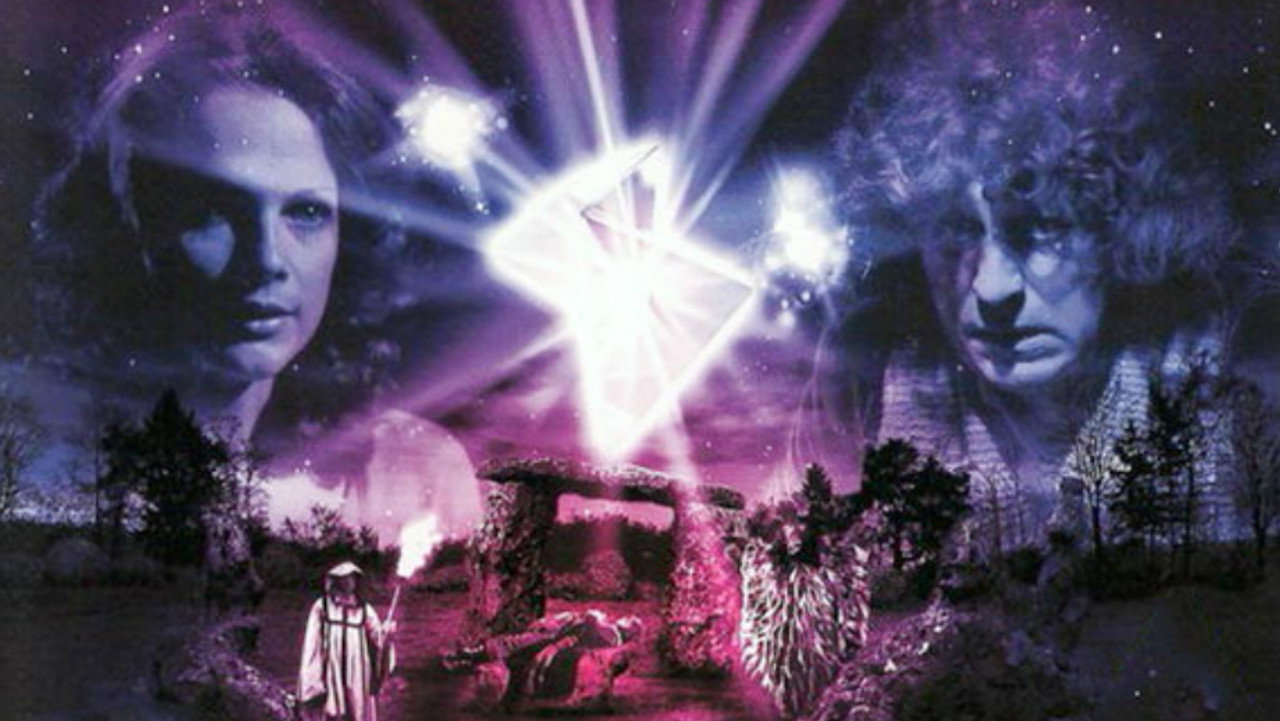

The story in 5 beats
- The Nine Travellers
The tracer brings the Doctor, Romana and K9 to 1978 England, where Professor Rumford and Vivien Fay are surveying a stone circle on Boscombe Moor.
- The Cailleach's followers
A local druid sect led by De Vries worships the Cailleach, a Celtic goddess of war and magic, and wants the strangers gone.
- Stones that drink
The druids are found dead by the circle, and the Doctor works out that some of the stones are alive, alien, and feed on blood.
A ship in hyperspaceSpoiler · tap to reveal
Romana is sent to a prison ship hidden in hyperspace, and the Doctor, following her, wakes its judges: two globes called the Megara, who put him on trial.
Who is Vivien Fay?Spoiler · tap to reveal
The Doctor turns the Megara's own rules against them to expose the thief they were built to catch, and the third segment turns up where she has been wearing it.
Why it still matters
This was the 100th Doctor Who story, and it plays like two stories stitched together on purpose. The first half is folk horror on a moor: druids in robes, a goddess of war and magic, rocks that move at night. Then the plot steps sideways into hyperspace and becomes a courtroom drama aboard a prison ship, with two floating globes for judges. The Discontinuity Guide loved the "Hammeresque" first two episodes and called the last two "woeful". David J. Howe and Stephen James Walker, in The Television Companion, thought the mix of settings captured much of what made the series work.
It is also a showcase for its women. Beatrix Lehmann, a stage actor to whom Christopher Isherwood dedicated Goodbye to Berlin, plays Professor Emilia Rumford, a brisk archaeologist who takes aliens and hyperspace more or less in her stride. It was her last role; she died in July 1979. Radio Times critic Patrick Mulkern called the serial "an intriguing yarn with small stakes and vivid characters" and singled out the female parts for praise.
It sits in the middle of season 16, the year-long hunt for the Key to Time. Script editor Anthony Read commissioned David Fisher to write it and the next story too; Fisher later began the scripts that Douglas Adams and Graham Williams reworked into City of Death. Director Darrol Blake made an unusual call for the location work: instead of the usual 16mm film, he shot the moor scenes on video with outside-broadcast cameras, so they would match the studio footage.
A new stone on the moor
Vivien Fay is Cessair of Diplos, an alien criminal who escaped the prison ship before her trial, and the Ogri are rock creatures from the planet Ogros that she commands. She has been hiding on Earth far longer than her face suggests, she is the goddess the druids worship, and it was she, briefly wearing the Doctor's face, who pushed Romana off the cliff. Her stolen prize, the Great Seal of Diplos, gives her the power of transformation, and it is the third segment of the Key.
The Megara refuse to examine anyone not on trial, so the Doctor drags Vivien into the path of their execution beam. They stop to scan her, find Cessair, and with Romana's evidence they pass judgment: she is turned into a standing stone in her own circle. The Doctor pockets the Seal, sends the Megara home, and leaves Professor Rumford with a stone circle that now has a different number of stones and a monograph to write about it.
Challenge the DNA
Is Vivien Fay a villain or just a survivor?
Or skip ahead to our reading
A villain who's very good at surviving. She hid well and lived long, and the people around her paid for it. The story's lightness makes her more frightening, not less.
Behind the scenes
- The working titles were The Nine Maidens and The Stones of Time.
- Location work was recorded at the Rollright Stones, the King's Men circle in Oxfordshire, though the story is set in Cornwall. Set designer John Stout added artificial cross-pieces, like those at Stonehenge, to the real stones.
- Darrol Blake shot the location scenes on video using outside-broadcast cameras instead of the usual 16mm film, to avoid the jolt of cutting between film and video.
- A scene was planned in which Romana and K9 surprise the Doctor with a cake for his 751st birthday. The BBC's notes tie it to the 100th story; part four also went out five days before the programme's fifteenth anniversary on November 23, 1978. Producer Graham Williams thought it too self-indulgent and it was never recorded.
- Gerald Cross, uncredited, is the voice that warns the Doctor to "Beware the Black Guardian" at the start, a device to remind viewers of the season's arc. He also voices one of the Megara.
- The cells of the hyperspace ship hold some familiar prisoners: the corpse of a Wirrn from The Ark in Space and what appears to be a Kraal android from The Android Invasion.
- Terrance Dicks novelised it for Target Books in March 1980. David Fisher later wrote his own novelisation for audio, read by Susan Engel (Vivien Fay), which came out in paperback in 2022.
The thread
Standing stones, the old religion, and legends that turn out to have a science-fiction explanation.
Came before
Shares DNA with
DNA strand
First Contact & Invaders
The story takes a familiar British setting, standing stones and the legends around them, and suggests the legends had something real and unearthly behind them. For two episodes it plays as folk horror, until the hyperspace half takes over.
Every great sci-fi story is built from a handful of strands like this one. Each strand page explains how it works and traces it across shows, books and films.
If this one stayed with you
Where to go next, and why.
Watch · Doctor Who
"The Dæmons"
The earlier Doctor Who take on English village occultism, with a dig, a coven and a horned legend that has a scientific explanation.
Watch · Star Trek
"Who Mourns for Adonais?"
Another figure out of old mythology who wants to be worshipped again, and a crew who decline.
Watch · Star Trek
"Catspaw"
If you like the Halloween half of this story best: witches, a castle dungeon and alien visitors dressed up in Earth's spooky stories.
Read · Novelisation
Doctor Who and the Stones of Blood — Terrance Dicks
The 1980 Target novelisation, the way many fans first met the story before home video.
Your next episode
Three directions to go from here, all on Sci-Fi DNA.

More of this feeling
The Dæmons
Doctor Who
Another English village with stones, rituals and something old.
Same question, different answer
The Devil in the Dark
Star Trek
Creatures made of rock, and who they really answer to.

Something completely different
The Androids of Tara
Doctor Who
A swashbuckling romp with swords, castles and doubles.