The idea in a minute
Simulation theory says the world you experience might be a computer program, and that you might be part of the program. This isn't quite The Matrix, where real human bodies sit in pods while their brains are fed a fake world. In the version philosophers argue about, there is no body in a pod. Your mind is the software.
The modern version is an argument, not a hunch. Suppose a civilization gets powerful enough to run detailed simulations of its own ancestors, and suppose it runs a lot of them. Then simulated minds would vastly outnumber the original ones. And if that's true, the odds say you're more likely to be one of the copies.
Where it came from
- c. 375 BCEPlato's allegory of the cave, in the Republic: prisoners who mistake shadows on a wall for the whole of reality.
- c. 300s BCEThe Chinese philosopher Zhuangzi dreams he is a butterfly, wakes up, and can't be sure he isn't a butterfly now dreaming he's Zhuangzi.
- 1641René Descartes' Meditations asks what you could still be sure of if an all-powerful deceiver were feeding you a false world.
- 1964 · fictionDaniel F. Galouye's novel Simulacron-3: a simulated city built for market research, and a hero who starts to suspect his own world is a simulation too.
- 1973 · fictionRainer Werner Fassbinder adapts it for West German television as World on a Wire.
- 1977Philip K. Dick tells an audience in Metz, France, that "we are living in a computer-programmed reality."
- 1999 · fictionThe Matrix, eXistenZ and The Thirteenth Floor (another Simulacron-3 adaptation) all open within a few months.
- 2003Oxford philosopher Nick Bostrom publishes "Are You Living in a Computer Simulation?" in Philosophical Quarterly. This is the argument everyone still argues about.
- 2016Neil deGrasse Tyson hosts a panel on the question at the American Museum of Natural History. That June, Elon Musk tells the Code Conference that the odds we're in "base reality" are "one in billions."
- 2022Philosopher David Chalmers' Reality+ argues that even if we are simulated, our world is still real: the tables are still tables, just made of a different stuff.
Why it grabs us
Part of it is timing. Plato could only ask whether the world was shadows. We've spent fifty years watching game worlds go from Pong to photo-real cities, so it's easy to picture the next step. "Glitch in the Matrix" has become everyday slang for déjà vu or a too-neat coincidence, which tells you how far the idea has spread.
It's also a perfect late-night question because nobody can win it. The idea is comforting and unsettling at once. Someone made all this on purpose, which is comforting. They could also switch it off.
The case for, and the case against
The strongest version of each side. Labels show what's established and what's a guess.
The case for
- REALBostrom's trilemma. At least one of three things must be true: civilizations like ours almost never survive long enough to run such simulations; those that could almost never choose to; or we're almost certainly in one. Bostrom himself doesn't claim to know which.
- GUESSThe numbers game. If simulations are possible and cheap, one real world could run millions of them. Pick a mind at random, and it's almost certainly simulated.
- REALIt might be testable. In 2012 physicists Silas Beane, Zohreh Davoudi and Martin Savage suggested that a universe computed on a grid could leave a fingerprint in the highest-energy cosmic rays. Nobody has found one.
The case against
- REALIt may not be science. Physicist Sabine Hossenfelder calls the simulation hypothesis pseudoscience: as usually stated, it makes no prediction you could check.
- REALThe computing bill. A 2017 paper by Zohar Ringel and Dmitry Kovrizhin showed that some quantum effects can't be simulated efficiently on ordinary computers. Headlines said "physicists prove we're not in a simulation." The paper didn't claim that, and a simulator could have hardware we can't imagine.
- GUESSThe big assumption. The whole argument assumes a mind can run on a computer. Nobody knows that. Can Machines Be Conscious? →
Where that leaves us: A serious philosophical argument with no evidence for or against. Fun to think about, and so far impossible to settle.
Where sci-fi took it
Three ways stories use the idea. Twists stay hidden until you tap. Twists stay hidden until you tap.
The twist reveal
On Sci-Fi DNA“Back to Reality”Red Dwarf · 1992 · the crew learn their lives were a gameShow the twist
The "simulation" is itself fake: a hallucination from despair squid ink. It's a reveal about the reveal.
Coming soon“Hang the DJ”2017 · a dating system that picks your partners and your time limitShow the twist ClipOfficial trailer · Netflix · 0:52
Frank and Amy are simulations inside a dating app, run a thousand times to test whether the real Frank and Amy are a match.
Trapped in the program
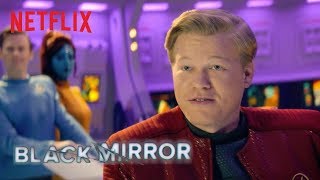 ClipOfficial trailer · Netflix · 0:44
Life inside the sim
On Sci-Fi DNA“Five Characters in Search of an Exit”Twilight Zone · 1961 · five strangers in a world someone else builtShow the twist
No computers, but the same question. They're dolls in a charity barrel, and their whole world is a toy. Rod Serling got to "made by someone bigger" with tin and snow.
Big Idea vs. DNA strand
Is Any of This Real?
That's the storytelling strand: the reveal that the world is fake. Simulation theory is the real-world question underneath it. Not every "it wasn't real" story is a simulation (plenty are dreams, drugs or dolls), so the strand page covers the trick and this page covers the idea.
Start here
If you only try a few, try these.
Watch · Film
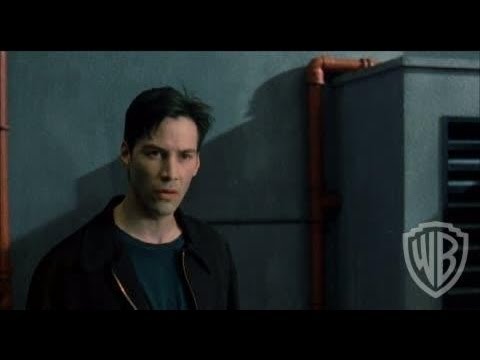
The Matrix (1999)
The one everyone means when they say "simulation." Still the clearest way into the idea, and still a terrific action film.
Watch · Black Mirror
“Hang the DJ”
If you want the idea with a warm heart instead of a cold sweat. Go in knowing nothing.

Watch · Red Dwarf V
“Back to Reality”
The funniest half-hour ever made about finding out your life was a game.
Read · Philosophy
“Are You Living in a Computer Simulation?”
The source of the modern argument. It's short, free online, and more careful than the headlines it inspired.
Sources
- Nick Bostrom, “Are You Living in a Computer Simulation?”, Philosophical Quarterly 53 (211), pp. 243–255, 2003
- Silas R. Beane, Zohreh Davoudi, Martin J. Savage, “Constraints on the Universe as a Numerical Simulation”, arXiv, 2012
- “Are We Living in a Computer Simulation?”, Scientific American, 2016
- “2016 Isaac Asimov Memorial Debate: Is the Universe a Simulation?”, American Museum of Natural History, 2016
- “Elon Musk: 'one in billions' chance humans are not living in computer simulation”, The Washington Times, 2016
- “Did Philip K. Dick discover the real-life Matrix in 1977?”, Literary Hub
- “Simulacron-3”, Wikipedia
- “World on a Wire”, Wikipedia
- Sabine Hossenfelder, “Why the simulation hypothesis is pseudoscience”, Big Think
- “Are we living in a computer simulation? (Ringel & Kovrizhin, Science Advances)”, EurekAlert! / Oxford University, 2017
- Scott Aaronson, “Your yearly dose of is-the-universe-a-simulation”, Shtetl-Optimized, 2017
- “David Chalmers on Reality+: Virtual Worlds and the Problems of Philosophy”, Future of Life Institute, 2022
- “Ship in a Bottle (Star Trek: The Next Generation)”, Wikipedia
- “Hang the DJ”, Wikipedia
- Scott Aaronson, “Because you asked: the Simulation Hypothesis has not been falsified; remains unfalsifiable”, Shtetl-Optimized, 2017
- “Zhuangzi”, Stanford Encyclopedia of Philosophy
- “Republic (Plato)”, Wikipedia