More from the film
Who this is for
You've finished The Prestige and want both secrets laid out, with the clues the film plants along the way.
What it covers
- The pledge, the turn and the prestige
- How Borden's version of the trick works
- What Tesla's machine really does
- The last scene, and the clues you can spot on a rewatch
Spoiler boundary
The whole film, including both secrets and the ending. Mentions Christopher Priest's novel in general terms.
Show the full explanationHide the explanationContains spoilers: The whole film, including both secrets and the ending.
How to read the labels
- Confirmed in the work
- Shown or stated on screen or on the page.
- From another version
- From the book, story or cut it's based on, not the version we're explaining.
- Interpretation
- A reading of what it means. Reasonable people differ.
- Continuity contradiction
- The work says two things that don't fit together.
The short answer
Alfred Borden's Transported Man works because "Borden" is two men: identical twins who share one life. One performs while the other hides as Borden's engineer, Fallon. Each loves a different woman, and both have lost two fingers so they stay identical.
Robert Angier's version uses a machine built by Nikola Tesla. It doesn't move him anywhere: it makes a copy of him, and the original is left behind. Every night, the Angier under the stage drowns in a tank. At the end, one Borden twin has been hanged for Angier's supposed murder. The other shoots Angier, who dies confessing his secret, and the fire that follows reveals rows of tanks holding his drowned doubles. The surviving Borden goes home to his daughter.
Three parts of a trick
Confirmed in the work The film is structured around the three parts of a magic trick: the pledge, the turn, and the prestige, which is the return of something you thought was lost.[1]
Interpretation Each of the two endings is a prestige of its own. Borden comes back from the dead because there were always two of him. Angier comes back every night because there is always another one of him.
Borden's secret
Confirmed in the work "Borden" is identical twins, Alfred and Frederick, sharing one identity. One loved Sarah, the other Olivia.[1]
Confirmed in the work They performed The Transported Man by switching places. Whichever twin wasn't on stage lived as Fallon, disguised with prosthetics and make-up.[1]
Confirmed in the work Both are missing two fingers: one lost them in an accident, and the other cut off his own to match.[1]
Angier's secret
Confirmed in the work Tesla's machine doesn't transport anything. It creates a duplicate of whatever is inside it and leaves the original where it was.[1]
Confirmed in the work Each night, the Angier left behind is drowned in a tank beneath the stage, so he kills a copy of himself every performance.[1]
The ending
Confirmed in the work Borden is convicted of Angier's murder and hanged. In prison, Angier visits him disguised as a wealthy patron, Lord Caldlow, and tears up the note in which Borden reveals his method.[1]
Confirmed in the work The surviving twin finds Angier in the basement of his theatre and shoots him. Dying, Angier learns the truth about Borden and admits his own secret.[1]
Confirmed in the work A lamp falls, the theatre catches fire, and the flames light up rows of water tanks holding Angier's drowned duplicates. The surviving Borden takes back his daughter, Jess.[1]
The film and the novel
From another version The Nolans dropped the novel's spiritualism subplot and replaced its present-day framing story with Borden waiting for the gallows. Christopher Priest approved of the adaptation.[1]
Behind the scenes
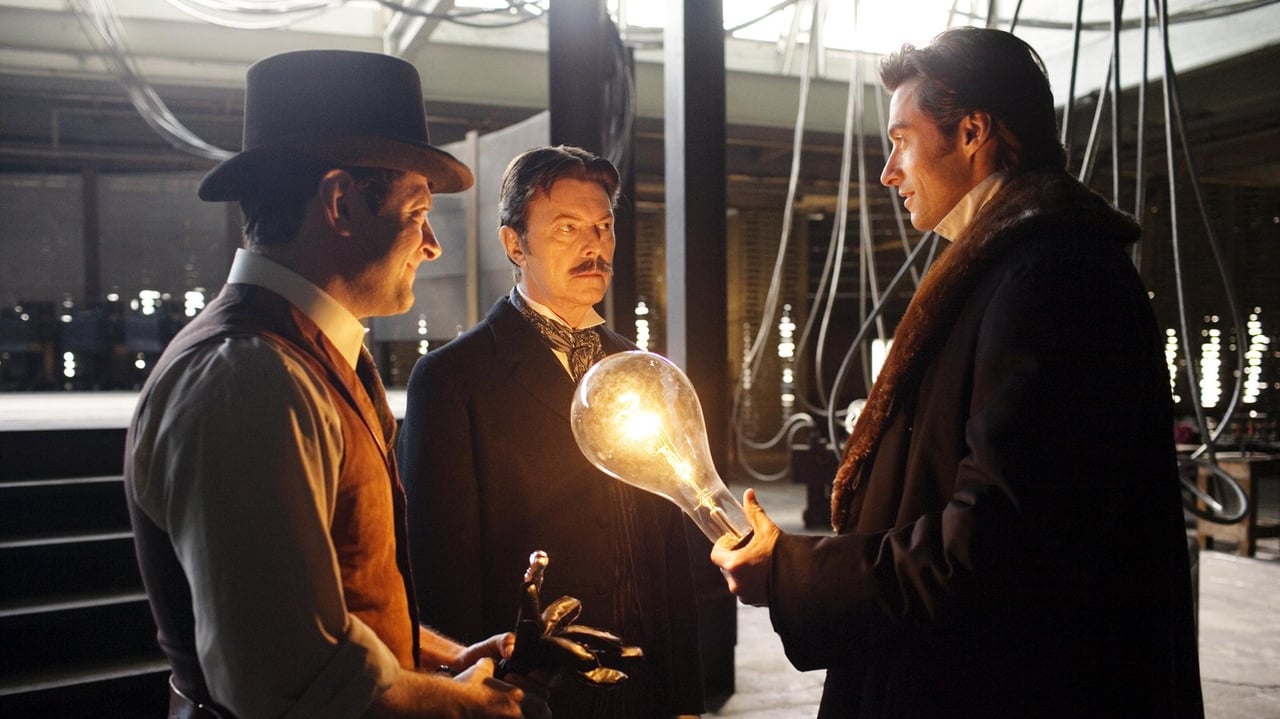
- Confirmed in the workDavid Bowie plays Nikola Tesla.[1]
- Confirmed in the workIt was nominated for Academy Awards for art direction and cinematography.[1]
- Continuity contradictionCritics split over the twist. Roger Ebert called it a cheat, while Christopher Priest praised it after seeing the film three times.[1]
The Question Underneath
How much of your life would you give up for one perfect trick?
Both men pay for their act with the people around them and with pieces of themselves. The film is built like a magic trick, and it asks whether the audience, wanting to be fooled, is part of the price.
Connections that give things away
- Similar story mechanismMoon (2009) Help Me Understand
Copies of one man, and what each copy owes the others.
Where to go next
More of this feeling
Help Me Understand
Nolan again, with another obsessive professional and a final shot built to be argued over.
Same question, different answer
Help Me Understand
Another story about how far someone will go to become the person their obsession demands.
Something completely different
Star Trek: The Next Generation · S2 E3
Victorian London again, this time on a holodeck, with a villain who outgrows his programming.
How it connects
- Same creatorInception (2010) Help Me Understand
Nolan's next original film, another story structured like a trick, with a last shot meant to be argued about.
Sources
- The Prestige (film) · Wikipedia · accessed 2026-11-20
Plot summaries are in our own words. Labels mark what the work shows, what its makers have said, and what is our reading. Last reviewed 2026-11-20. Spot an error? Tell us.