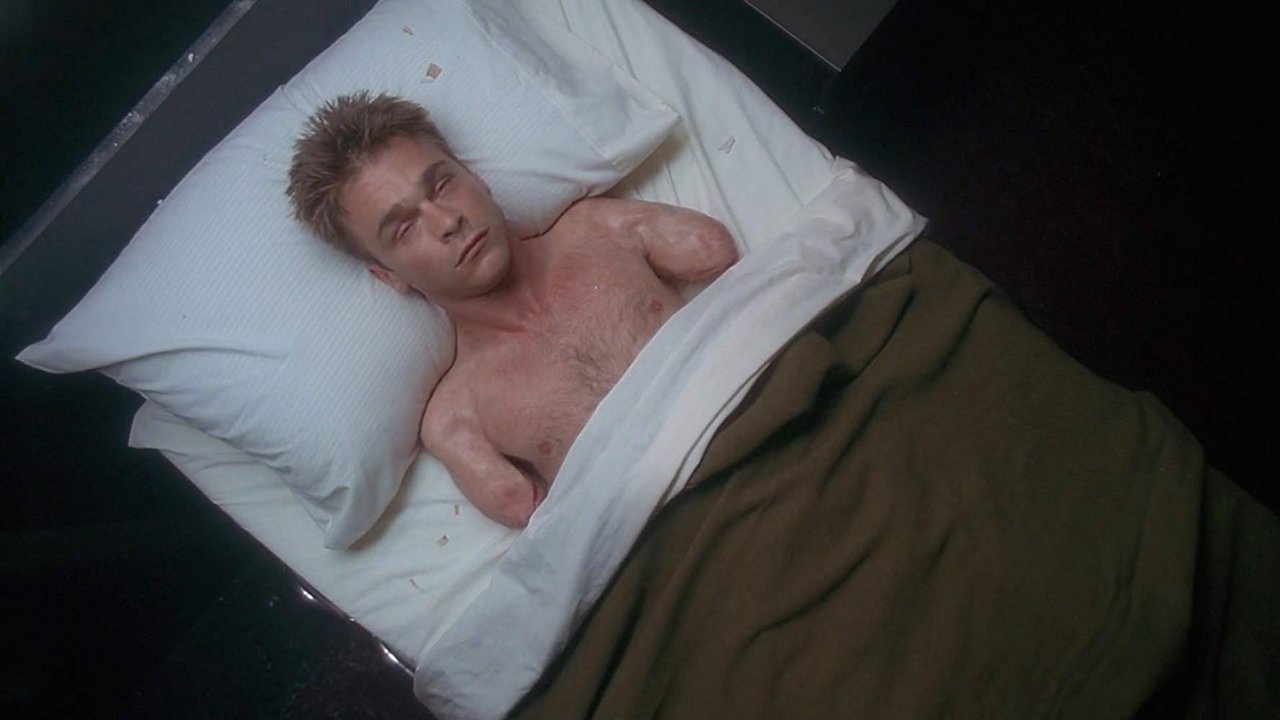
The story in 5 beats
- The third attempt
At the veterans' hospital at Fort Evanston, Maryland, Lt. Col. Victor Stans tries to drown himself in scalding water. Staff pull him out, scarred. He says a figure won't let him die.
- A house fire
Stans tells the agents his wife and children died in a fire the phantom soldier set. Then General Callahan, who never cleared their visit, glimpses the soldier himself.
- The mailman
Prints at Callahan's house belong to the hospital mailman, Quinton "Roach" Freely, who says he's "Rappo's mailman." Rappo is Leonard Trimble, a Gulf War veteran who lost all four limbs.
Played backwardsSpoiler · tap to reveal
Roach dies in his cell. X-ray film from the attack sites shows radiation, and Callahan's garbled voicemail, played backwards, is a threat. Mulder thinks Rappo leaves his body.
Stand downSpoiler · tap to reveal
Callahan confronts Rappo, who admits everything and goads him to shoot. Callahan fires over his head instead and tells him he'll suffer like the rest of them.
Why it still matters
This is a war story dressed as a ghost story. John Shiban, new to the writing staff, took his starting point from The Men, the 1950 film about a World War II lieutenant badly wounded in combat who wants nothing more than to walk again. Shiban's version turns that longing into bitterness: a Gulf War veteran who blames the war for ruining his life and has nothing left to lose.
Shiban said the hardest part to write was the beginning, where Mulder and Scully "have to come together on a case, yet they have to be at odds." Not every critic thought he managed it. Paula Vitaris of Cinefantastique found the two leads "off-balance" and noted some wrong military details, though she called it a "solid episode." Robert Shearman, in Wanting to Believe, found the plot predictable but wrote that Shiban "put real blood and passion into it which raises it high above the trappings of its clichés."
Rob Bowman's direction got the warmest notices. Emily St. James, writing for The A.V. Club in 2010, called it "terrific" and the military hospital "well-realized," while finding the story itself "straightforward."
No case to close
By then the phantom has already killed. Captain Draper, who first turned the agents away, drowned in the base pool, pulled under by something nobody could see; Callahan's young son, Trevor, was buried in his own sandbox; and Callahan has come home to find his wife dead. Enraged when Callahan won't shoot him, Rappo slips into a trance that Scully takes for a seizure, and his apparition goes after Callahan with steam from the basement pipes. Stans walks into Rappo's room, locks the door and smothers him with a pillow. The phantom vanishes before it can reach Mulder, and Callahan comes through unharmed.
With no physical evidence tying Rappo to the deaths, the case stays open. Stans is released and becomes Callahan's mailman, and the two men acknowledge each other. Mulder's closing narration says Rappo's family asked for a burial at Arlington; the army said no, and he was cremated and buried in a civilian cemetery in Pennsylvania.
Challenge the DNA
Was Rappo to blame for the deaths?
Or skip ahead to our reading
The episode lets you see both. He blames the Gulf War for ruining his life, and the army's indifference is part of the story.
Behind the scenes
- Some of the writing staff were uneasy about killing Callahan's son. Shiban wasn't: Rappo wanted to take everything from Callahan, he said, and losing his son would be the worst blow.
- For Draper's drowning, a hidden cable fixed to the floor of the pool yanked Nancy Sorel underwater, and the wave that swallows her was created by Mat Beck and David Gauthier of the effects team. For Trevor's death, a stuntman was buried in sand and burst out on cue, and the shot was built up digitally afterwards.
- The climax, where the apparition throws Callahan and Mulder across the room, used an air ram, a pneumatic device that fires a stunt performer through the air with compressed air. The visual effects took so much work they were nearly not finished in time.
- Rob Bowman called Ian Tracey "an incredibly strong actor" and right for Rappo. Emily St. James disagreed, finding Tracey not good enough to make Rappo's motives believable.
- Deryl Hayes, who plays an army psychiatrist, had played a CIA operative in the first-season episode "Shadows".
The thread
Wounded soldiers who can't go home again, and minds that act on the world while their bodies lie still.
Came before
Shares DNA with
DNA strand
Us vs. Them
The war here is inside one army. A veteran who came home broken turns on the officers above him, and the hospital meant to care for him becomes the battlefield.
Every great sci-fi story is built from a handful of strands like this one. Each strand page explains how it works and traces it across shows, books and films.
If this one stayed with you
Where to go next, and why.
Watch · Film
Coming Home (1978)
Jon Voight plays a Vietnam veteran left paraplegic, full of pain and anger, in Hal Ashby's drama, and falls for a Marine captain's wife he meets at the hospital.
Watch · Film
Born on the Fourth of July (1989)
Oliver Stone's film of Ron Kovic's memoir follows a paralyzed Vietnam veteran over twenty years, from his childhood through his service and the years after it.
Read · Novel
Johnny Got His Gun by Dalton Trumbo
A World War I soldier wakes in a hospital bed having lost his arms and legs, with his mind intact and almost no way to reach the people around him.
Your next episode
Three directions to go from here, all on Sci-Fi DNA.
More of this feeling
Hard Time
Star Trek: Deep Space Nine
A man carrying the memory of an ordeal nobody else can see gives it the same haunted mood.
Same question, different answer
The Wounded
Star Trek: The Next Generation
It asks what a war leaves behind in the people who fought it.

Something completely different
Oubliette
The X-Files
For a story about a different kind of survivor, try the case of the woman who was once kidnapped herself.