
More from the episode


The story in 5 beats
- Harmony, 1890
Woodrow Mulligan hates his times: the prices, the traffic, the livestock in the street. A bicycle crash drops him in a water trough.
- The time helmet
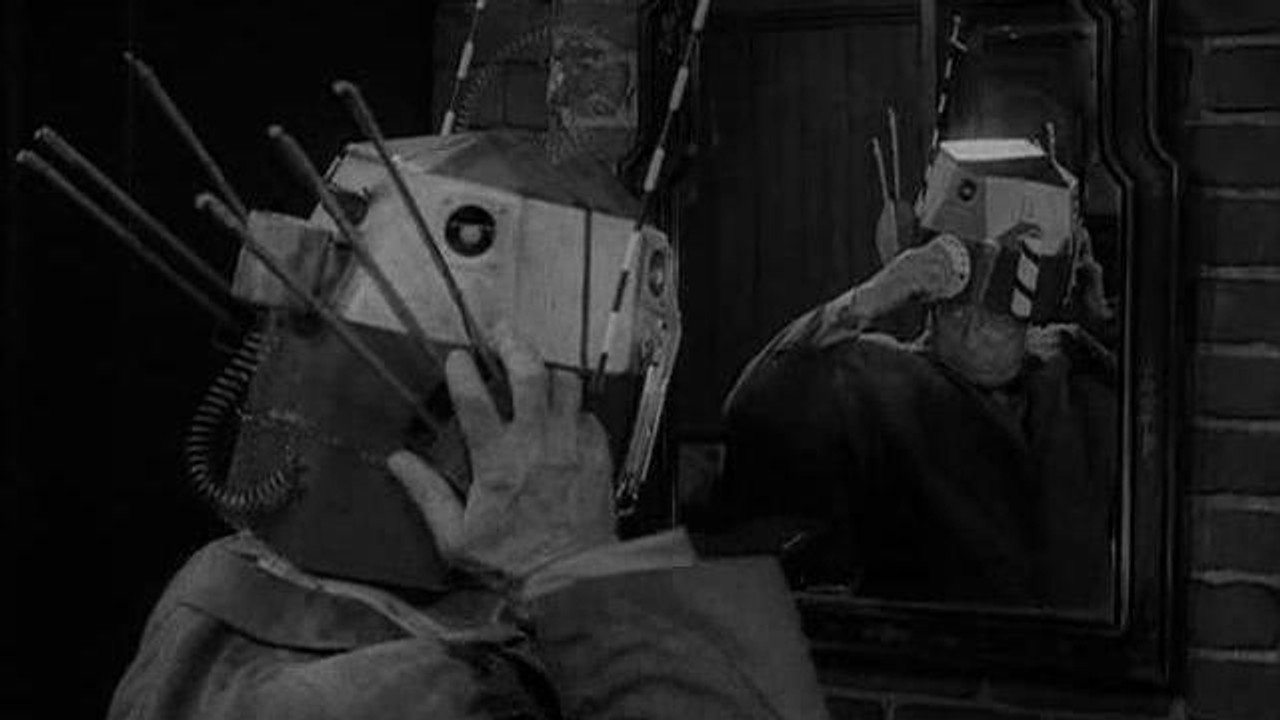
Mulligan sweeps up for Professor Gilbert, who has built a helmet that sends its wearer to another decade for half an hour. Mulligan tries it on.
- 1961
Sound arrives, and so do cars, crowds and prices. A kid grabs the helmet, Mulligan gives chase, and the helmet gets broken.
RolloSpoiler · tap to reveal
Rollo, a scientist who dreams of the simple 1890s, helps get the helmet fixed, then tries to use it himself. Both men land back in 1890.
Stay in your own timeSpoiler · tap to reveal
A week later Mulligan is content and Rollo misses his gadgets. Mulligan sets the dial for 1961 and sends him home.
Why it still matters
This is the night The Twilight Zone handed itself over to one of the great silent clowns. Richard Matheson wrote the script for Buster Keaton, and the 1890 scenes are shot as an actual silent film: title cards, a tinny saloon piano, sped-up action. The only voice you hear back there is Rod Serling's.
Keaton was in his mid-sixties, and nobody is pretending he can still do the stunts from The General. What he still has is the face, that flat, unbothered stare while the world misbehaves around him. Woodrow Mulligan grumbles about prices and noise and speed limits in sleepy Harmony, New York, then tries the professor's helmet and finds out what noise really sounds like.
It's a slight episode, and its making was a bit of a mess. Watch it for Keaton, for the switch from silence to the racket of 1961, and for Stanley Adams as a modern man with a very different opinion about the good old days.
Who really wants the past
Mulligan spends 1961 learning that the future is louder, pricier and no kinder. Rollo, who has spent his life romanticizing the 1890s, grabs the helmet to escape there, and Mulligan hangs on at the last second, so both men arrive in Harmony together. Rollo is charmed, for about a week.
Then the roles flip. Mulligan has made his peace with 1890, and Rollo is the one complaining that there's nothing to do and nothing works. Mulligan, fed up, sets the helmet for 1961, puts it on Rollo's head and sends him back. Serling's closing narration draws the moral in plain words: stay in your own backyard, and if possible help others stay in theirs.
Behind the scenes
- Matheson wrote the episode for Keaton after meeting him through writer William R. Cox, and pitched it to Serling and producer Buck Houghton once Keaton said he was interested. It was his second comedy for the show, after "A World of His Own."
- Houghton brought director Norman Z. McLeod out of retirement for the job. McLeod, he said, "wasn't working a lot, he didn't want to."
- The cut sat in the editing room for weeks. To give it what Houghton called "a goose," editor Jason Bernie took out frames so the 1890 scenes moved with a jumpy, early-film speed.
- Speeding it up made the episode too short, so a new repair shop scene, directed by Les Goodwins, was shot in late October to replace Matheson's supermarket sequence. Matheson called the change "complete death" and felt the story "just stagnates" once Rollo arrives.
- Stanley Adams, who plays Rollo, is better known to sci-fi fans as the merchant trader in Star Trek's "The Trouble with Tribbles."
- The episode was later adapted for The Twilight Zone Radio Dramas, with John Rhys-Davies.
The thread
A silent-comedy star gets a time machine and wades into the long-running argument about whether the old days were really better.
Came before
Shares DNA with
Left its mark on
DNA strand
Sci-Fi Played for Laughs
The time machine is a delivery system for sight gags, and the script cares a lot more about Mulligan's missing trousers than about how the helmet works. Matheson builds the jokes around Keaton's stillness: the noisier and faster the world gets, the funnier his blank face becomes.
Every great sci-fi story is built from a handful of strands like this one. Each strand page explains how it works and traces it across shows, books and films.
If this one stayed with you
Where to go next, and why.
Watch · Film
Sherlock Jr. (1924)
If you want to see what Keaton could do at full speed, start here. A projectionist dreams himself into the movie, and the stunts still look impossible.
Watch · Twilight Zone S1
"A Stop at Willoughby" (1960)
The same longing for a gentler century, played without a single joke. It makes a strange, good double bill with this one.
Watch · Film
Midnight in Paris (2011)
Rollo's mistake, stretched to feature length and played gently. A man who thinks he was born in the wrong decade gets to visit the right one.
Read · Novel
Time and Again — Jack Finney
A modern New Yorker slips back to the 1880s and finds it as crowded and complicated as his own city. It's the trip Rollo thought he wanted, done properly.
Sources
- “Once Upon a Time (The Twilight Zone),” Wikipedia
- “The Twilight Zone season 3,” Wikipedia
- Witney Seibold, “The Twilight Zone Dropped The Ball On Their Only Chance To Work With Buster Keaton,” SlashFilm, 2024
- Brian Durant, “Once Upon a Time,” The Twilight Zone Vortex, 2016
- Zack Handlen, “The Twilight Zone: "Once Upon A Time"/"Five Characters In Search Of An Exit",” The A.V. Club, 2013