More from the episode

The story in 5 beats
- Off course
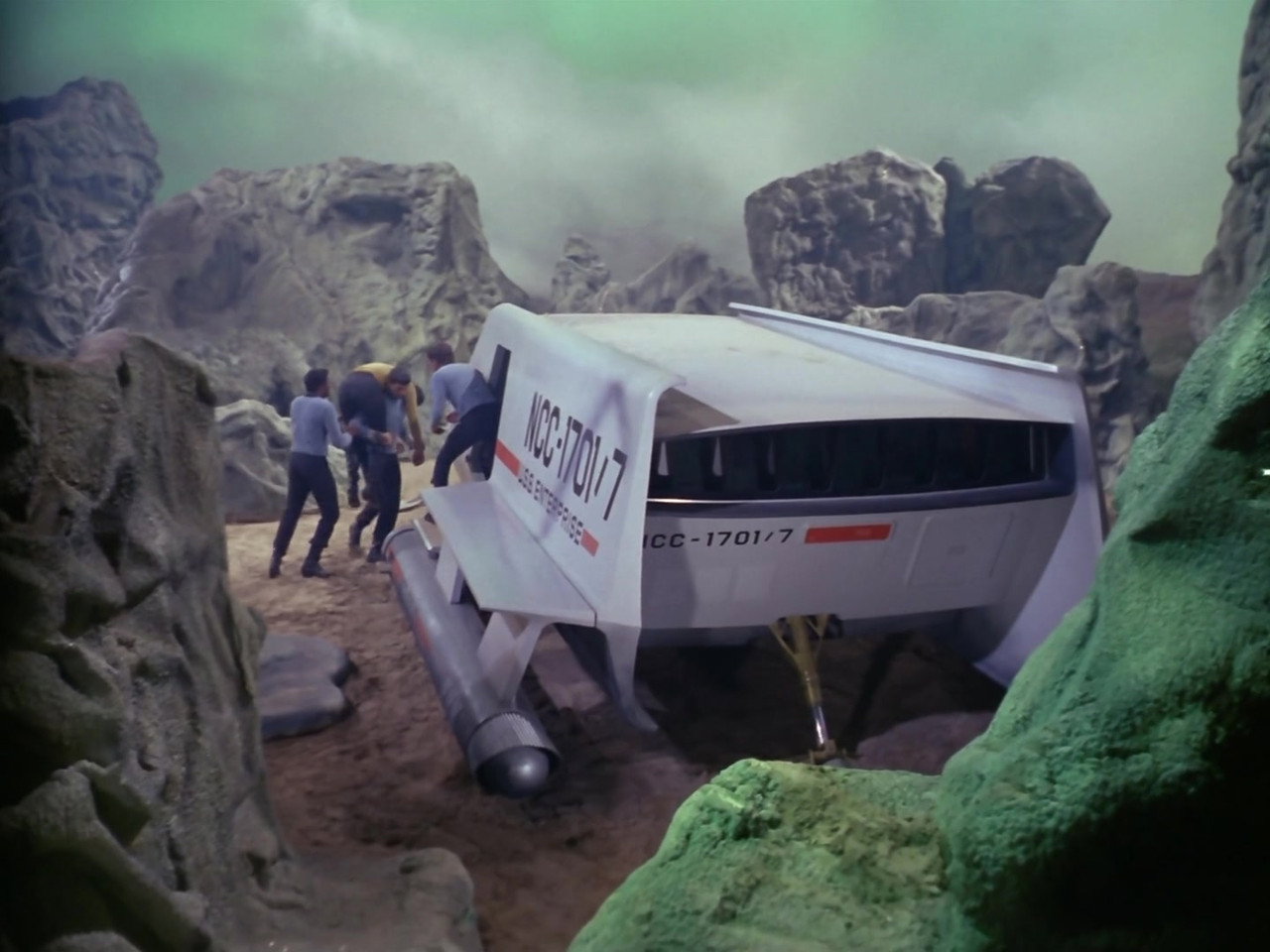
On the way to deliver medicine to a colony, Kirk sends Spock's science team to study Murasaki 312. The shuttle is pulled off course and crash-lands on Taurus II.
- Giants in the fog
Huge, ape-like natives attack. One crewman is killed by a spear. Spock decides to scare them off instead of killing them, and it doesn't go to plan.
- The clock runs
Commissioner Ferris pressures Kirk to give up the search and get the medicine where it's going. On the planet, Scotty rigs the phasers to power the shuttle.
Mutiny, nearlySpoiler · tap to reveal
Boma insists on burying the dead. The funeral draws another attack, and Spock is pinned by a boulder until McCoy and Boma pull him free.
A flare in the darkSpoiler · tap to reveal
Spock dumps the remaining fuel and burns it as a signal. Kirk sees it and beams them out as the shuttle burns up.
Why it still matters
Up to now Spock has been the calm voice at Kirk's elbow. Here the show takes Kirk away and hands Spock the job. The shuttlecraft Galileo, on its first flight on screen, gets dragged off course by a space phenomenon called Murasaki 312 and comes down on Taurus II, a gloomy rock full of very large, very unfriendly locals. That leaves seven people in a damaged shuttle under a commander who believes every problem has a correct answer.
What makes it work is that the crew doesn't simply trust him. McCoy needles him, the astrophysicist Boma openly resents him, and Scotty just wants to get the engine running. Spock keeps making decisions that are logical on paper and wrong in practice, and the episode lets him be wrong without making him a fool. On the ship, Kirk has his own problem: a Federation commissioner with a stopwatch who wants him to give up and leave.
It's a survival story first, built on an old Hollywood plane-crash formula, and it's also a long look at what it costs Spock to be half human.
The most illogical thing he ever did
The Galileo makes it off the ground with too little fuel to escape orbit, and the Enterprise has already had to leave on schedule. Every calculation says they're finished. So Spock does something with no logic behind it at all: he jettisons the fuel and ignites it, turning the shuttle into a flare. It's a gamble that someone, somewhere, is looking. Kirk is, and he swings the ship back in time to beam the five survivors aboard before the Galileo burns up.
Back aboard, Kirk asks him whether emotion drove that last decision. Spock won't go that far, but he does admit to stubbornness. The bridge laughs, and the joke lands because the episode has spent fifty minutes showing that logic alone couldn't save anyone, and that what worked in the end was a hunch.
Behind the scenes
- Oliver Crawford said the foundation for the episode was Five Came Back, a 1939 film about plane-crash survivors in hostile jungle. David Gerrold later lumped it in with Flight of the Phoenix among the early episodes' borrowings.
- S. Bar-David was a pen name for Shimon Wincelberg, brought in to rewrite the script. He also wrote "Dagger of the Mind".
- Yeoman Mears was written as Janice Rand. Grace Lee Whitney was being written out of the show, and revised pages handed Rand's lines to the new character.
- Don Marshall, who played Boma, said it mattered to him that Boma's skin colour made no difference to the story, and credited Gene Roddenberry: "He didn't see color."
- It was Robert Gist's only directing credit on the series.
The thread
A plane-crash survival picture moved to another planet, and an argument about logic and lives that Spock would keep having for decades.
Came before
Shares DNA with
DNA strand
Trapped With Strangers
Seven people who barely know each other, stuck in a wrecked shuttle, with a leader they don't trust and something outside throwing rocks. The giants are only half the pressure. The rest comes from the arguments inside the hull about who to save, who to bury and whose judgment counts.
Every great sci-fi story is built from a handful of strands like this one. Each strand page explains how it works and traces it across shows, books and films.
If this one stayed with you
Where to go next, and why.
Watch · Film
The Flight of the Phoenix (1965)
If the shuttle repairs were your favourite part, here's a whole film of stranded people arguing over whether a desperate engineering plan can possibly work.
Watch · Film
The Martian (2015)
One person, one hostile planet, and a lot of clever improvising with the gear at hand. Lighter on the bickering, heavier on the maths.
Read · Short story
"The Cold Equations" — Tom Godwin
Spock's "one life against six" arithmetic, applied on a small ship with no slack in the numbers.