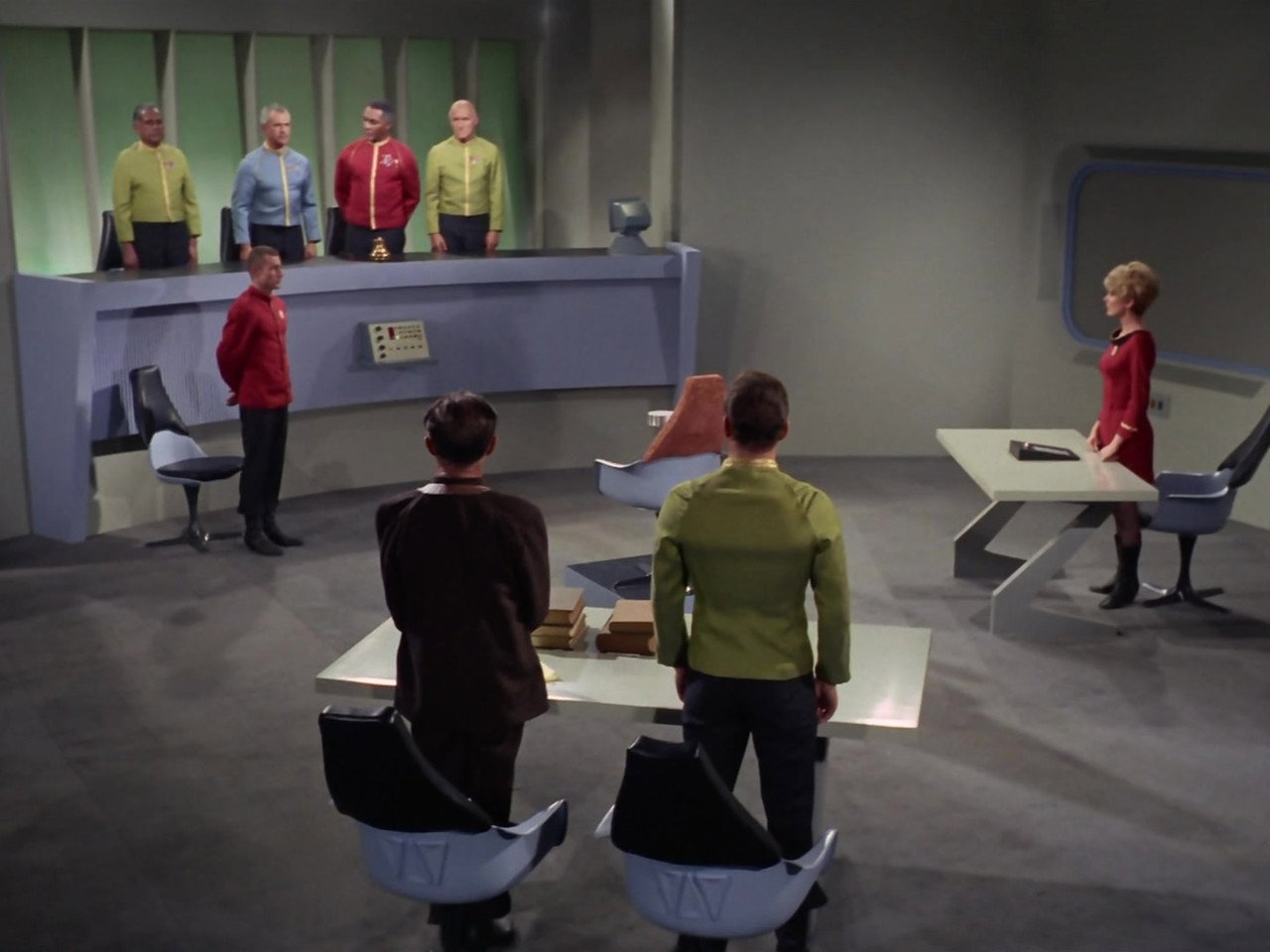
More from the episode

The story in 5 beats
- Starbase 11
The Enterprise limps in after an ion storm. Kirk's log says he ejected Finney's pod under Red Alert, but the computer says Yellow.
- Perjury
Commodore Stone charges Kirk. Finney's daughter Jame is on the starbase, and the prosecutor turns out to be Kirk's ex, Areel Shaw.
- The trial
Spock and McCoy testify to Kirk's character but can't dispute the record. The video plays, and it looks bad.
CheckmateSpoiler · tap to reveal
Spock beats the ship's computer at chess several times. It should be impossible, so someone has altered the computer.
One heartbeatSpoiler · tap to reveal
Back aboard the Enterprise, McCoy's sensor picks up a single heartbeat in Engineering. Finney is alive.
Why it still matters
During an ion storm, Kirk jettisoned a research pod with Lieutenant Commander Ben Finney still inside, to save the ship. He says he waited until Red Alert. The Enterprise's own records say otherwise: the pod went during Yellow Alert, and the video shows it. Finney had a grudge against Kirk, Kirk had reason to dislike him, and now Finney is dead. Commodore Stone wants him to step down, and Kirk demands a trial instead.
It's Star Trek's first courtroom drama, and it gets a lot out of a simple problem: the machine says one thing and your own memory says another. Kirk can't prove he's right. The crew who know him can only vouch for his character, and under oath they have to admit the records can't be wrong. To make things worse, the prosecutor is an old flame of his.
The scene-stealer is Elisha Cook Jr. as Samuel T. Cogley, a defence lawyer who prefers old-fashioned books to computers and isn't shy about saying so.
The ghost in the machine
Spock's chess games crack the case. He keeps beating the computer, which it shouldn't allow, and the only explanation is that someone has been inside it. Only three people had the access to change the records: Kirk, Spock and Finney. Cogley gets the court moved aboard the Enterprise, and McCoy's sensor finds a heartbeat where there should be none. Finney faked his own death, doctored the log to frame Kirk, and hid aboard ship.
He's done worse than that. He has sabotaged the ship so its orbit will decay and everyone left aboard will die with him. Kirk finds him in Engineering, throws him off balance by telling him his daughter is on the ship, and knocks him out, then repairs the damage in time. The charges are dropped. In the last scene, Shaw mentions that Finney already has a lawyer for his own court martial: Cogley.
Behind the scenes
- Producer Gene L. Coon commissioned it as a cheap, single-set episode, with the story taking place entirely in court. It didn't stay cheap: the final script needed four new sets (Kirk's quarters, Stone's office, the starbase bar and the courtroom) plus a matte painting of Starbase 11.
- Its working title was "Court Martial on Star Base 11".
- Elisha Cook Jr. struggled to memorise Cogley's long speeches. Many were cut, and some filmed speeches were broken up with reaction shots.
- It's the first episode to show a starbase, and the first to use the terms "Starfleet" and "Starfleet Command". Commodore Stone is the first commodore seen on the show.
- Richard Webb's uniform carries a full commander's insignia, though everyone calls Finney a lieutenant commander.
- Cogley turned up again decades later, credited on the cover of a magazine in Deep Space Nine's "Far Beyond the Stars".
The thread
The military courtroom drama brought aboard a starship, and the first of many *Star Trek* trials.
Came before
Shares DNA with
Left its mark on
DNA strand
Technology Outpaces Ethics
Everyone in this courtroom has decided that the computer's record is truer than a person's word, including Kirk's best friends. The episode shows how fast that faith turns into a weapon once someone learns to edit the record, and its hero is the lawyer who trusts the machine least.
Every great sci-fi story is built from a handful of strands like this one. Each strand page explains how it works and traces it across shows, books and films.
If this one stayed with you
Where to go next, and why.
Watch · TNG S2
"The Measure of a Man"
If the trial was the best part, this is Star Trek's great courtroom episode, with Picard defending a friend's right to exist.
Watch · Film
The Caine Mutiny (1954)
A naval officer on trial, testimony that won't line up, and long, tense rounds of cross-examination.
Read · Novel
Fahrenheit 451 — Ray Bradbury
Cogley's love of paper books against screens, turned into a whole world where the books are burned.