More from the episode
The story in 5 beats
- The beard bet
Riker, Worf, Geordi and Crusher play poker, and the talk turns to beards and then to a bet.
- The particle fountain
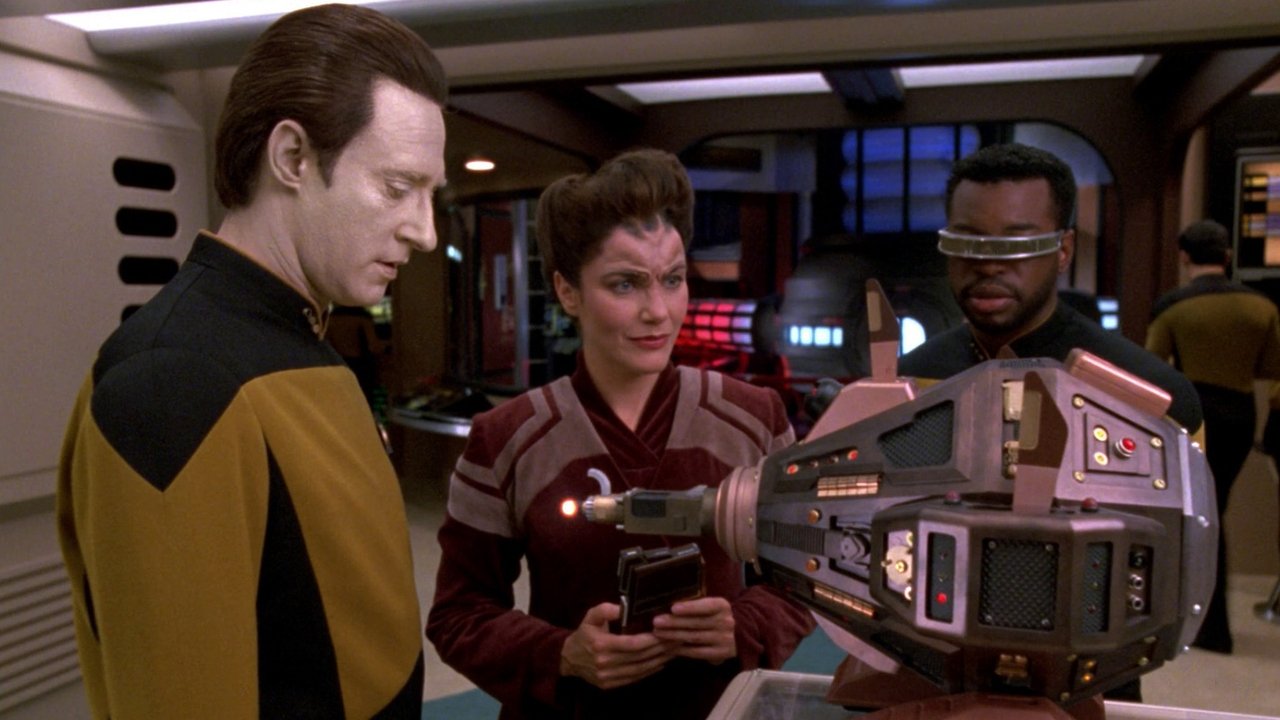
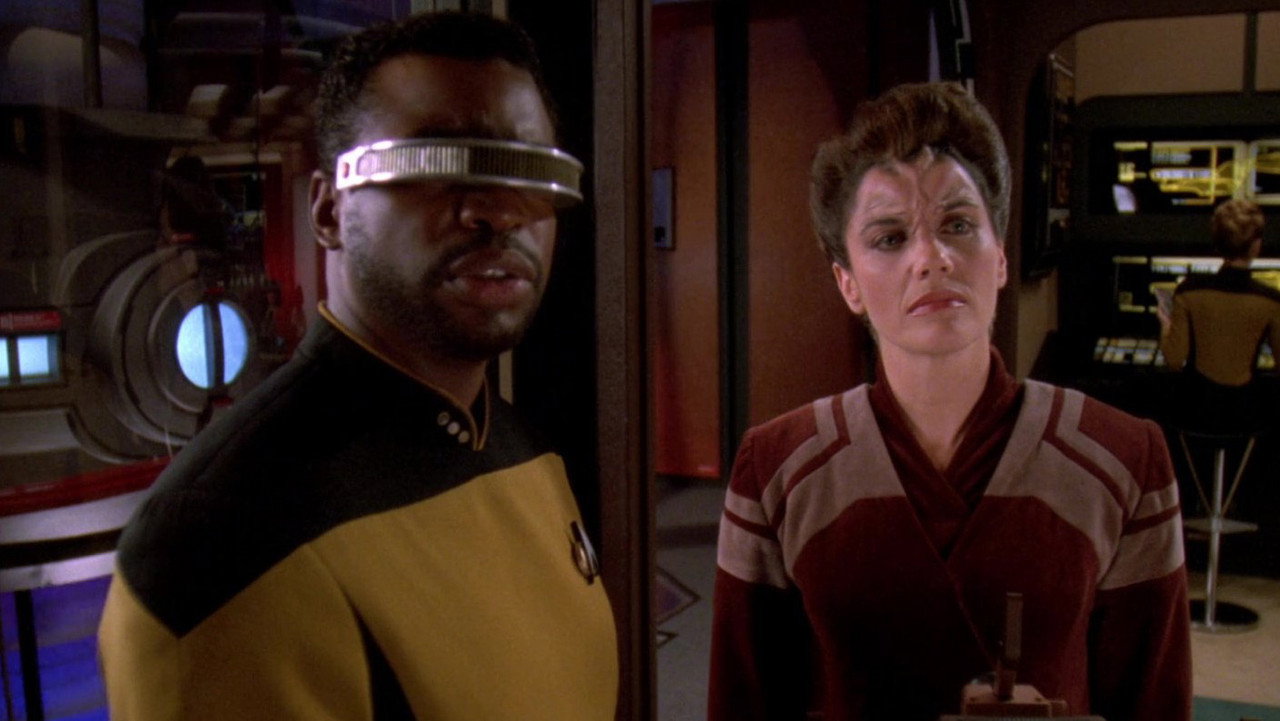
On Tyrus VIIa, Dr. Farallon shows off her mining project and the exocomps that keep it running.
- A robot says no
An exocomp refuses to enter a tunnel just before it blows up. Farallon wants to wipe its memory; Data wants to know why it hesitated.
Data's testSpoiler · tap to reveal
Data sends an exocomp into a real fault with a fake danger alarm rigged nearby. It fixes the fault and the fake alarm too.
Captain or exocompsSpoiler · tap to reveal
With Picard and Geordi trapped on the station, Riker orders the exocomps sent in to die for them. Data locks the transporter.
Why it still matters
TNG asked whether Data was a person back in "The Measure of a Man." Here Data gets to ask the same question about someone else. The Enterprise is checking on a mining experiment called the particle fountain, kept running by exocomps: small, boxy repair drones that can figure out a fault, make the tool they need and learn from the job. Then one of them refuses to crawl into a tunnel, and a moment later the tunnel explodes.
Dr. Farallon sees a glitch to be wiped. Data sees self-preservation, and the episode becomes a quiet argument about where a tool ends and a life begins. Naren Shankar's script gives Data a real experiment to run instead of a speech, and Jonathan Frakes directs it without fuss.
The A.V. Club called this Data "the most rebellious he's ever been in the entire run of the show," and he's at his most interesting when he digs in like this. The cold open is a good one too: a poker game about beards.
Ask them
Data's test convinces him that the exocomps knew they weren't really in danger, which means they can judge risk to themselves. When the fountain malfunctions and floods the station with radiation, Picard and Geordi are left behind. Riker and Farallon's plan is to beam exocomps in to shield them, at the cost of the machines. Data refuses to let sentient beings be sent to their deaths and locks the transporter controls.
His compromise is simple: give the exocomps the choice. They accept and reconfigure themselves for the job. Picard and Geordi are rescued, and all but one of the exocomps make it back to the Enterprise. The last one gives its life. Farallon admits she still isn't sure they're alive, but promises not to abuse them again. Data tells Picard he had to do for them what Picard once did for him in "The Measure of a Man." Picard tells him it was probably the most human thing he has ever done.
Behind the scenes
- In the story writer's original premise, the beings Data stands up for were talking wall terminals and household appliances.
- The exocomps were first called "metacomps," until someone found a company with that name.
- Rick Sternbach designed them. The budget ran to only two, so the third one on screen was composited in afterwards.
- A puppeteer moved them with control rods, which were removed digitally in post-production.
- This was Naren Shankar's first full script. He was the show's science adviser, with a PhD in applied physics from Cornell, and was promoted to story editor for season seven.
- Dr. Farallon is named after the Farallon Islands off San Francisco Bay.
The thread
Who gets to count as alive, and who decides.
Came before
Shares DNA with
Left its mark on
DNA strand
Do Machines Dream?
The episode sets a low bar for being alive, whether a tool cares if it survives, and has a machine make the case. Data is the right advocate, since he has been on the other side of this argument himself.
Every great sci-fi story is built from a handful of strands like this one. Each strand page explains how it works and traces it across shows, books and films.
If this one stayed with you
Where to go next, and why.
Watch · TNG S2
"The Measure of a Man" (1989)
The hearing Data brings up at the end. If his stand here moved you, this is where he learned what it means to have someone stand up for you.
Read · Novella
The Lifecycle of Software Objects by Ted Chiang
If Farallon's lingering doubt about whether they're alive stuck with you, Chiang spends a whole novella on people raising digital creatures and deciding what they owe them.
Watch · Lower Decks
"No Small Parts" (2020)
Almost thirty years on, Lower Decks put an exocomp in a Starfleet uniform and had a lot of fun with what that might look like.
Read · Short story
"The Bicentennial Man" by Isaac Asimov
A robot asking, over a very long life, to be counted as a person. Data would have read it.
Sources
- “The Quality of Life (Star Trek: The Next Generation),” Wikipedia
- “Star Trek: The Next Generation season 6,” Wikipedia
- “The Quality of Life: Episode Behind the Scenes,” TrekCore
- Keith R.A. DeCandido, “Star Trek: The Next Generation Rewatch: "The Quality of Life",” Reactor (Tor.com), 2012
- Zack Handlen, “Star Trek: The Next Generation: "Quality Of Life"/"Chain Of Command, Part One",” The A.V. Club, 2011
- Witney Seibold, “A Short History Of Exocomps In The Star Trek Universe,” SlashFilm, 2022