The story in 5 beats
- The bomb
The Enterprise brings medical supplies to Rutia IV. A bomb goes off near Crusher, Data and Worf, and Crusher stays to treat the wounded.
- Taken
An Ansata fighter grabs Crusher and vanishes with her, using a teleport device the Rutians can't trace.
- Why Finn needs a doctor
The Ansata's teleport device, the inverter, damages the DNA of the people who use it, and Finn's fighters are dying of it.
War on the shipSpoiler · tap to reveal
Believing the Federation has sided with the government, Finn's people board the Enterprise, plant a bomb on the warp core and take Picard hostage.
The cavernsSpoiler · tap to reveal
Data and Wesley trace the Ansata base. Riker and Devos lead the raid, and it ends with a boy holding a gun.
Why it still matters
Star Trek usually talks about war through aliens with forehead ridges. This one comes close to talking about terrorism directly. On Rutia IV, the Ansata separatists have been fighting the government for decades, the government is answering with raids and harsh interrogations, and the Federation is bound not to interfere. Writer Melinda M. Snodgrass has said she wanted to ask when people feel they have no choice but to turn to violence.
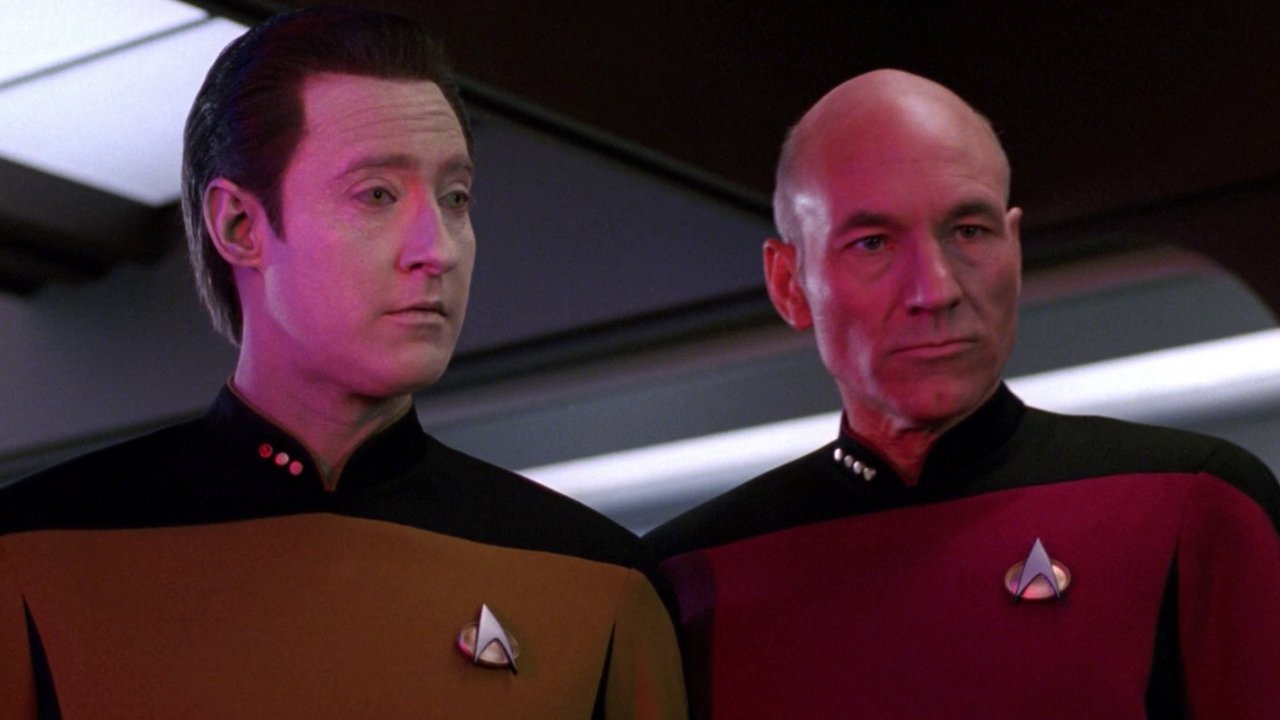
The episode is best known for a short exchange between Data and Picard. Data, who has been reading up on the history of armed rebellion, says terrorism can be an effective way to bring about political change, and one of his examples is Ireland being unified in 2024. Picard grants that it can be, but says he has never believed that political power comes from the barrel of a gun.
In 1990 the Troubles were still going on in Northern Ireland, and that line had consequences. The BBC declined to show the episode, and it took until 2007 for it to reach BBC Two, unedited, in a slot after midnight. Watch it for Richard Cox as Kyril Finn, the Ansata leader: charming, well read and entirely willing to kill.
Talking, not shooting
Finn's demands, delivered with Picard as his hostage, are a Federation embargo on Rutia and Federation mediation. Data and Wesley track the inverter's dimensional shifts to the Ansata caverns, and Riker, Worf and Devos's police go in. Finn is killed in the confrontation. Then a young Ansata boy picks up a gun and points it at Riker and Devos, and it's Crusher, who spent the episode arguing with Finn, who talks him into lowering it.
Devos looks at the boy and sees Finn's replacement. Riker hopes one boy putting down his gun might be a first step toward peace. The episode doesn't say who is right, and the Enterprise simply leaves. Snodgrass put it plainly years later: if we're talking and not shooting, we're in a better place.
Behind the scenes
- Snodgrass's first idea, according to /Film, was a metaphor for the American Revolution. The producers pushed it toward something more contemporary and added the argument over whether terrorism works. Finn still compares himself to George Washington.
- A BBC screening report dated July 1, 1991 noted the parallels with Northern Ireland and the Middle East, the violence and the reference to Irish reunification. The BBC chose not to air it. In Ireland, rights holder RTÉ didn't show it during the original run either.
- Sky One showed edited versions in the UK from November 29, 1992, and an unedited one in May 2006. BBC Two finally aired it unedited after midnight on September 29, 2007, during repeats of the season.
- Snodgrass told TVLine she only learned about the ban later, and that there isn't much a writer can do about it.
- Media scholars Roberta Pearson and Máire Messenger Davies cite the episode in Star Trek and American Television (2014) as television drama that challenges dominant assumptions.
- When 2024 came around, the year Data had named, fans started pointing to the line again.
The thread
A real kind of war told at one remove, and the line that brought it back to the real world.
Came before
Shares DNA with
DNA strand
Us vs. Them
Both sides on Rutia IV have a list of grievances, and both have bodies to point to: the government's dead schoolchildren, Finn's sick and hunted fighters. The Enterprise crew keeps trying to stand in the middle and keeps getting pulled to one side. The episode ends without telling you which side was right.
Every great sci-fi story is built from a handful of strands like this one. Each strand page explains how it works and traces it across shows, books and films.
If this one stayed with you
Where to go next, and why.
Watch · Film
The Battle of Algiers (1966)
If the arguments between Crusher and Finn were the part you kept thinking about, this is the same fight on a real city's streets.
Read · Novel
The Word for World Is Forest by Ursula K. Le Guin
A short novel about occupation and the moment a gentle people decide to fight back. It asks Snodgrass's question from the other side.
Watch · Star Trek: TNG S3
"The Hunted" (1990)
The episode right before this one: another planet's government, another armed man it would rather not deal with, and Picard stuck between them.
Sources
- “The High Ground (Star Trek: The Next Generation),” Wikipedia
- Keith R.A. DeCandido, “Star Trek: The Next Generation Rewatch: "The High Ground",” Tor.com, 2011
- Witney Seibold, “Star Trek: The Next Generation's Most Controversial Episode Explained,” /Film, 2021
- “'Star Trek' episode shelved after it boldly ventured into Irish politics,” BANG Showbiz via Yahoo News, 2024
- Kieran Fisher, “Why A Star Trek: The Next Generation Episode Was 'Banned' In The United Kingdom,” TVLine, 2025