The story in 5 beats
- A reluctant warrior
Alexander wants nothing to do with Klingon combat training. Worf can't reach him, and Picard suggests a trip to a Klingon festival.
- Attack at the festival
On Maranga IV, three Klingons ambush father and son. A stranger named K'mtar drives them off and comes back to the Enterprise with them.
- The Duras dagger
A dagger left behind carries the markings of the House of Duras. Riker gets a lead from Quark, and the trail leads to Lursa and B'Etor.
A mark that can't existSpoiler · tap to reveal
The dagger bears the mark of Lursa's son, a child she has only just learned she is carrying.
Father and sonSpoiler · tap to reveal
K'mtar is Alexander, forty years older, sent back to change the boy he was. Worf tells him the boy must choose his own path.
Why it still matters
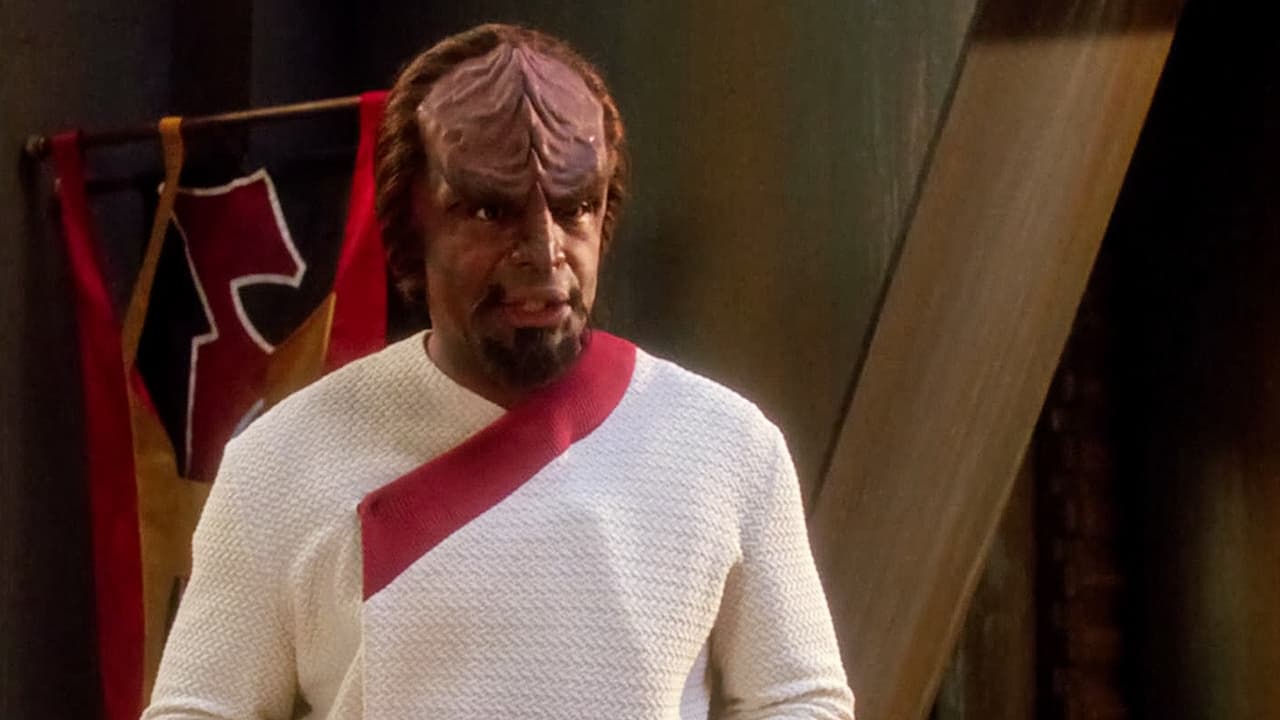
Worf has a problem lots of parents will recognize. His son Alexander, half Klingon and raised mostly among humans, has no interest in the warrior path. Worf pushes, Alexander digs in, and Picard suggests a field trip: the Kot'baval festival on Maranga IV, a full immersion in Klingon culture. It goes well until three assassins show up and a Klingon named K'mtar steps in to save them.
K'mtar says Worf's brother Kurn sent him as a gin'tak, an adviser to the House of Mogh, and he takes over the boy's training with an intensity that starts to worry everyone. James Sloyan plays him gruff and oddly tender, and he is the reason to watch. There's plenty of Klingon texture around him, from the festival to the Duras sisters back at their schemes, plus a detour to Quark's dabo table on Deep Space Nine, where Riker wins big.
René Echevarria's script spends less energy on its mystery than on who gets to decide what kind of man a boy grows up to be. His father, his people and the boy himself all have a claim.
The adviser is the son
The dagger is the giveaway. Lursa recognizes the marking as her son's, and she has only just found out she is pregnant, so the weapon can't have come from the present. Worf finds K'mtar standing over the sleeping Alexander, ready to kill him, and stops him. K'mtar confesses: he is Alexander, from about forty years in the future. He staged the attack at the festival himself, hoping a scare would make young Alexander want to protect his father.
He came back to prepare his younger self for an assassination attempt that, in his time, kills Worf. When training didn't take, he was ready to erase the boy entirely. Worf points out that he has already changed the future another way, by changing Worf. Knowing his son will follow a path he chose for himself, Worf says, he could die content. K'mtar accepts it and goes home to his own time.
Behind the scenes
- Mark Kalbfeld has the story credit. Staff writer Joe Menosky separately pitched Alexander falling into a time portal, an idea later recycled for Deep Space Nine's "Time's Orphan" with Molly O'Brien.
- It's Brian Bonsall's last appearance as Alexander. The character came back on Deep Space Nine, played by Marc Worden.
- K'mtar is James Sloyan's third Star Trek role, after Admiral Jarok in "The Defector" and Dr. Mora Pol in Deep Space Nine's "The Alternate."
- Armin Shimerman plays Quark, his Deep Space Nine character, and Riker's dabo winnings at Quark's become a plot point in that show's episode "Defiant."
- Barbara March and Gwynyth Walsh return as Lursa and B'Etor. Their next stop was the film Star Trek Generations, released later in 1994.
- K'mtar tells Alexander the story of Kahless and Morath, the same legend Worf told his son in "New Ground."
- Zack Handlen of The A.V. Club gave it a C+, writing that "time travel shouldn't be a casual plot fixative."
The thread
A father, a son and a culture the son never asked to inherit.
Came before
Shares DNA with
Left its mark on
DNA strand
Memory & Identity
Alexander is a Klingon who doesn't feel like one, and everyone around him has a theory about who he ought to be. The episode lets the argument run between father, culture and child, and it comes down gently on the side of the child.
Every great sci-fi story is built from a handful of strands like this one. Each strand page explains how it works and traces it across shows, books and films.
If this one stayed with you
Where to go next, and why.
Watch · Star Trek
"Journey to Babel" (1967)
If the father and son standoff was the part that landed, here is Spock and Sarek's version, with a mother caught in the middle.
Watch · TNG S6
"Rightful Heir" (1993)
Worf's own crisis about what Klingon tradition is worth, a year before he had to explain it to his son.
Read · Novel
Fathers and Sons by Ivan Turgenev
A young man comes home with ideas his father's generation can't follow. There are fewer bat'leths and the same ache.
Sources
- “Firstborn (Star Trek: The Next Generation),” Wikipedia
- “Star Trek: The Next Generation season 7,” Wikipedia
- Keith R.A. DeCandido, “Star Trek: The Next Generation Rewatch: "Firstborn",” Reactor (Tor.com), 2013
- Zack Handlen, “Star Trek: The Next Generation: "Firstborn"/"Bloodlines",” The A.V. Club, 2011