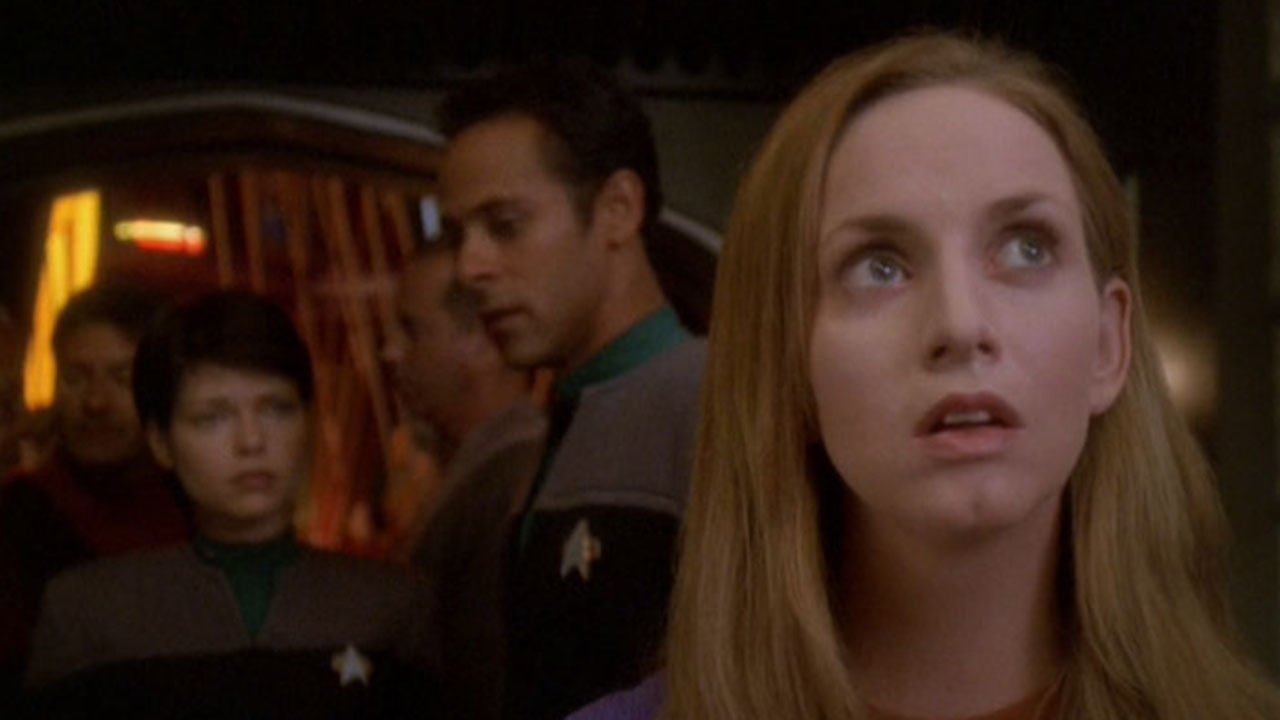
The story in 5 beats
- The admiral's staff
Jack, Lauren, Patrick and Sarina turn up at Deep Space Nine pretending to be an admiral and his staff. They want Bashir to cure Sarina, and they help him refine the instrument he'll need.
- First words
The operation works. Sarina speaks and takes in the world around her for the first time.
- Sing-along
To welcome her, the group starts singing. Sarina begins in a monotone, picks up solfège in minutes and is soon improvising an a cappella fugue with the others.
- Off the case
Bashir falls in love with Sarina and hands her care to another doctor so he can court her.
Her answerSpoiler · tap to reveal
She withdraws again after he invites her to dinner. When she comes back, she tells him how the last few weeks have felt to her, and makes a choice of her own.
Why it still matters
A season earlier, "Statistical Probabilities" introduced four genetically enhanced misfits: aggressive Jack, hypersexual Lauren, childlike Patrick and Sarina, who never says a word. "Chrysalis" brings them back so Bashir can try to cure Sarina's catatonia, and René Echevarria's script spends most of the hour on a harder question than the surgery: what a woman who has just started living owes the man who made it possible.
It works because nobody in it is a villain. Bashir, enhanced himself but without the side effects, is kind and brilliant and slowly losing perspective, and the episode lets you see it before he does. In Beyond the Final Frontier (2003), Mark Jones and Lance Parkin wrote that Alexander Siddig and Faith Salie give depth to "a pretty unpromising story" and counted it among the better Star Trek romances. Salie gets to talk, argue and, for one long scene, sing.
What Sarina wanted
Sarina isn't ready for a relationship, and when Bashir invites her to his quarters for dinner she goes catatonic again. Once she recovers, she tells him the truth: she felt she had to thank him for curing her by becoming the woman of his dreams. At the end she leaves Deep Space Nine for a scientific internship.
Her relapse echoes an earlier scene. When the group argues about how to stop the Big Crunch and Jack shuts her down, she slips back into her old stillness, and tells Bashir afterward that she was choosing to stay out of it because the others expected her quiet. The dinner invitation is the same pressure in a nicer outfit. Echevarria keeps Bashir sympathetic the whole way and lets him find out, late, that curing someone doesn't make you the author of who they become.
Challenge the DNA
Was Bashir wrong to fall for Sarina?
Or skip ahead to our reading
He meant well, and it put pressure on her she couldn't carry. She tells him she was trying to become the woman of his dreams. He learns that curing someone doesn't make you the author of who they become.
Behind the scenes
- Tim Ransom, Faith Salie, Hilary Shepard Turner and Michael Keenan all returned as the characters they had played in "Statistical Probabilities". Salie still had to audition again, because Sarina had no spoken lines in that first episode; the lines scripted for her there were cut for time.
- Singing wasn't part of Salie's audition, even though Sarina would have to sing. She drew on her experience in musicals at school and in theater.
- The musical scene took a day to film on the Paramount lot, and the audio was dubbed afterward in a separate recording session.
- Keith R. A. DeCandido gave it 6 out of 10 in his 2014 Tor.com rewatch, and its first broadcast drew a Nielsen rating of 4.3.
- Salie went on to a broadcasting career and has been a contributor to CBS News Sunday Morning since 2009.
The thread
The old story of a maker who falls for what he made, and the episodes that set up Bashir and his patients.
Came before
DNA strand
Technology Outpaces Ethics
The medicine in "Chrysalis" works perfectly. What nobody has worked out is the ethics around it: a doctor who has just given a woman her mind falls for her, takes himself off her case and calls that a solution. The episode treats his feelings as real and the pressure they put on her as just as real.
Every great sci-fi story is built from a handful of strands like this one. Each strand page explains how it works and traces it across shows, books and films.
If this one stayed with you
Where to go next, and why.
Watch · Film
Awakenings (1990)
Robin Williams as a doctor who wakes patients frozen for decades. The same mix of medical triumph and a doctor who gets more attached than he planned.
Read · Novel
Flowers for Algernon — Daniel Keyes
A man's intelligence soars after an experimental operation, and the people around him don't know how to treat the new version. Sarina's story from the inside.
Your next episode
Three directions to go from here, all on Sci-Fi DNA.
More of this feeling
Melora
Star Trek: Deep Space Nine
Bashir fell for a patient once before, a low-gravity ensign who wanted no fuss, and her episode has the same tangle of caring for someone and wanting them.
Same question, different answer
The Offspring
Star Trek: The Next Generation
Data builds a child and lets her choose her own face, and the hour asks how much a maker gets to decide for the mind he made.
Something completely different
Treachery, Faith, and the Great River
Star Trek: Deep Space Nine
A Weyoun clone insists on defecting to Odo, the god he isn't supposed to question, while Nog trades his way toward a part O'Brien needs.
Sources
- “Chrysalis (Star Trek: Deep Space Nine),” Wikipedia
- “List of Star Trek: Deep Space Nine episodes,” Wikipedia
- “Statistical Probabilities,” Wikipedia
- “Faith Salie,” Wikipedia
- Keith R. A. DeCandido, “Star Trek: Deep Space Nine Rewatch: "Chrysalis",” Tor.com, 2014
- “Hitting The High Notes Aboard 'Star Trek: Deep Space Nine',” New Sounds
- Mark Jones and Lance Parkin, “Beyond the Final Frontier,” Contender Books, 2003